QUESTION IMAGE
Question
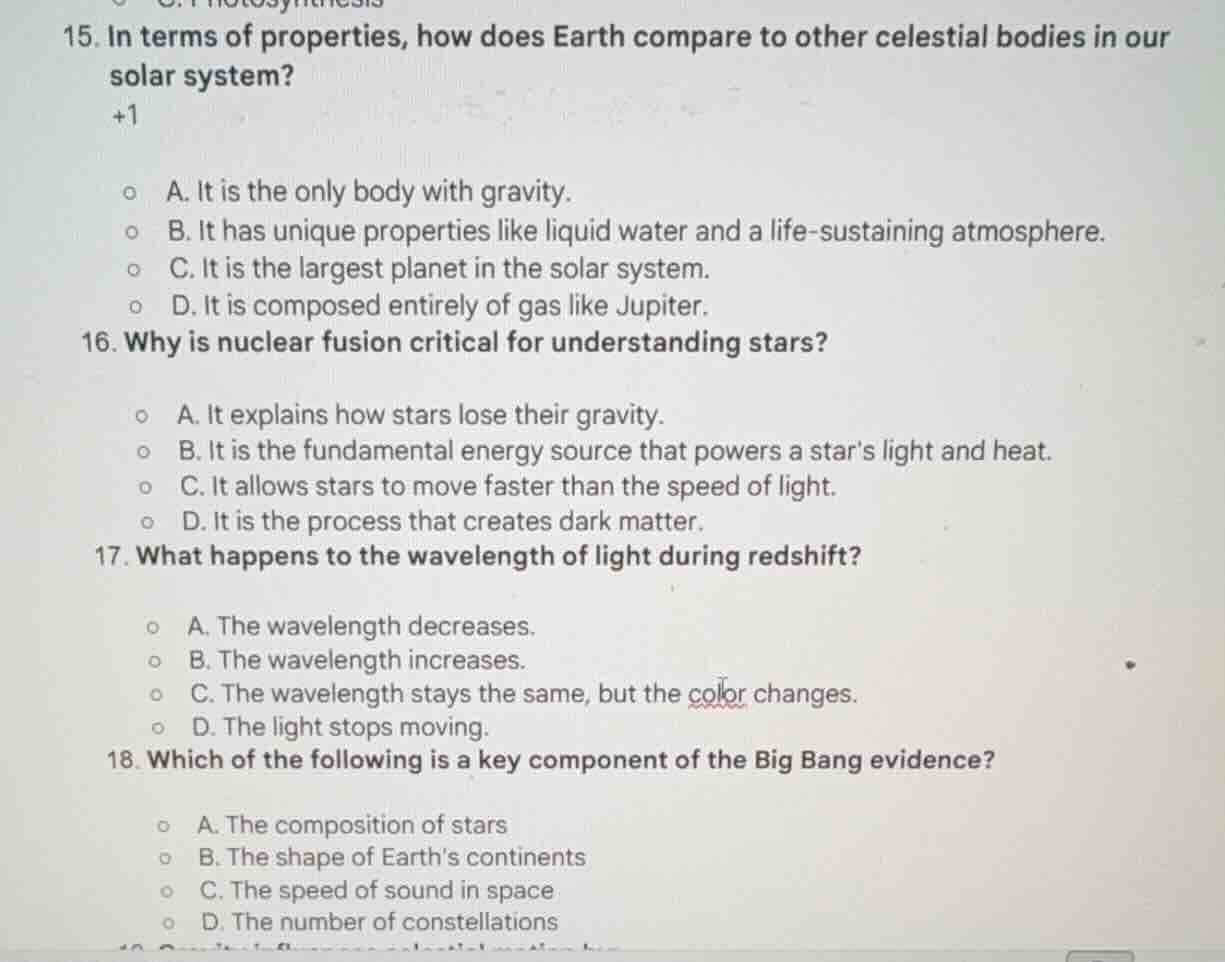
- in terms of properties, how does earth compare to other celestial bodies in our solar system?
+1
a. it is the only body with gravity.
b. it has unique properties like liquid water and a life-sustaining atmosphere.
c. it is the largest planet in the solar system.
d. it is composed entirely of gas like jupiter.
- why is nuclear fusion critical for understanding stars?
a. it explains how stars lose their gravity.
b. it is the fundamental energy source that powers a stars light and heat.
c. it allows stars to move faster than the speed of light.
d. it is the process that creates dark matter.
- what happens to the wavelength of light during redshift?
a. the wavelength decreases.
b. the wavelength increases.
c. the wavelength stays the same, but the color changes.
d. the light stops moving.
- which of the following is a key component of the big bang evidence?
a. the composition of stars
b. the shape of earths continents
c. the speed of sound in space
d. the number of constellations
- All celestial bodies in the solar system have gravity; Jupiter is the largest and a gas giant. Earth is unique in having stable liquid water and an atmosphere that supports life.
- Nuclear fusion in stars converts hydrogen to helium, producing the energy that generates their light and heat. The other options are incorrect as fusion does not reduce gravity, allow faster-than-light travel, or create dark matter.
- Redshift occurs when a light source moves away from an observer, stretching the light waves, which increases their wavelength.
- The composition of stars (primarily hydrogen and helium, with trace elements) matches the predicted light element abundance from the Big Bang. The other options are unrelated to Big Bang evidence.

Snap & solve any problem in the app
Get step-by-step solutions on Sovi AI
Photo-based solutions with guided steps
Explore more problems and detailed explanations
- B. It has unique properties like liquid water and a life-sustaining atmosphere.
- B. It is the fundamental energy source that powers a star's light and heat.
- B. The wavelength increases.
- A. The composition of stars