QUESTION IMAGE
Question
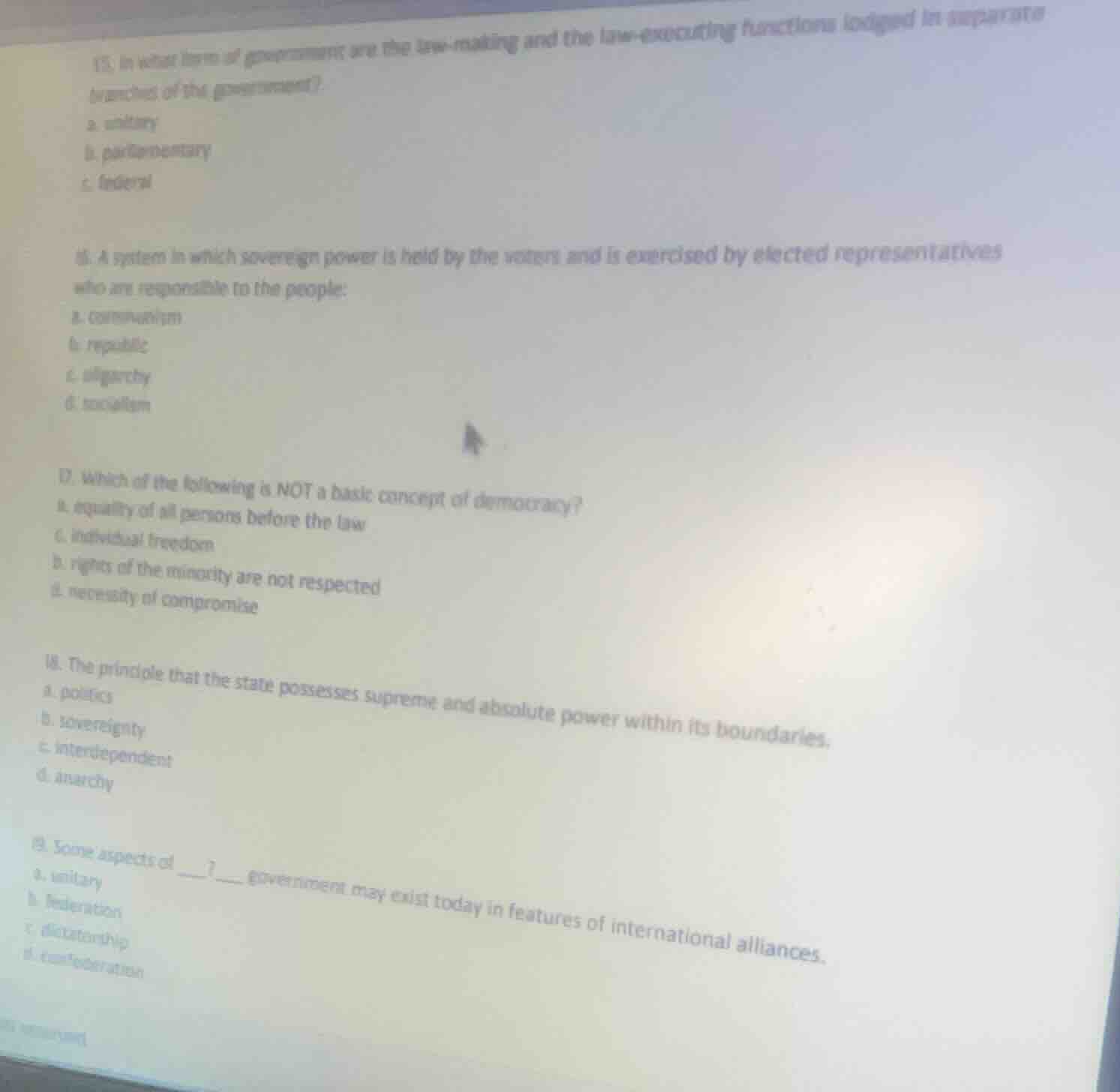
- in what form of government are the law - making and the law - executing functions lodged in separate branches of the government?
a. unitary
b. parliamentary
c. federal
- a system in which sovereign power is held by the voters and is exercised by elected representatives who are responsible to the people:
a. communism
b. republic
c. oligarchy
d. socialism
- which of the following is not a basic concept of democracy?
a. equality of all persons before the law
c. individual freedom
b. rights of the minority are not respected
d. necessity of compromise
- the principle that the state possesses supreme and absolute power within its boundaries.
a. politics
b. sovereignty
c. interdependent
d. anarchy
- some aspects of __?__ government may exist today in features of international alliances.
a. unitary
b. federation
c. dictatorship
d. confederation
Question 15
To determine the form of government where law - making and law - executing functions are in separate branches, we analyze each option:
- Option a (unitary): In a unitary government, power is concentrated in a central authority, and there is no separation of law - making and law - executing functions into separate branches.
- Option b (parliamentary): In a parliamentary system, the executive (law - executing) branch is derived from and is accountable to the legislative (law - making) branch, so they are not separate.
- Option c (federal): A federal government has a separation of powers, with law - making (legislative) and law - executing (executive) functions assigned to different branches.
We analyze each option to find the system where sovereign power is held by voters and exercised by elected representatives responsible to the people:
- Option a (communism): In communism, the means of production are owned communally, and the concept of sovereign power held by voters in the described way is not the main feature.
- Option b (republic): A republic is a system where sovereign power is held by the people (voters), and it is exercised through elected representatives who are responsible to the people.
- Option c (oligarchy): In an oligarchy, power is held by a small group of people, not by the voters.
- Option d (socialism): Socialism focuses on social ownership of the means of production, and the specific system of sovereign power held by voters and exercised by elected representatives as described is not the core of socialism.
We need to find which option is not a basic concept of democracy:
- Option a (equality of all persons before the law): This is a fundamental concept of democracy, as democracy emphasizes equal treatment under the law.
- Option b (rights of the minority are not respected): In a democracy, the rights of the minority are respected. So this is not a basic concept of democracy.
- Option c (individual freedom): Individual freedom is a key concept in democracy, allowing people to express themselves and pursue their interests.
- Option d (necessity of compromise): In a democratic system with diverse views, compromise is necessary to reach decisions that are acceptable to most.

Snap & solve any problem in the app
Get step-by-step solutions on Sovi AI
Photo-based solutions with guided steps
Explore more problems and detailed explanations
c. federal