QUESTION IMAGE
Question
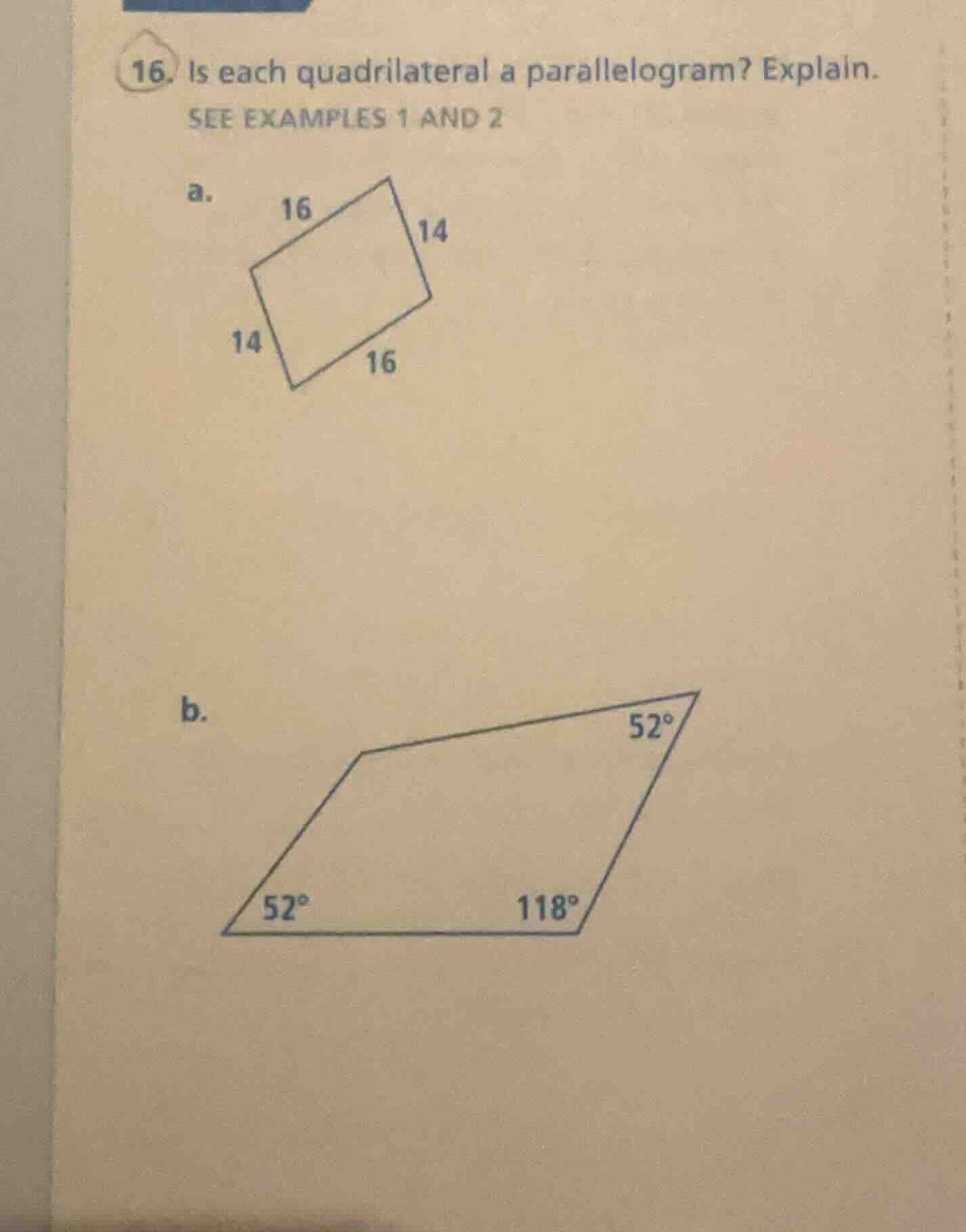
- is each quadrilateral a parallelogram? explain. see examples 1 and 2 a. quadrilateral with sides 16,14,16,14 b. quadrilateral with angles 52°, 118°, 52° (and one more angle implied)
Step1: Analyze quadrilateral a
A parallelogram requires both pairs of opposite sides to be congruent. For figure a:
Opposite sides: $16 \cong 16$, $14 \cong 14$
This satisfies the congruent opposite sides condition for a parallelogram.
Step2: Analyze quadrilateral b
First, calculate the missing angle:
Sum of quadrilateral angles = $360^\circ$
Missing angle = $360^\circ - (52^\circ + 118^\circ + 52^\circ) = 138^\circ$
In a parallelogram, opposite angles must be congruent. Here, the angles are $52^\circ, 118^\circ, 52^\circ, 138^\circ$ – the $118^\circ$ and $138^\circ$ angles are not congruent to their supposed opposites, so it fails the angle condition for a parallelogram.

Snap & solve any problem in the app
Get step-by-step solutions on Sovi AI
Photo-based solutions with guided steps
Explore more problems and detailed explanations
a. Yes, this quadrilateral is a parallelogram. Its opposite sides are congruent, which meets the criteria for a parallelogram.
b. No, this quadrilateral is not a parallelogram. Its opposite angles are not congruent (the fourth angle is $138^\circ$, which does not match the $118^\circ$ angle), so it does not satisfy the properties of a parallelogram.