QUESTION IMAGE
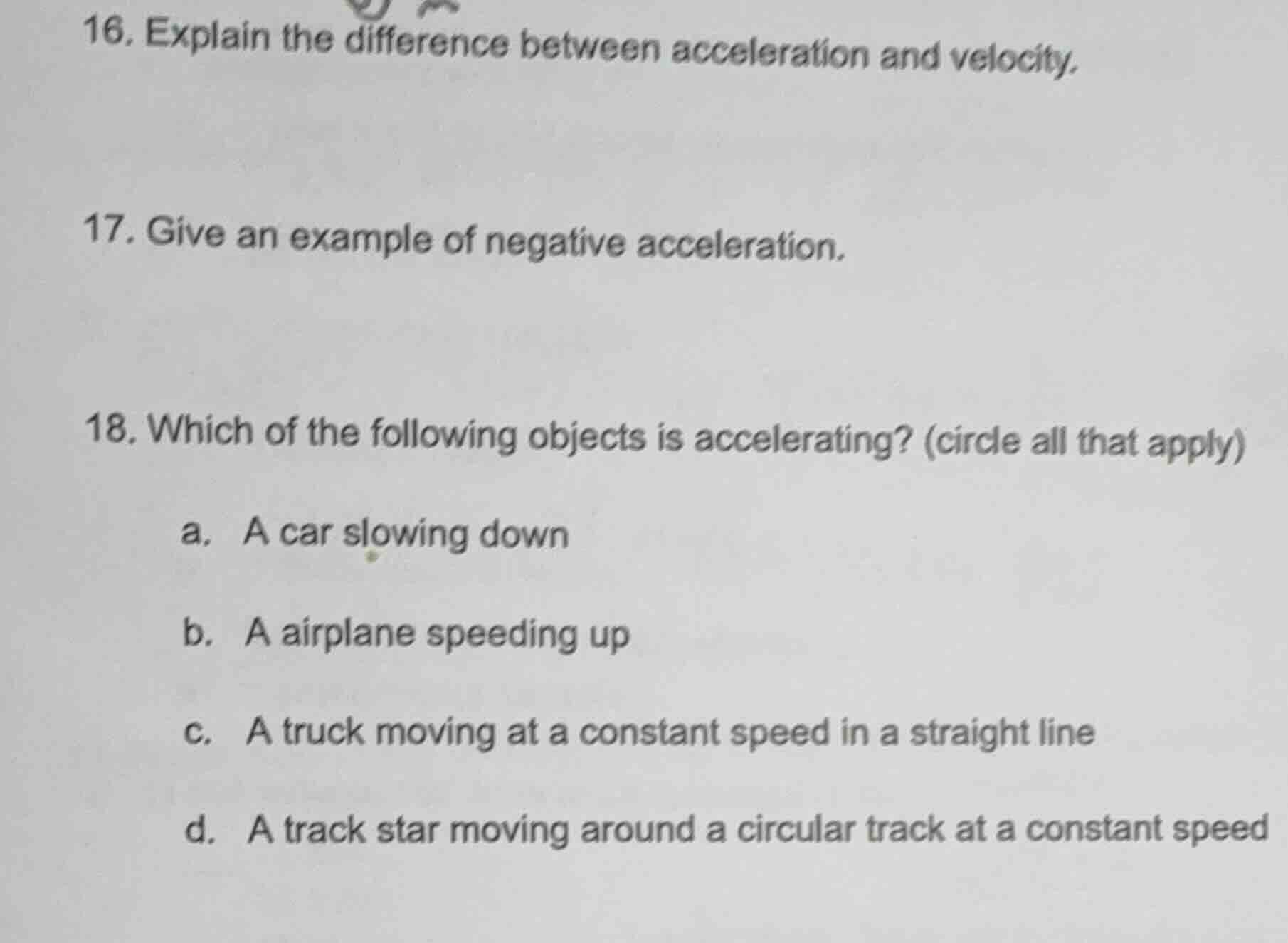
Question
- explain the difference between acceleration and velocity.
- give an example of negative acceleration.
- which of the following objects is accelerating? (circle all that apply)
a. a car slowing down
b. a airplane speeding up
c. a truck moving at a constant speed in a straight line
d. a track star moving around a circular track at a constant speed
Question 16
Velocity is a vector quantity that describes the rate of change of an object's position, including both speed and direction (e.g., 5 m/s east). Acceleration is also a vector quantity, defined as the rate of change of velocity. This means acceleration can result from a change in speed (speeding up or slowing down) or a change in direction (even if speed is constant, like in circular motion). For example, a car moving at 20 m/s north has a velocity; if it increases to 30 m/s north, the change in velocity over time is acceleration.
Negative acceleration (also called deceleration when opposite to velocity direction) occurs when an object's velocity decreases over time. A common example is a car applying brakes to slow down. If the car's velocity is in the positive direction (e.g., moving forward), the acceleration from braking is negative because it opposes the velocity, reducing the speed. Another example: a ball thrown upward—gravity causes a downward (negative, if upward is positive) acceleration, slowing the ball's upward speed until it stops and falls back.
Acceleration is any change in velocity (speed or direction).
- Option a: A car slowing down has a changing speed (decreasing), so it’s accelerating (negative acceleration, but still acceleration).
- Option b: An airplane speeding up has a changing speed (increasing), so it’s accelerating.
- Option c: A truck moving at constant speed in a straight line has no change in speed or direction, so velocity is constant—no acceleration.
- Option d: A track star moving in a circular track at constant speed has a changing direction (velocity is a vector, direction changes), so there’s centripetal acceleration (change in velocity due to direction change).
Thus, a, b, and d involve acceleration.

Snap & solve any problem in the app
Get step-by-step solutions on Sovi AI
Photo-based solutions with guided steps
Explore more problems and detailed explanations
Velocity is the rate of change of position (speed + direction). Acceleration is the rate of change of velocity (change in speed, direction, or both).