QUESTION IMAGE
Question
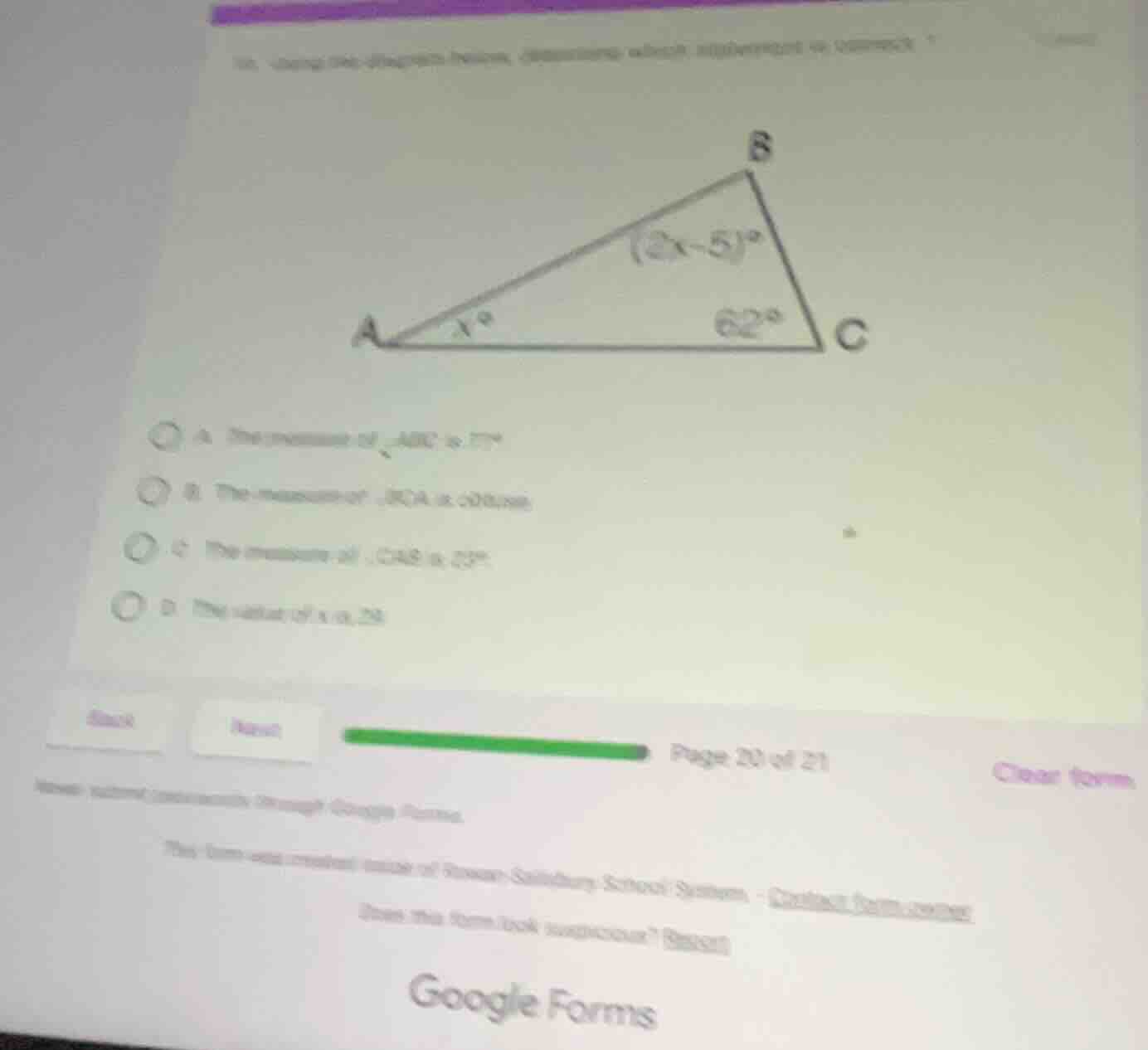
- using the diagram below, determine which statement is correct?
a. the measure of ∠abc is 77°
b. the measure of ∠bca is obtuse
c. the measure of ∠cab is 75°
d. the value of x is 25
Step1: Recall triangle angle sum property
The sum of interior angles in a triangle is \(180^\circ\). So, for \(\triangle ABC\), we have \(x + (2x - 5)+ 62 = 180\).
Step2: Solve the equation for \(x\)
Combine like terms: \(3x + 57 = 180\). Subtract 57 from both sides: \(3x = 180 - 57 = 123\). Divide by 3: \(x=\frac{123}{3}=41\)? Wait, no, wait, let's re - check. Wait, the angle at \(A\) is \(x\), angle at \(B\) is \((2x - 5)\), angle at \(C\) is \(62^\circ\). So sum: \(x+(2x - 5)+62 = 180\). So \(3x+57 = 180\), \(3x=180 - 57=123\), \(x = 41\)? But let's check the options. Wait, maybe I misread the angle at \(A\). Wait, maybe the angle at \(A\) is \(x\) and angle at \(B\) is \(2x - 5\), angle at \(C\) is \(62\). Let's check option D: \(x = 25\). If \(x = 25\), then angle at \(B\) is \(2\times25-5 = 45\). Then sum of angles: \(25 + 45+62=132
eq180\). Wait, that's wrong. Wait, maybe the triangle is isoceles? Wait, no, maybe the problem is that the angle at \(A\) is \(x\), angle at \(B\) is \(2x - 5\), and angle at \(C\) is \(62\). Let's check option C: measure of \(\angle CAB\) is \(25^\circ\), so \(x = 25\), then angle at \(B\) is \(2\times25-5 = 45\), sum \(25 + 45+62=132\), no. Wait, maybe the diagram has angle at \(A\) as \(x\), angle at \(B\) as \(2x - 5\), and angle at \(C\) as \(62\). Wait, maybe the question is about the correct statement. Let's check each option:
Option A: Perimeter? We don't know the side lengths, so we can't find perimeter. So A is wrong.
Option B: \(\angle BCA=62^\circ\), which is acute (less than \(90^\circ\)), so B is wrong.
Option C: \(\angle CAB = 25^\circ\), let's see if that works. If \(\angle CAB=x = 25\), then \(\angle ABC=2x - 5=45\), sum \(25 + 45+62 = 132
eq180\). Wait, that's not possible. Wait, maybe I made a mistake. Wait, maybe the triangle has angle sum \(180\), so \(x+(2x - 5)+62 = 180\), \(3x+57 = 180\), \(3x = 123\), \(x = 41\). Then \(\angle CAB = 41^\circ\), \(\angle ABC=2\times41 - 5=77^\circ\), \(\angle BCA = 62^\circ\). Now check option D: \(x = 25\), which is wrong. Wait, maybe the original problem has a typo, but let's re - examine the options. Wait, maybe the angle at \(B\) is \(77^\circ\) (from option A: measure of \(\angle ABC\) is \(77^\circ\)). If \(\angle ABC = 77^\circ\), then \(2x-5 = 77\), \(2x=82\), \(x = 41\). Then \(\angle CAB = 41^\circ\), \(\angle BCA = 62^\circ\), sum \(41 + 77+62 = 180\), which works. Then option A: measure of \(\angle ABC\) is \(77^\circ\), that's correct. Wait, the option A says "The measure of \(\angle ABC\) is \(77^\circ\)". Let's check: if \(2x - 5=77\), then \(2x=82\), \(x = 41\), and \(41+77 + 62=180\), which is correct. So option A is correct? Wait, but let's check the other options again.
Option B: \(\angle BCA = 62^\circ\), which is acute, so B is wrong.
Option C: \(\angle CAB = 25^\circ\), but we found \(x = 41\), so C is wrong.
Option D: \(x = 25\), but \(x = 41\), so D is wrong.
Wait, maybe I misread the angle at \(B\)'s expression. If the angle at \(B\) is \(2x-5\) and when \(x = 41\), \(2x - 5=77\), so \(\angle ABC = 77^\circ\), so option A is correct.

Snap & solve any problem in the app
Get step-by-step solutions on Sovi AI
Photo-based solutions with guided steps
Explore more problems and detailed explanations
A. The measure of \(\angle ABC\) is \(77^\circ\)