QUESTION IMAGE
Question
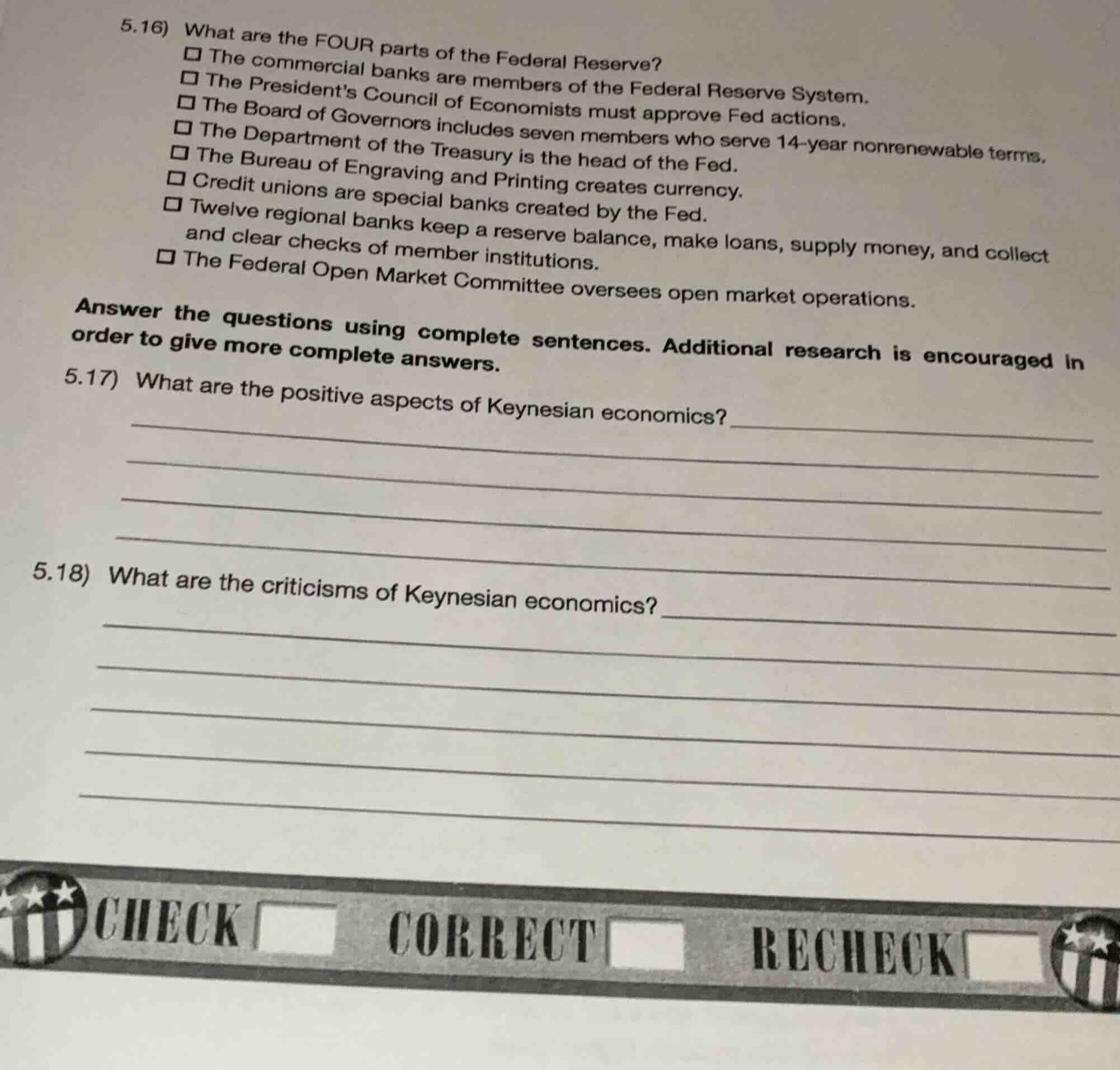
5.16) what are the four parts of the federal reserve?
□ the commercial banks are members of the federal reserve system.
□ the presidents council of economists must approve fed actions.
□ the board of governors includes seven members who serve 14 - year nonrenewable terms.
□ the department of the treasury is the head of the fed.
□ the bureau of engraving and printing creates currency.
□ credit unions are special banks created by the fed.
□ twelve regional banks keep a reserve balance, make loans, supply money, and collect and clear checks of member institutions.
□ the federal open market committee oversees open market operations.
answer the questions using complete sentences. additional research is encouraged in order to give more complete answers.
5.17) what are the positive aspects of keynesian economics?
5.18) what are the criticisms of keynesian economics?
check correct recheck
For 5.16:
Identify the core structural components of the U.S. Federal Reserve System from the given options, excluding non-structural or incorrect claims.
For 5.17:
Summarize evidence-based benefits of Keynesian economic policies, focusing on countercyclical stability and economic support.
For 5.18:
Outline common scholarly and practical critiques of Keynesian economic frameworks, including concerns about inefficiencies and long-term impacts.

Snap & solve any problem in the app
Get step-by-step solutions on Sovi AI
Photo-based solutions with guided steps
Explore more problems and detailed explanations
- 5.16)
- The Board of Governors includes seven members who serve 14-year nonrenewable terms.
- Twelve regional banks keep a reserve balance, make loans, supply money, and collect and clear checks of member institutions.
- The Federal Open Market Committee oversees open market operations.
- The commercial banks are members of the Federal Reserve System.
- 5.17)
Keynesian economics has several positive aspects. It provides a framework for governments to use fiscal (spending and tax) and monetary policy to mitigate the severity of recessions and high unemployment by boosting aggregate demand, which can help stabilize economies during periods of crisis. It also emphasizes the importance of addressing short-term economic downturns, which can prevent prolonged periods of economic hardship for households and businesses. Additionally, it recognizes that market economies do not always self-correct quickly, justifying targeted government intervention to support economic activity.
- 5.18)
Criticisms of Keynesian economics include concerns that prolonged government deficit spending (a key Keynesian tool) can lead to high levels of national debt and potential inflation over time. Some argue that government intervention can be inefficient, as policymakers may not accurately time or size fiscal/monetary actions, leading to unintended consequences like misallocation of resources. Austrian and neoclassical economists also critique it for downplaying the role of long-term market adjustments and incentives, arguing that it can discourage saving and investment, which are critical for long-term economic growth. There are also concerns that Keynesian policies can create dependency on government support rather than allowing markets to adapt and self-correct.