QUESTION IMAGE
Question
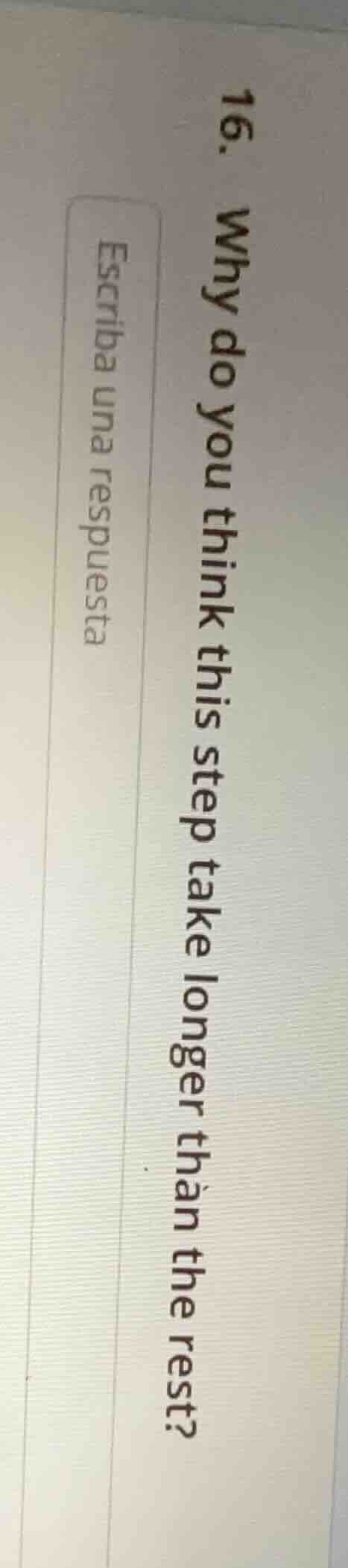
- why do you think this step take longer than the rest? escriba una respuesta
To answer this, we first need to know what "this step" refers to (e.g., a step in a process like a scientific experiment, a business workflow, a construction project, etc.). Without that context, a precise answer isn't possible. However, generally, a step might take longer due to:
- Complexity: More sub - tasks, decision - making, or coordination needed. For example, in a software engineering project, the "testing" step might be long if the code has many edge cases.
- Resource Limitations: Insufficient staff, equipment, or materials. Like in a manufacturing process, if there's a shortage of a key component, the assembly step could be delayed.
- Dependence on External Factors: Waiting for approvals, data from outside, or natural processes (e.g., in a biology experiment, waiting for cell cultures to grow).
- Quality Assurance Requirements: Rigorous checks that take time, such as in pharmaceutical production where each batch must pass multiple safety tests.
If we assume a common context (e.g., a project management scenario), a step could take longer because it has more dependencies, requires specialized skills that are in short supply, or involves tasks with high uncertainty (like research - based steps in a development project).
Since the question is too vague without context, to give a more accurate answer, please provide details about what process or activity "this step" is part of.

Snap & solve any problem in the app
Get step-by-step solutions on Sovi AI
Photo-based solutions with guided steps
Explore more problems and detailed explanations
To answer this, we first need to know what "this step" refers to (e.g., a step in a process like a scientific experiment, a business workflow, a construction project, etc.). Without that context, a precise answer isn't possible. However, generally, a step might take longer due to:
- Complexity: More sub - tasks, decision - making, or coordination needed. For example, in a software engineering project, the "testing" step might be long if the code has many edge cases.
- Resource Limitations: Insufficient staff, equipment, or materials. Like in a manufacturing process, if there's a shortage of a key component, the assembly step could be delayed.
- Dependence on External Factors: Waiting for approvals, data from outside, or natural processes (e.g., in a biology experiment, waiting for cell cultures to grow).
- Quality Assurance Requirements: Rigorous checks that take time, such as in pharmaceutical production where each batch must pass multiple safety tests.
If we assume a common context (e.g., a project management scenario), a step could take longer because it has more dependencies, requires specialized skills that are in short supply, or involves tasks with high uncertainty (like research - based steps in a development project).
Since the question is too vague without context, to give a more accurate answer, please provide details about what process or activity "this step" is part of.