QUESTION IMAGE
Question
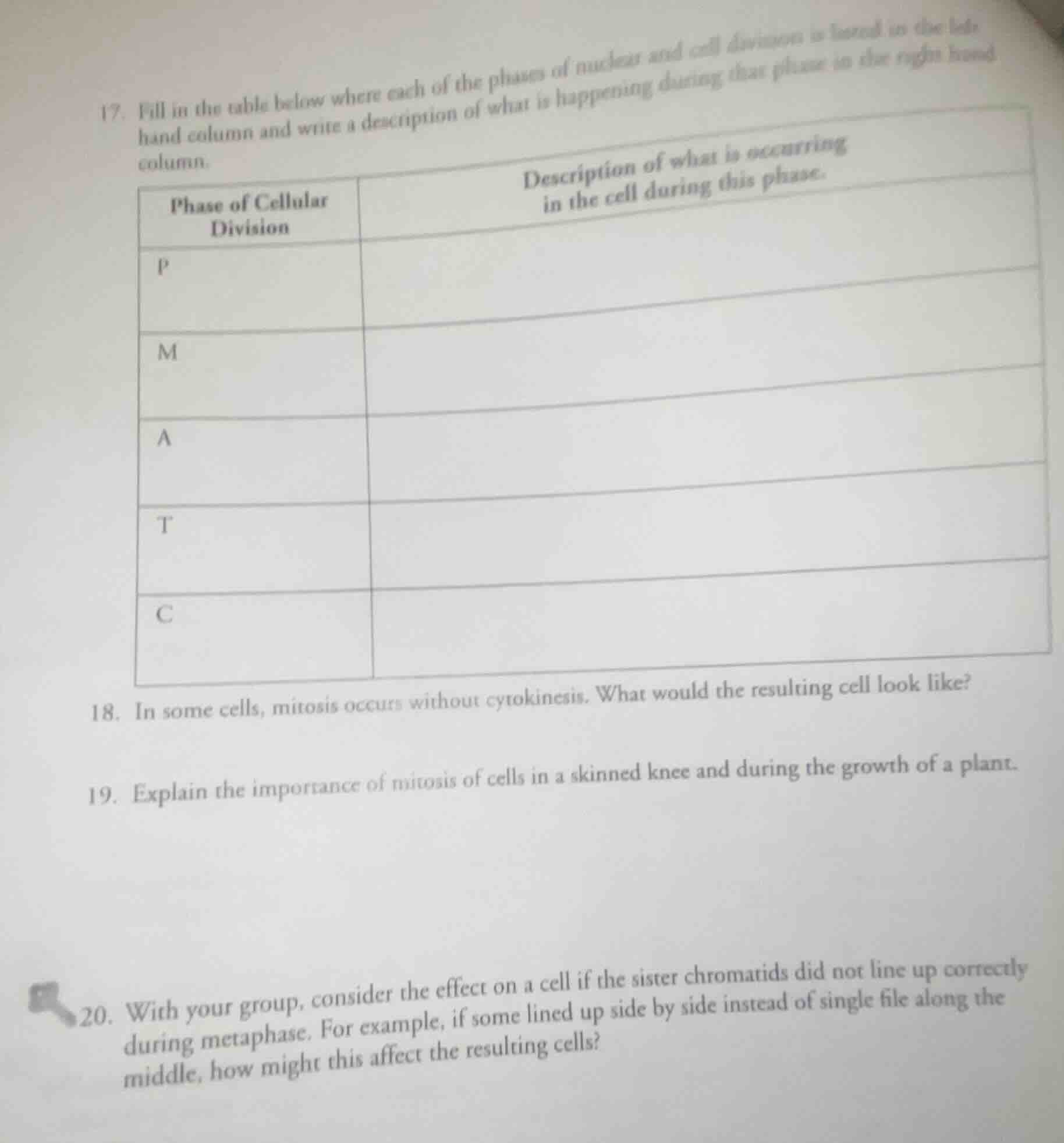
- fill in the table below where each of the phases of nuclear and cell division is listed in the left hand column and write a description of what is happening during that phase in the right hand column.
| phase of cellular division | description of what is occurring in the cell during this phase. |
|---|---|
| m | |
| a | |
| t | |
| c |
- in some cells, mitosis occurs without cytokinesis. what would the resulting cell look like?
- explain the importance of mitosis of cells in a skinned knee and during the growth of a plant.
- with your group, consider the effect on a cell if the sister chromatids did not line up correctly during metaphase. for example, if some lined up side by side instead of single file along the middle, how might this affect the resulting cells?
For Question 17:
Each letter corresponds to a phase of mitosis and cytokinesis. The descriptions summarize the key cellular events of each stage.
- P (Prophase): Chromosomes condense, nuclear envelope breaks down, spindle fibers form.
- M (Metaphase): Chromosomes align at the cell's equatorial plate.
- A (Anaphase): Sister chromatids separate and move to opposite poles.
- T (Telophase): Chromosomes decondense, nuclear envelopes reform, spindle breaks down.
- C (Cytokinesis): Cytoplasm splits, forming two daughter cells.
For Question 18:
Mitosis divides the nucleus into two identical nuclei, but cytokinesis splits the cytoplasm. Without cytokinesis, the cytoplasm does not separate, so the cell retains one shared cytoplasm.
For Question 19:
Mitosis produces genetically identical daughter cells, which is critical for growth and repair.
- Skinned knee: Mitosis replaces damaged/destroyed skin cells to close the wound and regenerate the protective skin layer.
- Plant growth: Mitosis creates new cells in meristems (root/shoot tips), allowing the plant to increase in size, develop new tissues, and replace old cells.
For Question 20:
The alignment of chromosomes at the metaphase plate ensures sister chromatids separate evenly to opposite poles. If alignment is incorrect, the spindle fibers will pull chromatids unevenly, leading to daughter cells with an abnormal number of chromosomes (aneuploidy).

Snap & solve any problem in the app
Get step-by-step solutions on Sovi AI
Photo-based solutions with guided steps
Explore more problems and detailed explanations
17.
| Phase of Cellular Division | Description of what is occurring in the cell during this phase. |
|---|---|
| M | Chromosomes align at the cell's equatorial plate. |
| A | Sister chromatids separate; move to opposite cell poles. |
| T | Chromosomes decondense; nuclear envelopes reform; spindle disassembles. |
| C | Cytoplasm divides; two daughter cells form. |
- The resulting cell will have one large cytoplasm containing two distinct, genetically identical nuclei (it will be a multinucleated cell).
19.
- Skinned knee: Mitosis generates identical new skin cells to replace damaged/dead cells, closing the wound and restoring the skin's protective barrier.
- Plant growth: Mitosis produces new identical cells in meristematic tissues, enabling the plant to increase in size, develop new roots/stems/leaves, and maintain healthy tissues.
- The resulting daughter cells will have an abnormal number of chromosomes (aneuploidy). Some cells will have extra copies of certain chromosomes, while others will be missing copies, as the misaligned chromatids will be pulled unevenly to the cell poles during anaphase. This can lead to non-functional cells or cells with harmful genetic abnormalities.