QUESTION IMAGE
Question
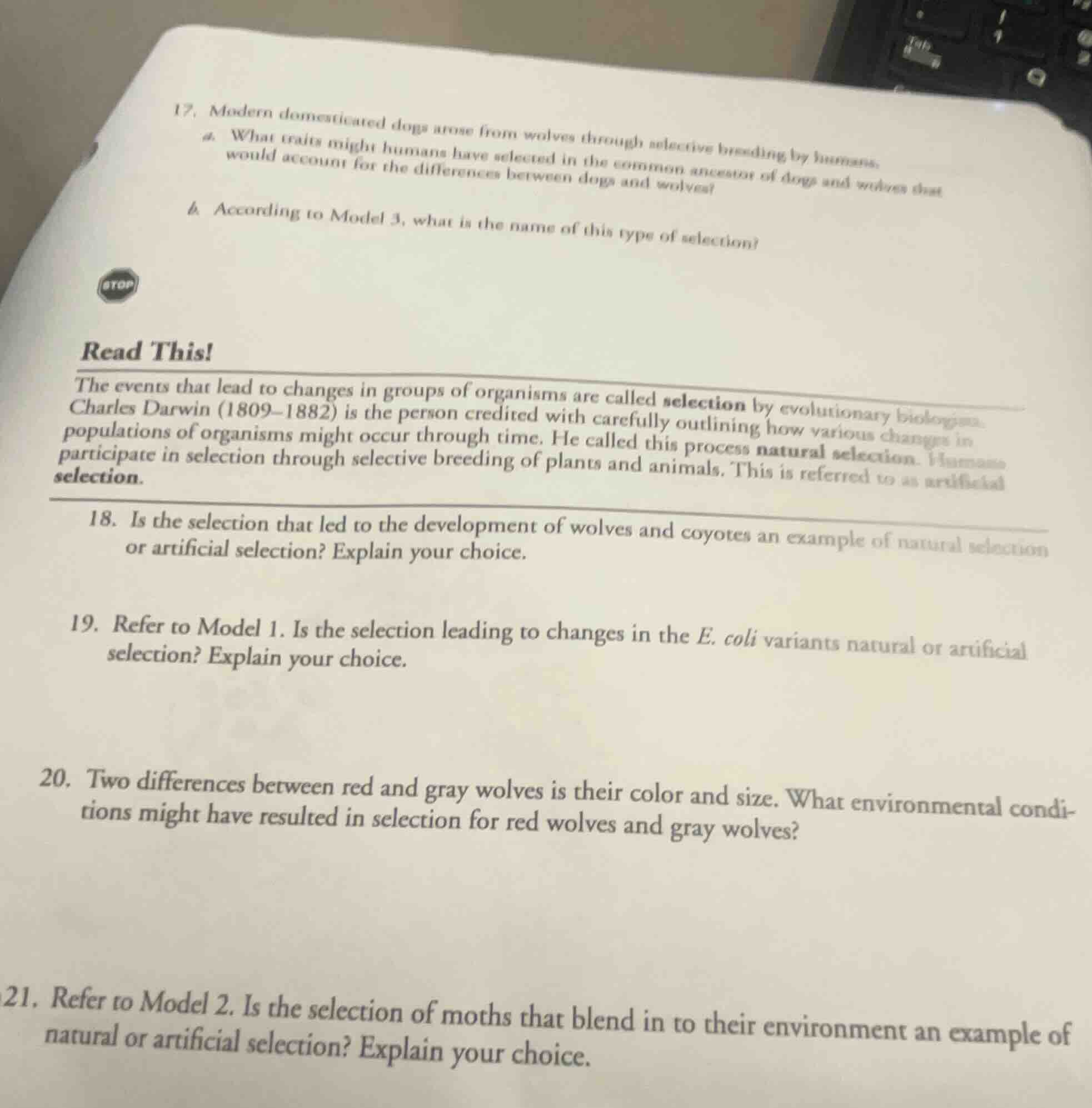
- modern domesticated dogs arose from wolves through selective breeding by humans.a. what traits might humans have selected in the common ancestor of dogs and wolves that would account for the differences between dogs and wolves?b. according to model 3, what is the name of this type of selection?read this!the events that lead to changes in groups of organisms are called selection by evolutionary biologists. charles darwin (1809–1882) is the person credited with carefully outlining how various changes in populations of organisms might occur through time. he called this process natural selection. humans participate in selection through selective breeding of plants and animals. this is referred to as artificial selection.18. is the selection that led to the development of wolves and coyotes an example of natural selection or artificial selection? explain your choice.19. refer to model 1. is the selection leading to changes in the e. coli variants natural or artificial selection? explain your choice.20. two differences between red and gray wolves is their color and size. what environmental conditions might have resulted in selection for red wolves and gray wolves?21. refer to model 2. is the selection of moths that blend in to their environment an example of natural or artificial selection? explain your choice.
17a: Humans selected for tameness, smaller size, varied coat patterns, and reduced aggression in the common ancestor, as these traits made animals more suitable for cohabitation, work, or companionship, leading to the differences between dogs and wolves.
17b: Based on the provided text defining human-directed selective breeding, this is artificial selection.
18: Wolves and coyotes evolved due to environmental pressures like food availability, predation, and habitat, with no human involvement in breeding, so this is natural selection.
19: (Note: Since Model 1 is not provided, assuming standard context: E. coli variants change in response to environmental pressures like antibiotic exposure or resource availability without human breeding intervention, so this is natural selection. If Model 1 involved human manipulation like lab-controlled selection, it would be artificial, but default context points to natural selection.)
20: For gray wolves: colder, open habitats like tundra or snow-covered forests, where larger size aids in hunting large prey and gray fur provides camouflage. For red wolves: warmer, wooded or marshy habitats, where smaller size aids in navigating dense vegetation and red/brown fur camouflages against leaf litter and brush.
21: Moths blending into their environment is driven by predation pressure (birds preying on visible moths) with no human breeding, so this is natural selection.

Snap & solve any problem in the app
Get step-by-step solutions on Sovi AI
Photo-based solutions with guided steps
Explore more problems and detailed explanations
17a. Traits include tameness, smaller size, reduced aggression, and varied coat patterns, selected for human cohabitation/use.
17b. Artificial selection
- Natural selection; no human involvement, driven by environmental pressures shaping their evolution.
- (Default context) Natural selection; changes are driven by environmental pressures on E. coli, not human selective breeding.
- Gray wolves: cold, open snowy habitats (large size for hunting, gray fur camouflage). Red wolves: warm, wooded/marshy habitats (smaller size for navigation, red fur camouflage).
- Natural selection; camouflage arises from predation pressure, not human-directed breeding.