QUESTION IMAGE
Question
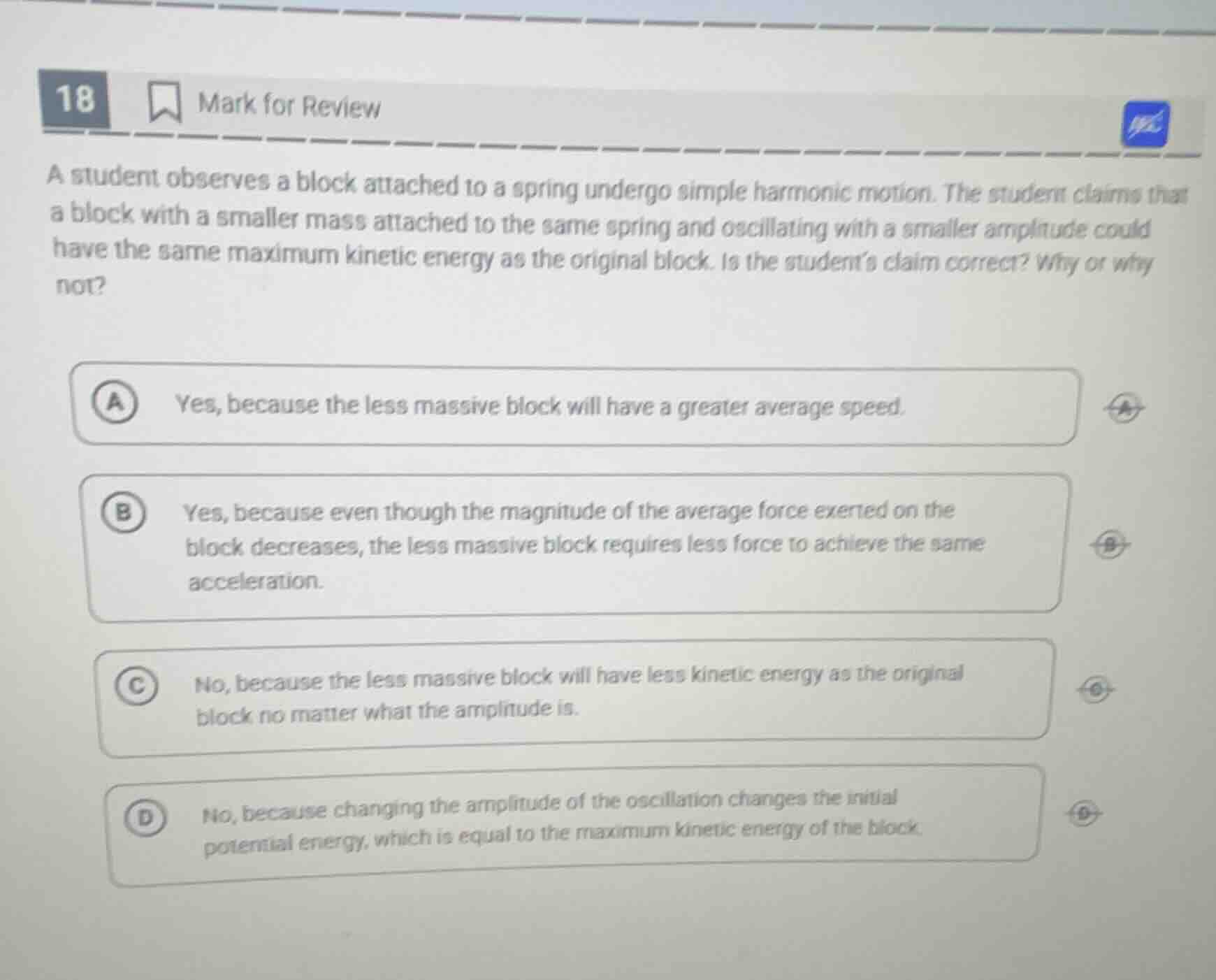
18 mark for review a student observes a block attached to a spring undergo simple harmonic motion. the student claims that a block with a smaller mass attached to the same spring and oscillating with a smaller amplitude could have the same maximum kinetic energy as the original block. is the student’s claim correct? why or why not? a yes, because the less massive block will have a greater average speed. b yes, because even though the magnitude of the average force exerted on the block decreases, the less massive block requires less force to achieve the same acceleration. c no, because the less massive block will have less kinetic energy as the original block no matter what the amplitude is. d no, because changing the amplitude of the oscillation changes the initial potential energy, which is equal to the maximum kinetic energy of the block.
To determine the validity of the student's claim, we analyze the energy in simple harmonic motion (SHM) of a mass - spring system. The total mechanical energy \( E \) of a mass - spring system in SHM is given by \( E=\frac{1}{2}kA^{2}\), where \( k \) is the spring constant and \( A \) is the amplitude of oscillation. At the equilibrium position, the potential energy of the spring is zero, and all the mechanical energy is converted into kinetic energy. So, the maximum kinetic energy \( K_{max} \) of the block is equal to the total mechanical energy of the system, i.e., \( K_{max}=\frac{1}{2}kA^{2}\).
- Option A: The concept of average speed is not relevant here. The maximum kinetic energy depends on the amplitude and the spring constant, not the average speed. So, this option is incorrect.
- Option B: The force exerted on the block in SHM is related to the spring force (\( F = - kx\)) and not to the reasoning about average force and acceleration given here. The maximum kinetic energy is determined by the energy of the system, not by the force - mass - acceleration relationship in this context. So, this option is incorrect.
- Option C: The maximum kinetic energy is \( \frac{1}{2}kA^{2}\), which is independent of the mass of the block. So, it is wrong to say that the less - massive block will always have less kinetic energy. This option is incorrect.
- Option D: The total mechanical energy of the mass - spring system (and thus the maximum kinetic energy of the block) is given by \( \frac{1}{2}kA^{2}\). If the amplitude \( A \) changes, the total mechanical energy (and hence the maximum kinetic energy) changes. So, a block with a smaller amplitude will have a smaller maximum kinetic energy, and the student's claim is incorrect. This option correctly explains why the student's claim is wrong.

Snap & solve any problem in the app
Get step-by-step solutions on Sovi AI
Photo-based solutions with guided steps
Explore more problems and detailed explanations
D. No, because changing the amplitude of the oscillation changes the initial potential energy, which is equal to the maximum kinetic energy of the block.