QUESTION IMAGE
Question
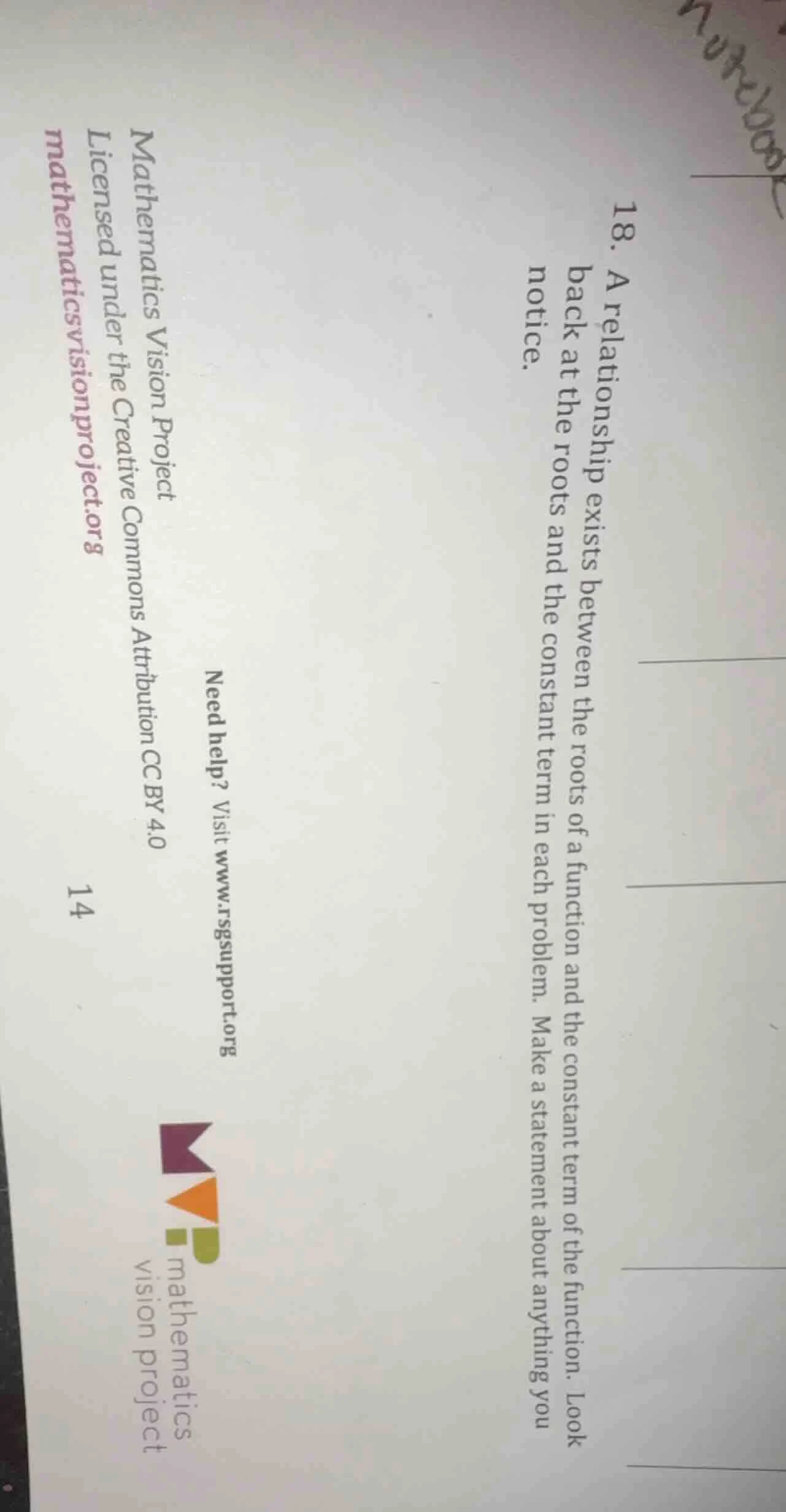
- a relationship exists between the roots of a function and the constant term of the function. look back at the roots and the constant term in each problem. make a statement about anything you notice.
To solve this problem, we analyze the relationship between the roots of a polynomial function and its constant term. We'll use the example of a quadratic function, but the concept extends to higher - degree polynomials.
Step 1: Recall the quadratic formula and Vieta's formulas for a quadratic function
For a quadratic function of the form \(ax^{2}+bx + c = 0\) (\(a
eq0\)), the roots \(r_1\) and \(r_2\) can be found using the quadratic formula \(x=\frac{-b\pm\sqrt{b^{2}-4ac}}{2a}\). From Vieta's formulas, we know that the product of the roots \(r_1\times r_2=\frac{c}{a}\). If we consider a monic quadratic function (where \(a = 1\)), the equation is \(x^{2}+bx + c=0\), and the product of the roots \(r_1\times r_2=c\) (the constant term).
Step 2: Generalize to higher - degree polynomials
For a polynomial function of degree \(n\), \(P(x)=a_nx^{n}+a_{n - 1}x^{n - 1}+\cdots+a_1x + a_0\) (\(a_n
eq0\)), by the Factor Theorem, if \(r_1,r_2,\cdots,r_n\) are the roots of the polynomial (real or complex), then \(P(x)=a_n(x - r_1)(x - r_2)\cdots(x - r_n)\). When we expand the right - hand side \((x - r_1)(x - r_2)\cdots(x - r_n)=x^{n}-(r_1 + r_2+\cdots+r_n)x^{n - 1}+(r_1r_2 + r_1r_3+\cdots+r_{n - 1}r_n)x^{n - 2}-\cdots+(- 1)^nr_1r_2\cdots r_n\). Then \(P(x)=a_nx^{n}-a_n(r_1 + r_2+\cdots+r_n)x^{n - 1}+a_n(r_1r_2 + r_1r_3+\cdots+r_{n - 1}r_n)x^{n - 2}-\cdots+(-1)^na_nr_1r_2\cdots r_n\). The constant term \(a_0=(-1)^na_nr_1r_2\cdots r_n\). So, \(\frac{a_0}{(-1)^na_n}=r_1r_2\cdots r_n\), which means that the product of the roots of the polynomial (up to a factor related to the leading coefficient and the degree of the polynomial) is related to the constant term.
Step 3: Make a statement
For a polynomial function \(P(x)=a_nx^{n}+a_{n - 1}x^{n - 1}+\cdots+a_1x + a_0\) with roots \(r_1,r_2,\cdots,r_n\), the product of the roots \(r_1r_2\cdots r_n=\frac{(- 1)^n a_0}{a_n}\). In the case of a monic polynomial (\(a_n = 1\)), the product of the roots \(r_1r_2\cdots r_n=(-1)^n a_0\). For example, in a quadratic monic polynomial \(x^{2}+bx + c\), the product of the roots is equal to the constant term \(c\) (since \(n = 2\), \((-1)^2a_0=a_0 = c\)). In a cubic monic polynomial \(x^{3}+bx^{2}+cx + d\), the product of the roots \(r_1r_2r_3=-d\) (since \(n = 3\), \((-1)^3a_0=-d\)).
So, in general, the product of the roots of a polynomial (adjusted by a factor that depends on the leading coefficient and the degree of the polynomial) is related to the constant term of the polynomial. For a monic polynomial of degree \(n\), the product of the roots is \((-1)^n\) times the constant term.

Snap & solve any problem in the app
Get step-by-step solutions on Sovi AI
Photo-based solutions with guided steps
Explore more problems and detailed explanations
For a polynomial \(P(x)=a_nx^n + a_{n - 1}x^{n-1}+\cdots+a_1x + a_0\) with roots \(r_1,r_2,\cdots,r_n\), \(r_1r_2\cdots r_n=\frac{(-1)^n a_0}{a_n}\). For a monic polynomial (\(a_n = 1\)), \(r_1r_2\cdots r_n=(-1)^n a_0\).