QUESTION IMAGE
Question
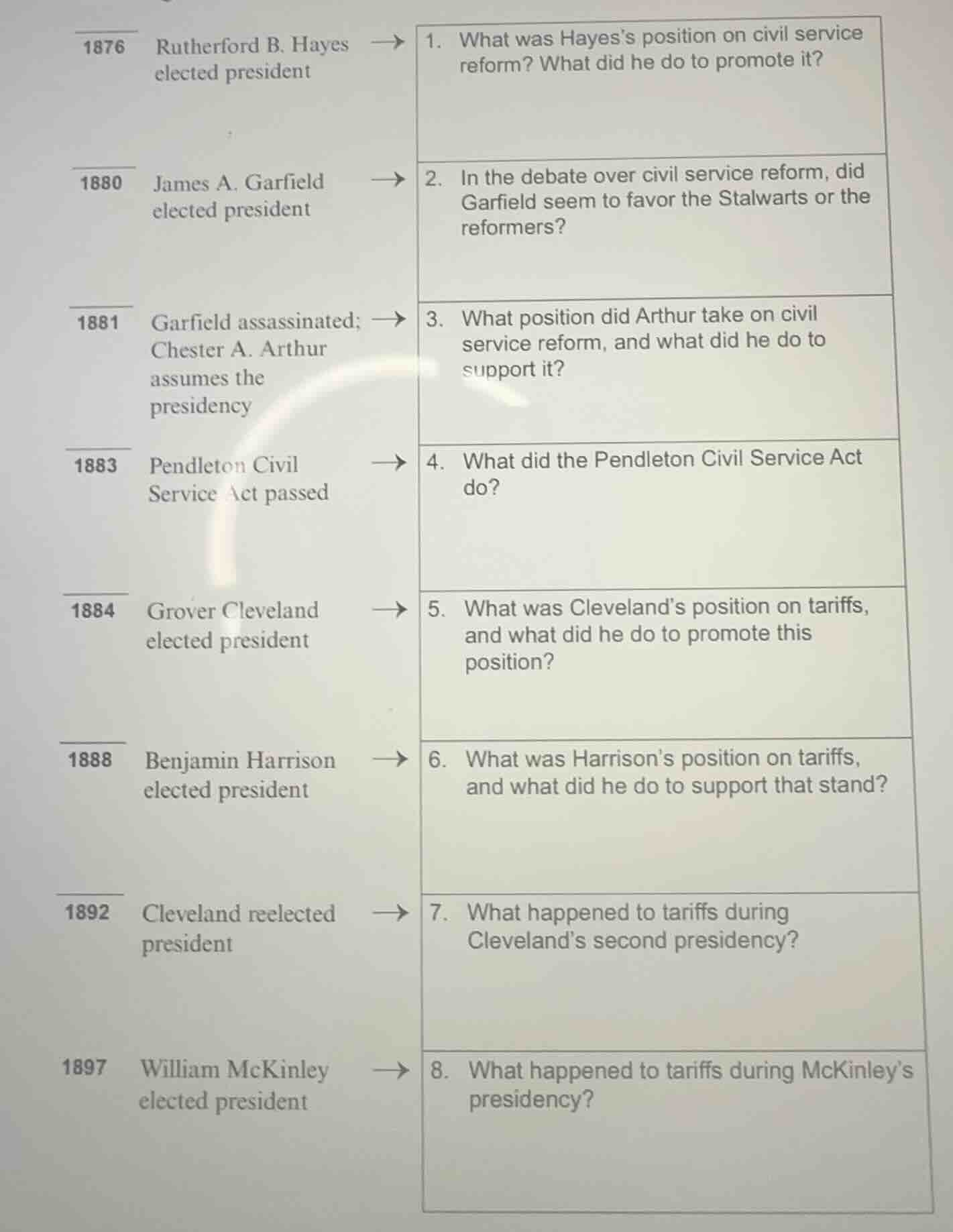
1876 rutherford b. hayes elected president → 1. what was hayess position on civil service reform? what did he do to promote it?
1880 james a. garfield elected president → 2. in the debate over civil service reform, did garfield seem to favor the stalwarts or the reformers?
1881 garfield assassinated; chester a. arthur assumes the presidency → 3. what position did arthur take on civil service reform, and what did he do to support it?
1883 pendleton civil service act passed → 4. what did the pendleton civil service act do?
1884 grover cleveland elected president → 5. what was clevelands position on tariffs, and what did he do to promote this position?
1888 benjamin harrison elected president → 6. what was harrisons position on tariffs, and what did he do to support that stand?
1892 cleveland reelected president → 7. what happened to tariffs during clevelands second presidency?
1897 william mckinley elected president → 8. what happened to tariffs during mckinleys presidency?
To answer these questions, we analyze each one based on historical knowledge of the relevant U.S. presidents and events:
Question 1: Hayes’s Position on Civil Service Reform
- Brief Explanations: Hayes supported civil service reform. He investigated corruption in the New York Customs House, fired officials (like Chester Arthur, temporarily), and set an example of merit-based governance, though he faced resistance.
- Answer: Hayes supported civil service reform. He investigated the New York Customs House for corruption, fired some officials (e.g., Chester Arthur, temporarily), and advocated for merit - based hiring, though his efforts had limited immediate impact.
Question 2: Garfield’s Stance in Civil Service Reform Debate
- Brief Explanations: Garfield favored reformers. He opposed the Stalwarts’ (who supported the spoils system) influence and appointed reform - minded officials, showing alignment with those pushing for civil service reform.
- Answer: Garfield seemed to favor the reformers. He opposed the Stalwarts’ (pro - spoils system) influence and appointed reform - minded officials, indicating his support for civil service reform.
Question 3: Arthur’s Position on Civil Service Reform
- Brief Explanations: Arthur, initially a Stalwart, shifted to support reform after Garfield’s assassination. He pushed for the Pendleton Civil Service Act, which established merit - based hiring for federal jobs.
- Answer: Arthur, initially a Stalwart, became a supporter of civil service reform after Garfield’s assassination. He actively pushed for the Pendleton Civil Service Act, which was a key step in implementing merit - based hiring for federal positions.
Question 4: What the Pendleton Civil Service Act Did
- Brief Explanations: The act established a merit - based system for federal employment. It created the Civil Service Commission, required exams for many jobs, and prohibited firing or demoting employees for political reasons, reducing the spoils system.
- Answer: The Pendleton Civil Service Act established a merit - based system for federal employment. It created the Civil Service Commission, required competitive exams for many federal jobs, and prohibited firing or demoting employees for political reasons, reducing the influence of the spoils system.
Question 5: Cleveland’s Position on Tariffs
- Brief Explanations: Cleveland opposed high tariffs, seeing them as unfair to consumers and businesses. He vetoed tariff - raising bills, gave speeches criticizing tariffs, and advocated for lower tariffs to promote fair trade and reduce consumer costs.
- Answer: Cleveland opposed high tariffs, viewing them as unfair to consumers and businesses. He vetoed bills that would raise tariffs, gave speeches criticizing high tariffs, and advocated for lower tariffs to promote fair trade and reduce consumer costs.
Question 6: Harrison’s Position on Tariffs
- Brief Explanations: Harrison supported high tariffs, believing they protected domestic industries. He signed the McKinley Tariff Act, which raised tariffs on many goods to shield U.S. businesses from foreign competition.
- Answer: Harrison supported high tariffs, believing they protected domestic industries. He signed the McKinley Tariff Act, which significantly raised tariffs on many imported goods to shield U.S. businesses from foreign competition.
Question 7: Tariffs During Cleveland’s Second Presidency
- Brief Explanations: During his second term, Cleveland continued to push for lower tariffs. However, Congress (…

Snap & solve any problem in the app
Get step-by-step solutions on Sovi AI
Photo-based solutions with guided steps
Explore more problems and detailed explanations
To answer these questions, we analyze each one based on historical knowledge of the relevant U.S. presidents and events:
Question 1: Hayes’s Position on Civil Service Reform
- Brief Explanations: Hayes supported civil service reform. He investigated corruption in the New York Customs House, fired officials (like Chester Arthur, temporarily), and set an example of merit-based governance, though he faced resistance.
- Answer: Hayes supported civil service reform. He investigated the New York Customs House for corruption, fired some officials (e.g., Chester Arthur, temporarily), and advocated for merit - based hiring, though his efforts had limited immediate impact.
Question 2: Garfield’s Stance in Civil Service Reform Debate
- Brief Explanations: Garfield favored reformers. He opposed the Stalwarts’ (who supported the spoils system) influence and appointed reform - minded officials, showing alignment with those pushing for civil service reform.
- Answer: Garfield seemed to favor the reformers. He opposed the Stalwarts’ (pro - spoils system) influence and appointed reform - minded officials, indicating his support for civil service reform.
Question 3: Arthur’s Position on Civil Service Reform
- Brief Explanations: Arthur, initially a Stalwart, shifted to support reform after Garfield’s assassination. He pushed for the Pendleton Civil Service Act, which established merit - based hiring for federal jobs.
- Answer: Arthur, initially a Stalwart, became a supporter of civil service reform after Garfield’s assassination. He actively pushed for the Pendleton Civil Service Act, which was a key step in implementing merit - based hiring for federal positions.
Question 4: What the Pendleton Civil Service Act Did
- Brief Explanations: The act established a merit - based system for federal employment. It created the Civil Service Commission, required exams for many jobs, and prohibited firing or demoting employees for political reasons, reducing the spoils system.
- Answer: The Pendleton Civil Service Act established a merit - based system for federal employment. It created the Civil Service Commission, required competitive exams for many federal jobs, and prohibited firing or demoting employees for political reasons, reducing the influence of the spoils system.
Question 5: Cleveland’s Position on Tariffs
- Brief Explanations: Cleveland opposed high tariffs, seeing them as unfair to consumers and businesses. He vetoed tariff - raising bills, gave speeches criticizing tariffs, and advocated for lower tariffs to promote fair trade and reduce consumer costs.
- Answer: Cleveland opposed high tariffs, viewing them as unfair to consumers and businesses. He vetoed bills that would raise tariffs, gave speeches criticizing high tariffs, and advocated for lower tariffs to promote fair trade and reduce consumer costs.
Question 6: Harrison’s Position on Tariffs
- Brief Explanations: Harrison supported high tariffs, believing they protected domestic industries. He signed the McKinley Tariff Act, which raised tariffs on many goods to shield U.S. businesses from foreign competition.
- Answer: Harrison supported high tariffs, believing they protected domestic industries. He signed the McKinley Tariff Act, which significantly raised tariffs on many imported goods to shield U.S. businesses from foreign competition.
Question 7: Tariffs During Cleveland’s Second Presidency
- Brief Explanations: During his second term, Cleveland continued to push for lower tariffs. However, Congress (controlled by Republicans) resisted, and no major tariff reduction legislation passed, though the issue remained a key political debate.
- Answer: During Cleveland’s second presidency, he continued to advocate for lower tariffs. However, Congress (dominated by Republicans) resisted his efforts, and no major tariff - reduction legislation was passed, though the tariff issue remained a prominent political debate.
Question 8: Tariffs During McKinley’s Presidency
- Brief Explanations: McKinley supported high tariffs. He signed the Dingley Tariff Act, which raised tariffs to even higher levels than the McKinley Tariff, further protecting domestic industries from foreign competition.
- Answer: During McKinley’s presidency, he supported high tariffs. He signed the Dingley Tariff Act, which raised tariffs to higher levels than the previous McKinley Tariff, further protecting domestic industries from foreign competition.