QUESTION IMAGE
Question
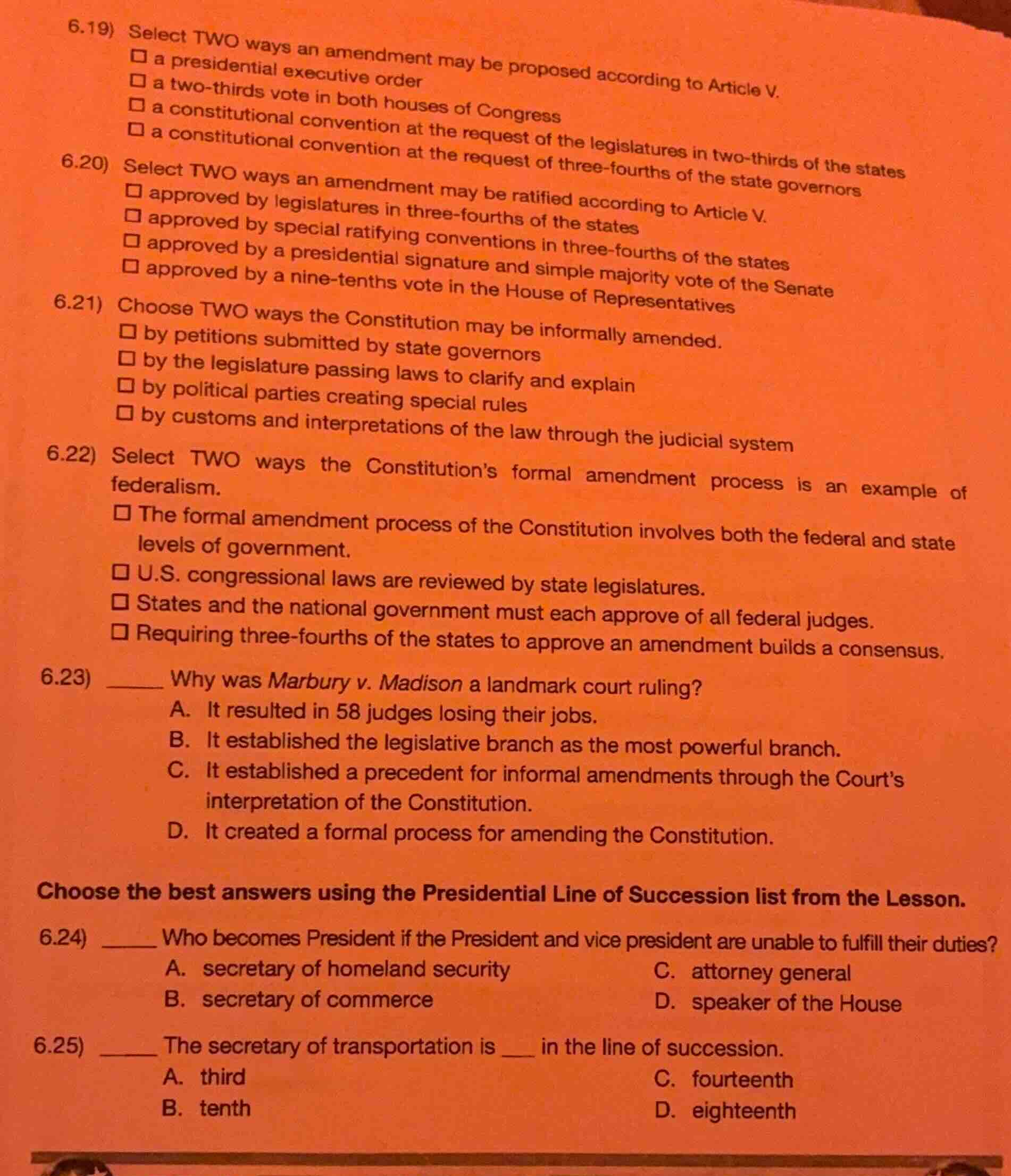
6.19) select two ways an amendment may be proposed according to article v.
□ a presidential executive order
□ a two - thirds vote in both houses of congress
□ a constitutional convention at the request of the legislatures in two - thirds of the states
□ a constitutional convention at the request of three - fourths of the state governors
6.20) select two ways an amendment may be ratified according to article v.
□ approved by legislatures in three - fourths of the states
□ approved by special ratifying conventions in three - fourths of the states
□ approved by a presidential signature and simple majority vote of the senate
□ approved by a nine - tenths vote in the house of representatives
6.21) choose two ways the constitution may be informally amended.
□ by petitions submitted by state governors
□ by the legislature passing laws to clarify and explain
□ by political parties creating special rules
□ by customs and interpretations of the law through the judicial system
6.22) select two ways the constitutions formal amendment process is an example of federalism.
□ the formal amendment process of the constitution involves both the federal and state levels of government.
□ u.s. congressional laws are reviewed by state legislatures.
□ states and the national government must each approve of all federal judges.
□ requiring three - fourths of the states to approve an amendment builds a consensus.
6.23) ______ why was marbury v. madison a landmark court ruling?
a. it resulted in 58 judges losing their jobs.
b. it established the legislative branch as the most powerful branch.
c. it established a precedent for informal amendments through the courts interpretation of the constitution.
d. it created a formal process for amending the constitution.
choose the best answers using the presidential line of succession list from the lesson.
6.24) ______ who becomes president if the president and vice president are unable to fulfill their duties?
a. secretary of homeland security c. attorney general
b. secretary of commerce d. speaker of the house
6.25) ____ the secretary of transportation is _ in the line of succession.
a. third c. fourteenth
b. tenth d. eighteenth
6.19
Article V of the U.S. Constitution outlines two methods for proposing amendments: a two-thirds vote in both congressional chambers, or a national convention called by two-thirds of state legislatures.
6.20
Article V defines two ratification methods: approval by three-fourths of state legislatures, or approval by special ratifying conventions in three-fourths of states.
6.21
Informal constitutional amendments occur through legislative clarification of constitutional rules, and judicial interpretation of laws and the Constitution over time.
6.22
Federalism divides power between federal and state governments. The amendment process reflects this by involving both levels, and state approval builds consensus across the federal system.
6.23
Marbury v. Madison established the principle of judicial review, which is a key form of informal constitutional amendment via court interpretation.
6.24
Under the Presidential Succession Act, the Speaker of the House is next in line after the President and Vice President.
6.25
Per the official presidential line of succession, the Secretary of Transportation is 14th in order.

Snap & solve any problem in the app
Get step-by-step solutions on Sovi AI
Photo-based solutions with guided steps
Explore more problems and detailed explanations
6.19)
- a two-thirds vote in both houses of Congress
- a constitutional convention at the request of the legislatures in two-thirds of the states
6.20)
- approved by legislatures in three-fourths of the states
- approved by special ratifying conventions in three-fourths of the states
6.21)
- by the legislature passing laws to clarify and explain
- by customs and interpretations of the law through the judicial system
6.22)
- The formal amendment process of the Constitution involves both the federal and state levels of government.
- Requiring three-fourths of the states to approve an amendment builds a consensus.
6.23)
C. It established a precedent for informal amendments through the Court's interpretation of the Constitution.
6.24)
D. speaker of the House
6.25)
C. fourteenth