QUESTION IMAGE
Question
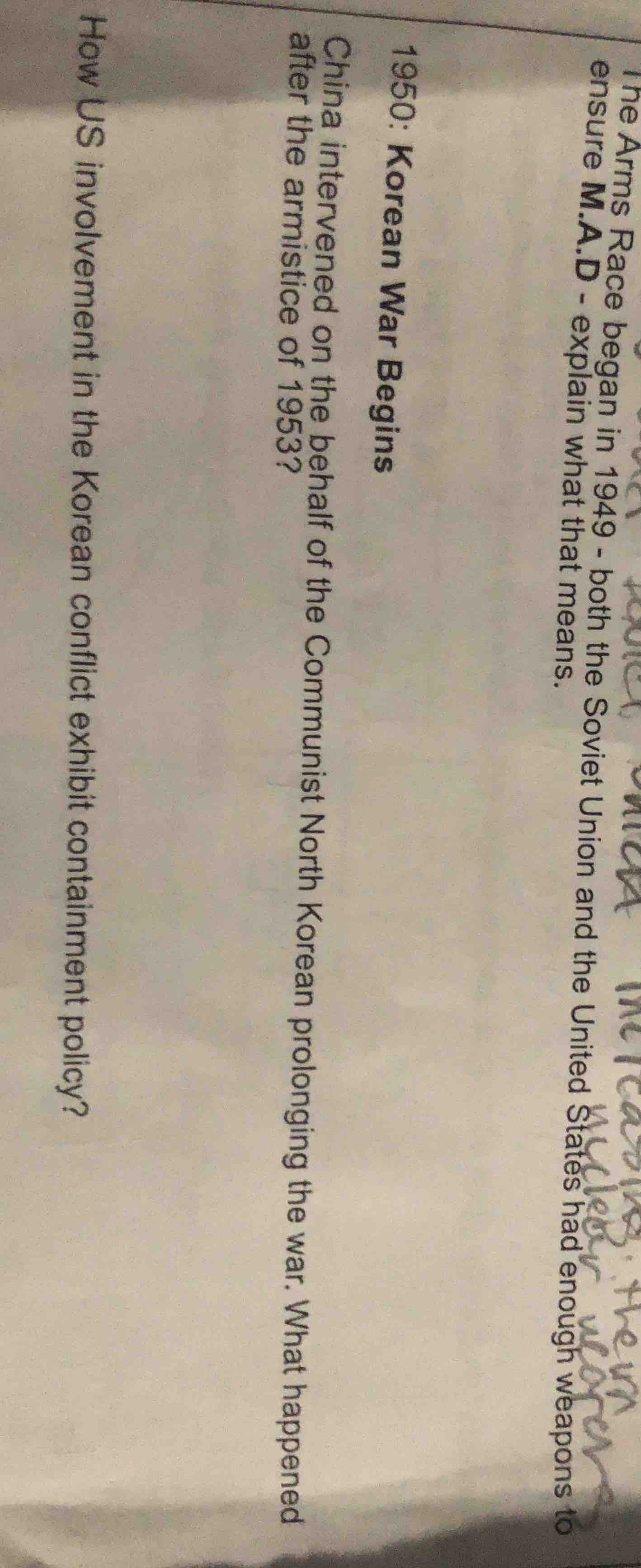
1950: korean war begins
china intervened on the behalf of the communist north korean prolonging the war. what happened after the armistice of 1953?
how us involvement in the korean conflict exhibit containment policy?
Brief Explanations
- For M.A.D.: Mutually Assured Destruction (M.A.D.) is a Cold War nuclear deterrence concept. It means if either the U.S. or Soviet Union launched a nuclear attack, the other could retaliate with devastating nuclear strikes, resulting in the total destruction of both nations. This created a deterrent against nuclear conflict, as neither side could win a nuclear war.
- Post-1953 Korean War armistice: After the 1953 armistice, the Korean Peninsula remained divided into communist North Korea and capitalist South Korea. A demilitarized zone (DMZ) was established between the two states as a buffer. No formal peace treaty was signed, so the two Koreas are still technically at war, and tensions along the DMZ have persisted into the present day.
- U.S. containment in Korea: Containment was the U.S. Cold War policy to stop the spread of communism. In Korea, the U.S. led a UN coalition to defend South Korea from communist North Korean invasion, preventing communism from spreading to the southern half of the peninsula. This direct military intervention was a core example of using force to "contain" communist expansion.

Snap & solve any problem in the app
Get step-by-step solutions on Sovi AI
Photo-based solutions with guided steps
Explore more problems and detailed explanations
- M.A.D. (Mutually Assured Destruction) means that both the U.S. and Soviet Union possessed enough nuclear weapons that a nuclear attack by one would trigger a retaliatory strike that completely destroyed both nations, creating a deterrent against nuclear war.
- After the 1953 armistice, Korea remained split into communist North Korea and capitalist South Korea, separated by a demilitarized zone (DMZ). No formal peace treaty was signed, leaving the two nations technically still at war with ongoing tensions.
- U.S. involvement in the Korean War was an example of containment because the U.S. led a UN military force to defend South Korea from communist North Korean invasion, stopping the spread of communism to the southern part of the Korean Peninsula.