QUESTION IMAGE
Question
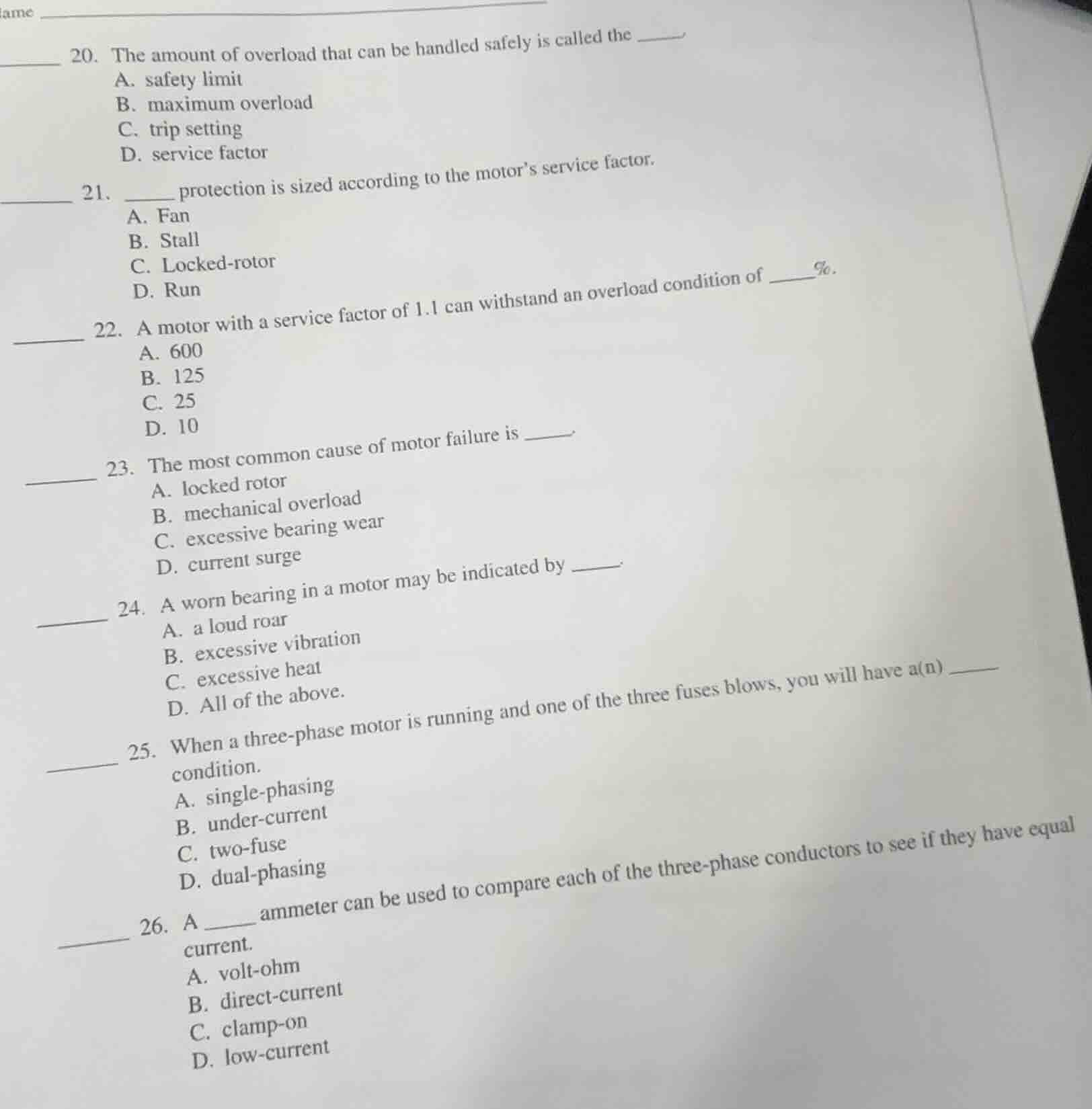
- the amount of overload that can be handled safely is called the ____a. safety limitb. maximum overloadc. trip settingd. service factor21. __ protection is sized according to the motors service factor.a. fanb. stallc. locked-rotord. run22. a motor with a service factor of 1.1 can withstand an overload condition of __%.a. 600b. 125c. 25d. 1023. the most common cause of motor failure is __a. locked rotorb. mechanical overloadc. excessive bearing weard. current surge24. a worn bearing in a motor may be indicated by __.a. a loud roarb. excessive vibrationc. excessive heatd. all of the above.25. when a three-phase motor is running and one of the three fuses blows, you will have a(n) __ condition.a. single-phasingb. under-currentc. two-fused. dual-phasing26. a ____ ammeter can be used to compare each of the three-phase conductors to see if they have equal current.a. volt-ohmb. direct-currentc. clamp-ond. low-current
Brief Explanations
- The service factor defines the safe overload capacity of a motor.
- Run protection is sized based on the motor's service factor to handle safe overloads.
- A service factor of 1.1 means the motor can handle 10% overload (1.1 - 1 = 0.1, or 10%).
- Excessive bearing wear is the most prevalent cause of motor failure due to constant friction.
- Worn bearings create noise, vibration, and increased heat from friction.
- When one fuse blows in a three-phase motor, it operates on two phases, called single-phasing.
- A clamp-on ammeter allows non-invasive measurement of current in each three-phase conductor to check for equality.

Snap & solve any problem in the app
Get step-by-step solutions on Sovi AI
Photo-based solutions with guided steps
Explore more problems and detailed explanations
- D. service factor
- D. Run
- D. 10
- C. excessive bearing wear
- D. All of the above.
- A. single-phasing
- C. clamp-on