QUESTION IMAGE
Question
- the area of a square is $9\\ cm^2$.
a. how long is each side of the square?
b. what is the perimeter of the square?
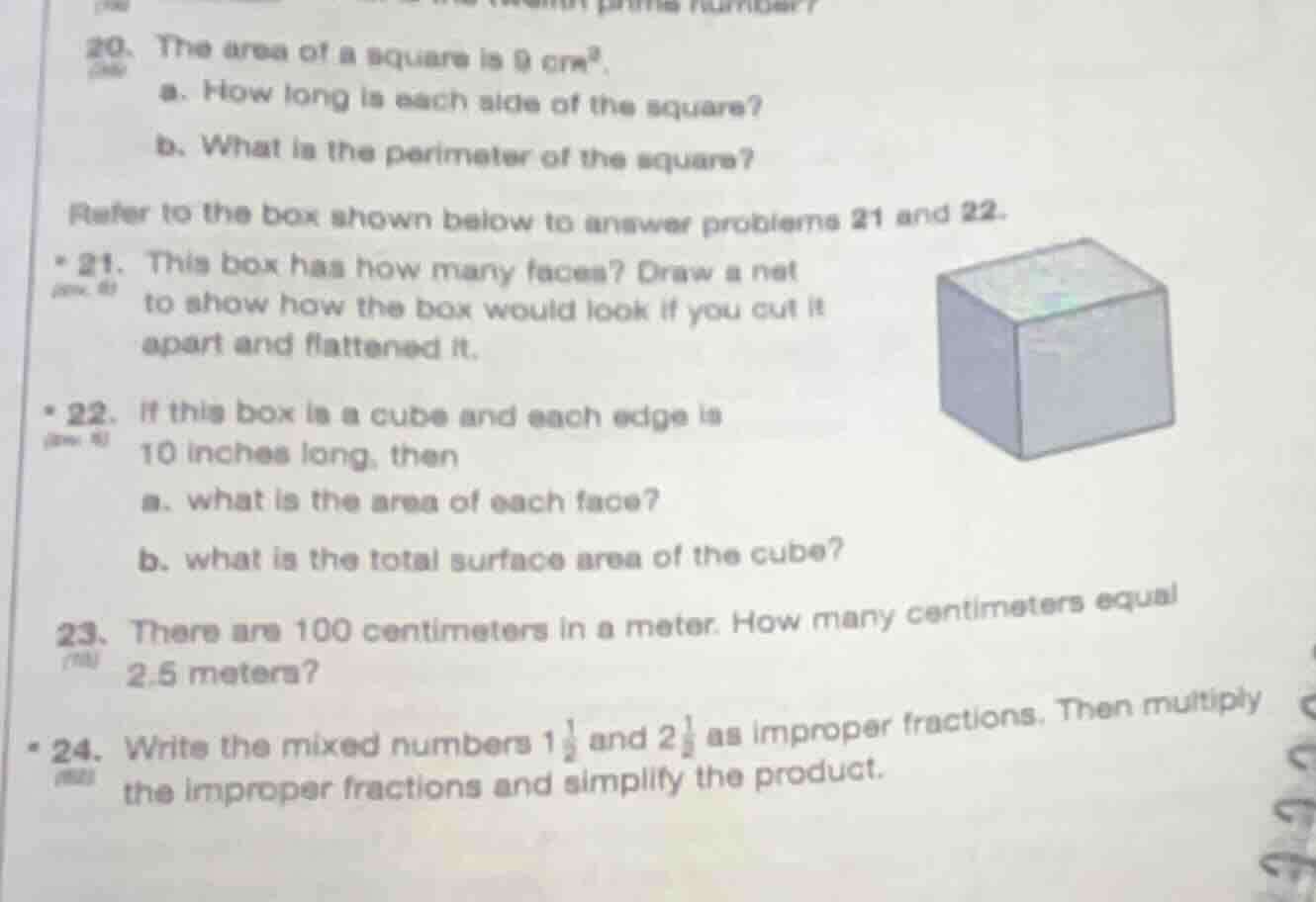
refer to the box shown below to answer problems 21 and 22.
*21. this box has how many faces? draw a net to show how the box would look if you cut it apart and flattened it.
*22. if this box is a cube and each edge is 10 inches long, then
a. what is the area of each face?
b. what is the total surface area of the cube?
- there are 100 centimeters in a meter. how many centimeters equal 2.5 meters?
*24. write the mixed numbers $1\frac{1}{2}$ and $2\frac{1}{2}$ as improper fractions. then multiply the improper fractions and simplify the product.
Problem 20
Step1: Find square side length
Area of square: $A = s^2$, so $s = \sqrt{A}$
$s = \sqrt{9\ \text{cm}^2} = 3\ \text{cm}$
Step2: Calculate square perimeter
Perimeter of square: $P = 4s$
$P = 4 \times 3\ \text{cm} = 12\ \text{cm}$
Problem 21
Step1: Identify cube face count
A cube (box) has 6 flat faces.
Step2: Describe net of cube
A net is 6 connected squares (e.g., 4 in a row with 1 square attached to the top and bottom of one middle square).
Problem 22
Step1: Find face area of cube
Area of 1 face: $A_{\text{face}} = s^2$
$A_{\text{face}} = (10\ \text{in})^2 = 100\ \text{in}^2$
Step2: Calculate total surface area
Total surface area: $SA = 6 \times A_{\text{face}}$
$SA = 6 \times 100\ \text{in}^2 = 600\ \text{in}^2$
Problem 23
Step1: Convert meters to centimeters
Use conversion factor: $1\ \text{m} = 100\ \text{cm}$
$\text{Length} = 2.5\ \text{m} \times 100\ \frac{\text{cm}}{\text{m}} = 250\ \text{cm}$
Problem 24
Step1: Convert mixed to improper fractions
$1\frac{1}{2} = \frac{1 \times 2 + 1}{2} = \frac{3}{2}$; $2\frac{1}{2} = \frac{2 \times 2 + 1}{2} = \frac{5}{2}$
Step2: Multiply and simplify fractions
$\frac{3}{2} \times \frac{5}{2} = \frac{15}{4} = 3\frac{3}{4}$

Snap & solve any problem in the app
Get step-by-step solutions on Sovi AI
Photo-based solutions with guided steps
Explore more problems and detailed explanations
- a. $3\ \text{cm}$
b. $12\ \text{cm}$
- a. 6 faces
b. A net of 6 connected squares (e.g., 4 in a horizontal row, with 1 square attached to the top and bottom of the second square in the row)
- a. $100\ \text{in}^2$
b. $600\ \text{in}^2$
- $250\ \text{cm}$
- Improper fractions: $\frac{3}{2}$ and $\frac{5}{2}$; Simplified product: $\frac{15}{4}$ or $3\frac{3}{4}$