QUESTION IMAGE
Question
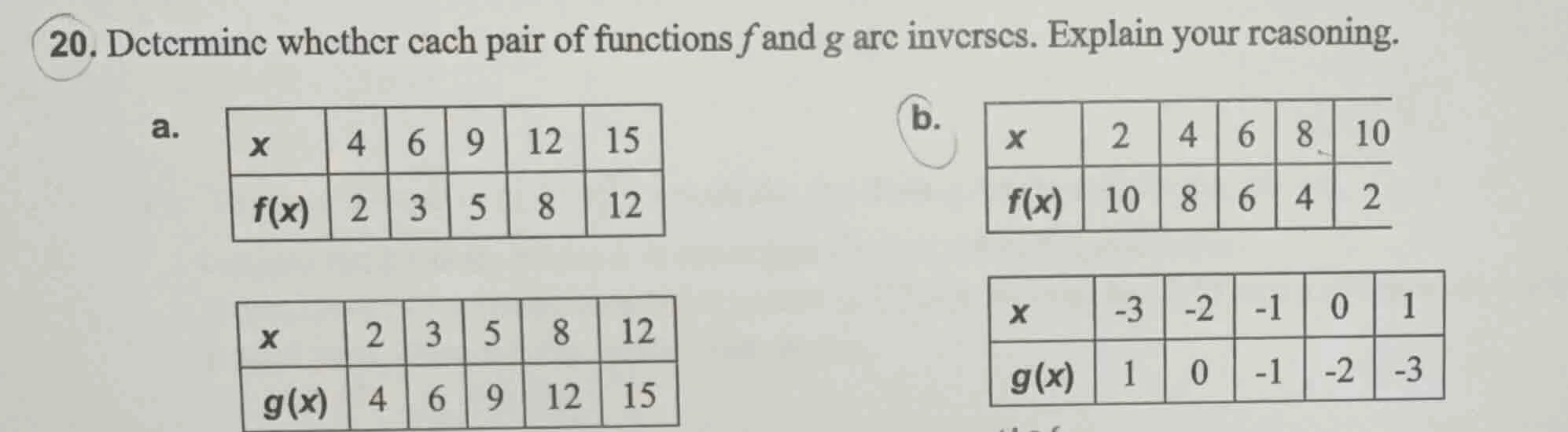
- determine whether each pair of functions ( f ) and ( g ) are inverses. explain your reasoning.
a.
| ( x ) | 4 | 6 | 9 | 12 | 15 |
| ( f(x) ) | 2 | 3 | 5 | 8 | 12 |
| ( x ) | 2 | 3 | 5 | 8 | 12 |
| ( g(x) ) | 4 | 6 | 9 | 12 | 15 |
b.
| ( x ) | 2 | 4 | 6 | 8 | 10 |
| ( f(x) ) | 10 | 8 | 6 | 4 | 2 |
| ( x ) | -3 | -2 | -1 | 0 | 1 |
| ( g(x) ) | 1 | 0 | -1 | -2 | -3 |
Part a
Step1: Recall inverse function definition
Two functions \( f \) and \( g \) are inverses if \( f(g(x)) = x \) and \( g(f(x)) = x \) for all \( x \) in their domains. For discrete functions (given by tables), we check if the input of \( f \) becomes the output of \( g \) and vice - versa.
Step2: Analyze function \( f \) and \( g \) for part a
- For function \( f \): The domain of \( f \) is \(\{4,6,9,12,15\}\) and the range is \(\{2,3,5,8,12\}\).
- For function \( g \): The domain of \( g \) is \(\{2,3,5,8,12\}\) (which is the range of \( f \)) and the range of \( g \) is \(\{4,6,9,12,15\}\) (which is the domain of \( f \)).
Let's check the composition. If we take an \( x \) from the domain of \( f \), say \( x = 4 \), \( f(4)=2 \), and then \( g(2) = 4 \). If \( x = 6 \), \( f(6)=3 \), and \( g(3)=6 \). If \( x = 9 \), \( f(9)=5 \), and \( g(5)=9 \). If \( x = 12 \), \( f(12)=8 \), and \( g(8)=12 \). If \( x = 15 \), \( f(15)=12 \), and \( g(12)=15 \). Also, if we take an \( x \) from the domain of \( g \), say \( x = 2 \), \( g(2)=4 \), and \( f(4)=2 \); \( x = 3 \), \( g(3)=6 \), and \( f(6)=3 \); \( x = 5 \), \( g(5)=9 \), and \( f(9)=5 \); \( x = 8 \), \( g(8)=12 \), and \( f(12)=8 \); \( x = 12 \), \( g(12)=15 \), and \( f(15)=12 \). So \( f(g(x))=x \) and \( g(f(x)) = x \) for all \( x \) in their respective domains.
Part b
Step1: Recall inverse function definition
Again, use the definition that \( f(g(x))=x \) and \( g(f(x))=x \) for all \( x \) in their domains.
Step2: Analyze function \( f \) and \( g \) for part b
- For function \( f \): The domain is \(\{2,4,6,8,10\}\) and the range is \(\{10,8,6,4,2\}\).
- For function \( g \): The domain is \(\{-3,-2,-1,0,1\}\) and the range is \(\{1,0,-1,-2,-3\}\).
The range of \( f \) is \(\{10,8,6,4,2\}\), and the domain of \( g \) is \(\{-3,-2,-1,0,1\}\), which are not related. Also, let's check a value. For \( x = 2 \) in \( f \), \( f(2)=10 \), and \( g(10) \) is not even in the domain of \( g \) (since the domain of \( g \) is \(\{-3,-2,-1,0,1\}\)). So \( f \) and \( g \) do not satisfy the inverse function property.

Snap & solve any problem in the app
Get step-by-step solutions on Sovi AI
Photo-based solutions with guided steps
Explore more problems and detailed explanations
a. The functions \( f \) and \( g \) are inverses because for every \( x \) in the domain of \( f \), \( g(f(x))=x \), and for every \( x \) in the domain of \( g \), \( f(g(x)) = x \) (the domain of \( f \) is the range of \( g \) and vice - versa, and the composition holds as shown in the analysis).
b. The functions \( f \) and \( g \) are not inverses because the domain of \( g \) is not the range of \( f \) (and vice - versa), and the composition \( f(g(x)) \) and \( g(f(x)) \) does not hold (e.g., \( f(2) = 10 \), and \( g(10) \) is not defined in the given \( g \) function's domain).