QUESTION IMAGE
Question
- - / 1 points
details
my notes
ask your teacher
practice another
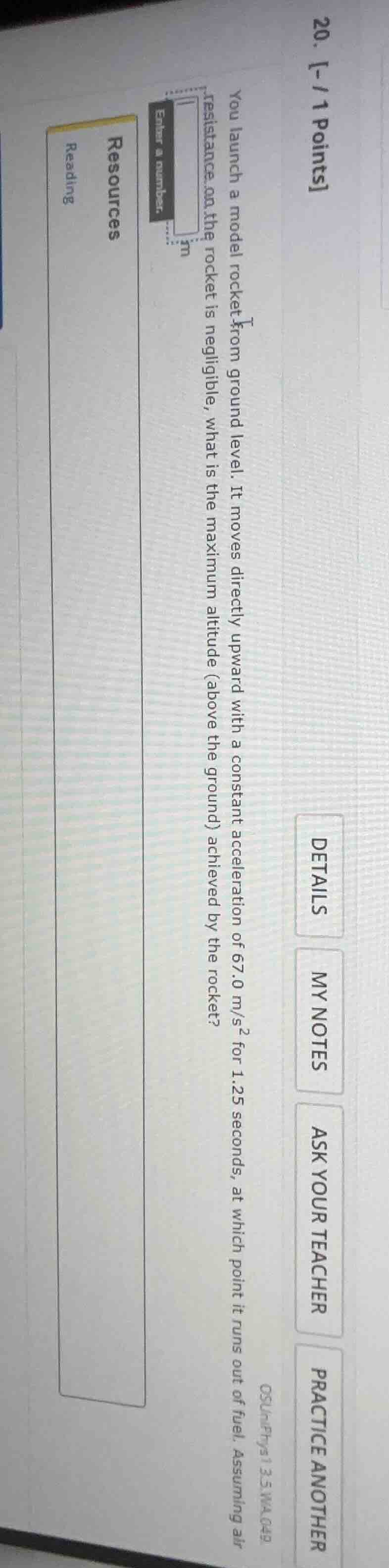
you launch a model rocket from ground level. it moves directly upward with a constant acceleration of $67.0\\ \text{m/s}^2$ for 1.25 seconds, at which point it runs out of fuel. assuming air resistance on the rocket is negligible, what is the maximum altitude (above the ground) achieved by the rocket?
enter a number: ______ m
resources
reading
Step1: Find velocity at fuel depletion
$v = v_0 + a t$
$v = 0 + 67.0 \times 1.25 = 83.75 \, \text{m/s}$
Step2: Find height during acceleration
$h_1 = v_0 t + \frac{1}{2} a t^2$
$h_1 = 0 + \frac{1}{2} \times 67.0 \times (1.25)^2 = 52.34375 \, \text{m}$
Step3: Find height after fuel runs out
At max height, final velocity $v_f=0$. Use $v_f^2 = v^2 - 2 g h_2$
$0 = (83.75)^2 - 2 \times 9.81 \times h_2$
$h_2 = \frac{(83.75)^2}{2 \times 9.81} = \frac{7014.0625}{19.62} \approx 357.5 \, \text{m}$
Step4: Sum heights for max altitude
$H = h_1 + h_2$
$H = 52.34375 + 357.5 \approx 409.84 \, \text{m}$

Snap & solve any problem in the app
Get step-by-step solutions on Sovi AI
Photo-based solutions with guided steps
Explore more problems and detailed explanations
$\approx 410 \, \text{m}$ (or $409.8 \, \text{m}$ for more precision)