QUESTION IMAGE
Question
6 of 20 questions remaining
use the editor to format your answer
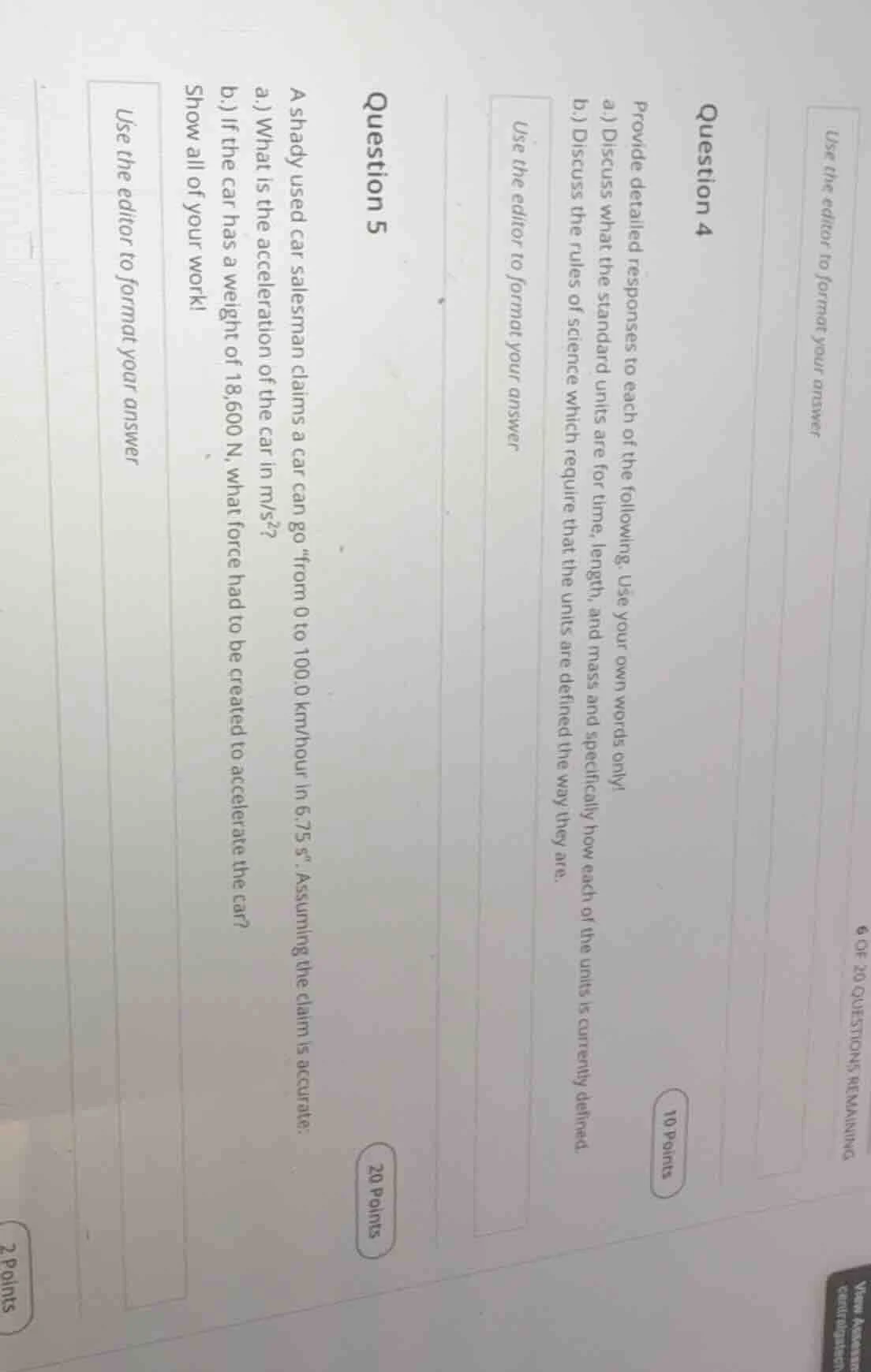
question 4
10 points
provide detailed responses to each of the following. use your own words only!
a.) discuss what the standard units are for time, length, and mass and specifically how each of the units is currently defined.
b.) discuss the rules of science which require that the units are defined the way they are.
use the editor to format your answer
question 5
20 points
a shady used car salesman claims a car can go \from 0 to 100.0 km/hour in 6.75 s\. assuming the claim is accurate:
a.) what is the acceleration of the car in m/s²?
b.) if the car has a weight of 18,600 n, what force had to be created to accelerate the car?
show all of your work!
use the editor to format your answer
Question 4
a.) Time's standard unit is the second (s). It is defined as the duration of 9,192,631,770 periods of the radiation corresponding to the transition between the two hyperfine levels of the ground state of the cesium-133 atom. Length's standard unit is the meter (m), defined as the distance light travels in a vacuum in $\frac{1}{299,792,458}$ of a second. Mass's standard unit is the kilogram (kg), defined by the fixed numerical value of the Planck constant $h$ as $6.62607015 \times 10^{-34}$ J·s (where 1 J = 1 kg·m²·s⁻²).
b.) The rules of science require unit definitions to be: 1. Invariant: Units must not change over time or location (e.g., the meter’s light-based definition is consistent everywhere). 2. Reproducible: Any lab globally can recreate the unit using the defined physical constant or phenomenon. 3. Precise: Definitions are based on exact, measurable physical constants rather than physical artifacts (like the old prototype kilogram) to eliminate uncertainty. 4. Coherent: Units fit within a single system (SI) where derived units are combinations of base units without extra conversion factors.
Step1: Convert final velocity to m/s
First, convert 100.0 km/h to m/s:
$$100.0\ \frac{\text{km}}{\text{h}} = 100.0 \times \frac{1000\ \text{m}}{3600\ \text{s}} = \frac{100000}{3600}\ \text{m/s} \approx 27.78\ \text{m/s}$$
Step2: Calculate acceleration
Use the acceleration formula $a = \frac{v_f - v_i}{t}$, where initial velocity $v_i = 0$:
$$a = \frac{27.78\ \text{m/s} - 0}{6.75\ \text{s}} \approx 4.12\ \text{m/s}^2$$
Step3: Find mass of the car
Use weight formula $W = mg$ (where $g = 9.81\ \text{m/s}^2$) to solve for mass $m$:
$$m = \frac{W}{g} = \frac{18600\ \text{N}}{9.81\ \text{m/s}^2} \approx 1896.02\ \text{kg}$$
Step4: Calculate net force
Use Newton's second law $F = ma$:
$$F = 1896.02\ \text{kg} \times 4.12\ \text{m/s}^2 \approx 7811.6\ \text{N}$$

Snap & solve any problem in the app
Get step-by-step solutions on Sovi AI
Photo-based solutions with guided steps
Explore more problems and detailed explanations
a.)
- Time: The standard unit is the second (s), defined by the frequency of radiation from cesium-133 atoms (9,192,631,770 cycles = 1 second).
- Length: The standard unit is the meter (m), defined as the distance light travels in a vacuum in $\frac{1}{299,792,458}$ seconds.
- Mass: The standard unit is the kilogram (kg), defined using the fixed Planck constant value $h = 6.62607015 \times 10^{-34}$ J·s.
b.)
Science requires units to be defined as invariant (consistent across time/space), reproducible (replicable globally), precise (based on unchanging physical constants), and coherent (compatible within a unified measurement system like SI).
---