QUESTION IMAGE
Question
- use the distance formula and slope to determine if the object below is a square. if not, please explain why.
Response
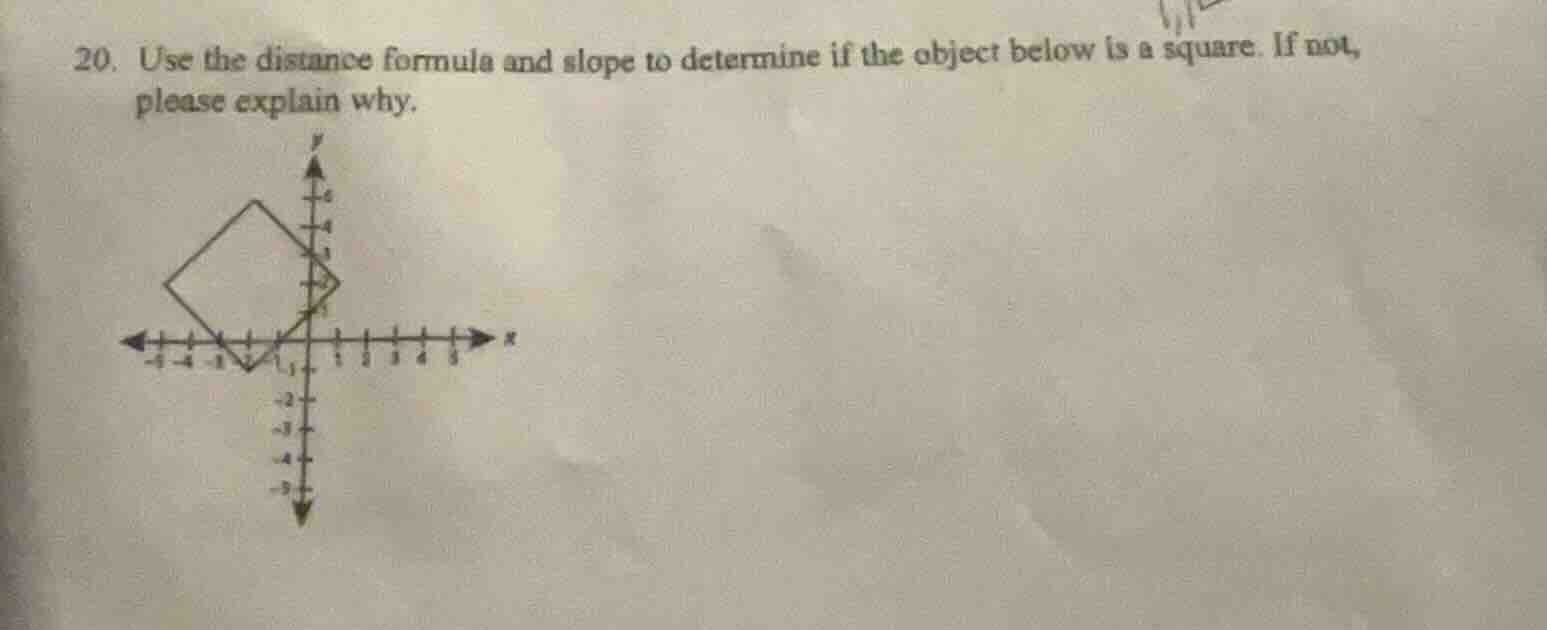
First, identify the vertices of the quadrilateral from the graph: let's label them as \(A(1,2)\), \(B(-2,5)\), \(C(-5,2)\), \(D(-2,-1)\)
Step1: Calculate side lengths
Use distance formula \(d=\sqrt{(x_2-x_1)^2+(y_2-y_1)^2}\)
- \(AB=\sqrt{(-2-1)^2+(5-2)^2}=\sqrt{(-3)^2+3^2}=\sqrt{9+9}=\sqrt{18}=3\sqrt{2}\)
- \(BC=\sqrt{(-5-(-2))^2+(2-5)^2}=\sqrt{(-3)^2+(-3)^2}=\sqrt{9+9}=\sqrt{18}=3\sqrt{2}\)
- \(CD=\sqrt{(-2-(-5))^2+(-1-2)^2}=\sqrt{3^2+(-3)^2}=\sqrt{9+9}=\sqrt{18}=3\sqrt{2}\)
- \(DA=\sqrt{(1-(-2))^2+(2-(-1))^2}=\sqrt{3^2+3^2}=\sqrt{9+9}=\sqrt{18}=3\sqrt{2}\)
Step2: Calculate diagonal lengths
- \(AC=\sqrt{(-5-1)^2+(2-2)^2}=\sqrt{(-6)^2+0^2}=\sqrt{36}=6\)
- \(BD=\sqrt{(-2-(-2))^2+(-1-5)^2}=\sqrt{0^2+(-6)^2}=\sqrt{36}=6\)
Step3: Calculate slopes
Use slope formula \(m=\frac{y_2-y_1}{x_2-x_1}\)
- Slope of \(AB\): \(m_{AB}=\frac{5-2}{-2-1}=\frac{3}{-3}=-1\)
- Slope of \(BC\): \(m_{BC}=\frac{2-5}{-5-(-2)}=\frac{-3}{-3}=1\)
- Slope of \(CD\): \(m_{CD}=\frac{-1-2}{-2-(-5)}=\frac{-3}{3}=-1\)
- Slope of \(DA\): \(m_{DA}=\frac{2-(-1)}{1-(-2)}=\frac{3}{3}=1\)
Step4: Check perpendicularity
Verify product of adjacent slopes is \(-1\):
- \(m_{AB} \times m_{BC} = -1 \times 1 = -1\) (perpendicular)
- \(m_{BC} \times m_{CD} = 1 \times -1 = -1\) (perpendicular)
- \(m_{CD} \times m_{DA} = -1 \times 1 = -1\) (perpendicular)
- \(m_{DA} \times m_{AB} = 1 \times -1 = -1\) (perpendicular)

Snap & solve any problem in the app
Get step-by-step solutions on Sovi AI
Photo-based solutions with guided steps
Explore more problems and detailed explanations
The object is a square. All four sides are equal in length (\(3\sqrt{2}\)), the diagonals are equal in length (6), and all adjacent sides are perpendicular (product of adjacent slopes is -1).