QUESTION IMAGE
Question
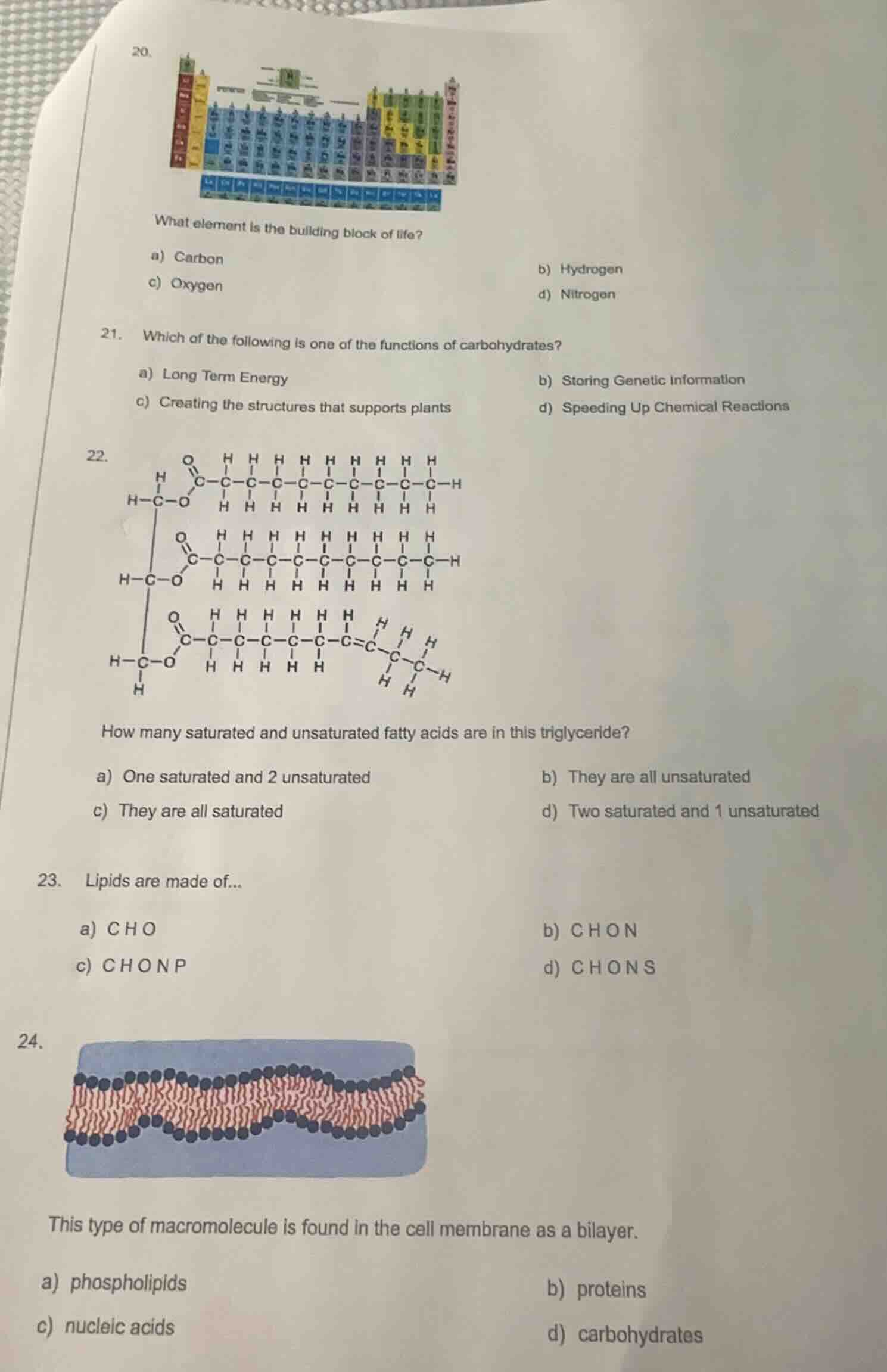
20.what element is the building block of life?a) carbonb) hydrogenc) oxygend) nitrogen21. which of the following is one of the functions of carbohydrates?a) long term energyb) storing genetic informationc) creating the structures that supports plantsd) speeding up chemical reactions22.$ce{h-c(h)-o-c(=o)-c(h2)-c(h2)-c(h2)-c(h2)-c(h2)-c(h2)-c(h2)-c(h2)-c(h2)-c(h2)-c(h3)}LXB0ce{h-c(h)-o-c(=o)-c(h2)-c(h2)-c(h2)-c(h2)-c(h2)-c(h2)-c(h)=c(h)-c(h2)-c(h3)}$how many saturated and unsaturated fatty acids are in this triglyceride?a) one saturated and 2 unsaturatedb) they are all unsaturatedc) they are all saturatedd) two saturated and 1 unsaturated23. lipids are made of...a) chob) chonc) chonpd) chons24.this type of macromolecule is found in the cell membrane as a bilayer.a) phospholipidsb) proteinsc) nucleic acidsd) carbohydrates
- Carbon forms the backbone of all organic molecules essential for life, making it the building block of life.
- Carbohydrates primarily provide short-term energy, but some (like cellulose) form plant structural supports. Long-term energy is from lipids, genetic info from nucleic acids, and reaction speed from enzymes (proteins).
- Saturated fatty acids have only single C-C bonds; unsaturated have at least one double C-C bond. The first two fatty acid chains have no double bonds, the third has one double bond.
- Lipids (fats, oils, etc.) are composed of Carbon (C), Hydrogen (H), and Oxygen (O). CHON is for proteins, CHONP for nucleic acids/phospholipids, CHONS for some modified proteins.
- Phospholipids have a hydrophilic head and hydrophobic tail, forming the bilayer structure of cell membranes.

Snap & solve any problem in the app
Get step-by-step solutions on Sovi AI
Photo-based solutions with guided steps
Explore more problems and detailed explanations
- a) Carbon
- c) Creating the structures that supports plants
- d) Two saturated and 1 unsaturated
- a) CHO
- a) phospholipids