QUESTION IMAGE
Question
© 2017 kuta software llc. all rights reserved.
surface area
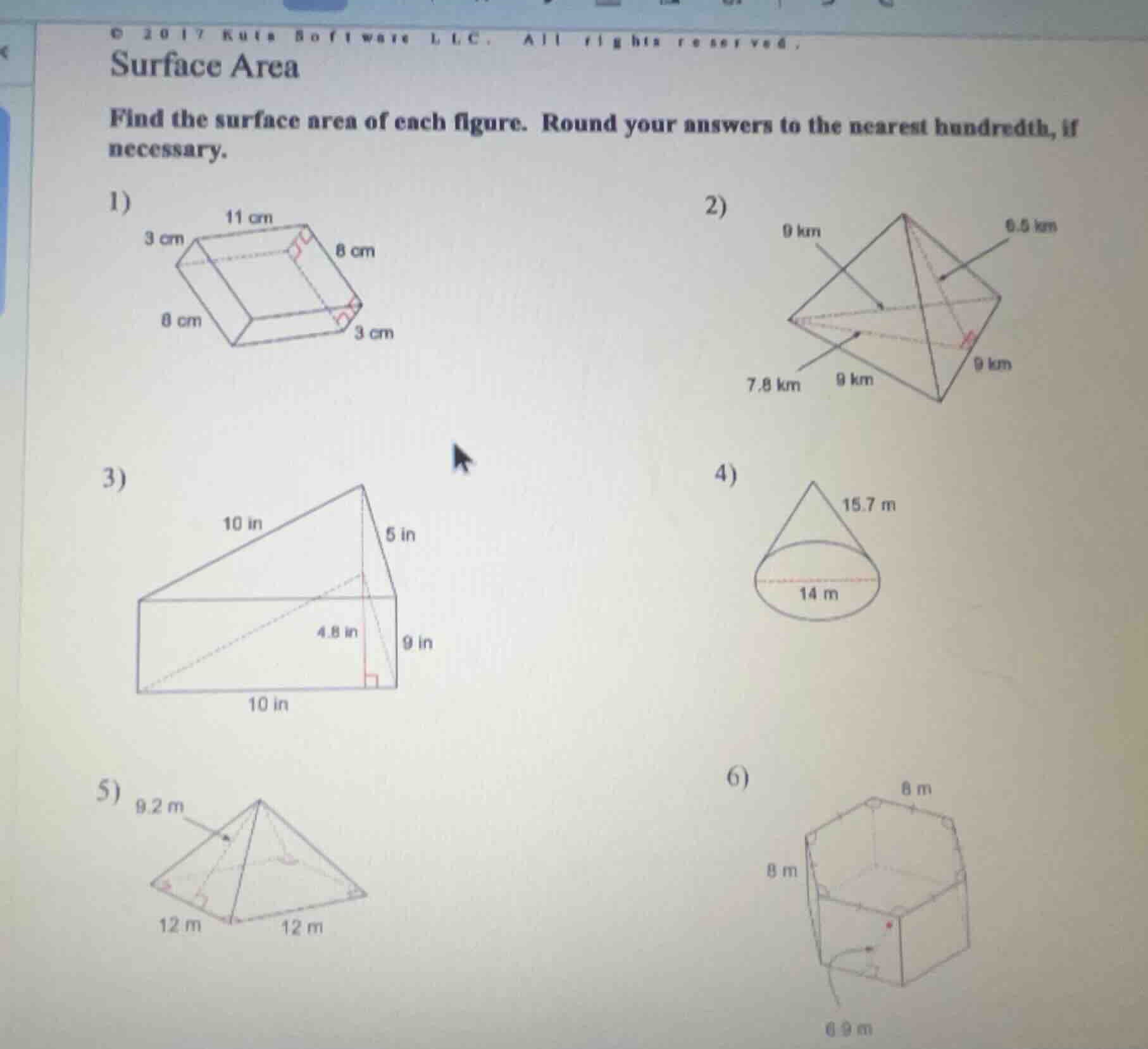
find the surface area of each figure. round your answers to the nearest hundredth, if necessary.
1)
figure of a prism with dimensions 3 cm, 11 cm, 8 cm, 8 cm, 3 cm
2)
figure of a pyramid-like figure with dimensions 9 km, 6.5 km, 7.8 km, 9 km, 9 km
3)
figure of a triangular prism with dimensions 10 in, 5 in, 4.8 in, 9 in, 10 in
4)
figure of a cone with diameter 14 m and slant height 15.7 m
5)
figure of a square pyramid with base 12 m and height 9.2 m
6)
figure of a pentagonal prism with side 8 m, height 8 m, and another dimension 6.9 m
---
1) Rectangular Prism
Step1: Recall surface area formula
Surface Area = $2(lw + lh + wh)$
Step2: Substitute values ($l=11, w=8, h=3$)
$2((11 \times 8) + (11 \times 3) + (8 \times 3))$
Step3: Calculate inside parentheses
$2(88 + 33 + 24) = 2(145)$
Step4: Compute final value
$2 \times 145 = 290$
---
2) Triangular Dipyramid (2 square pyramids)
Step1: Find base area (square)
Base Area = $9 \times 9 = 81$
Step2: Find 1 pyramid lateral area
Lateral Area (1 pyramid) = $4 \times \frac{1}{2} \times 9 \times 6.5 = 117$
Step3: Total surface area (2 pyramids, no shared base)
Total Area = $2 \times 117 = 234$
---
3) Triangular Prism
Step1: Calculate triangular base area
Base Area = $2 \times \frac{1}{2} \times 10 \times 4.8 = 48$
Step2: Calculate lateral face areas
Lateral Area = $(10 \times 9) + (10 \times 9) + (5 \times 9) = 90 + 90 + 45 = 225$
Step3: Sum base and lateral areas
Total Area = $48 + 225 = 273$
---
4) Cone (total surface area)
Step1: Find radius ($d=14$, so $r=7$)
$r = \frac{14}{2} = 7$
Step2: Calculate base area
Base Area = $\pi r^2 = \pi \times 7^2 = 49\pi \approx 153.94$
Step3: Calculate lateral (curved) area
Lateral Area = $\pi r l = \pi \times 7 \times 15.7 \approx 345.79$
Step4: Sum base and lateral areas
Total Area = $153.94 + 345.79 \approx 499.73$
---
5) Square Pyramid
Step1: Calculate base area (square)
Base Area = $12 \times 12 = 144$
Step2: Calculate lateral face area
Lateral Area = $4 \times \frac{1}{2} \times 12 \times 9.2 = 220.8$
Step3: Sum base and lateral areas
Total Area = $144 + 220.8 = 364.8$
---
6) Hexagonal Prism
Step1: Calculate base area (2 hexagons)
Area of 1 hexagon = $6 \times \frac{1}{2} \times 8 \times 6.9 = 165.6$; Total Base Area = $2 \times 165.6 = 331.2$
Step2: Calculate lateral face area
Lateral Area = $6 \times 8 \times 8 = 384$
Step3: Sum base and lateral areas
Total Area = $331.2 + 384 = 715.2$

Snap & solve any problem in the app
Get step-by-step solutions on Sovi AI
Photo-based solutions with guided steps
Explore more problems and detailed explanations
- $\boldsymbol{290\ \text{cm}^2}$
- $\boldsymbol{234\ \text{km}^2}$
- $\boldsymbol{273\ \text{in}^2}$
- $\boldsymbol{499.73\ \text{m}^2}$
- $\boldsymbol{364.8\ \text{m}^2}$
- $\boldsymbol{715.2\ \text{m}^2}$