QUESTION IMAGE
Question
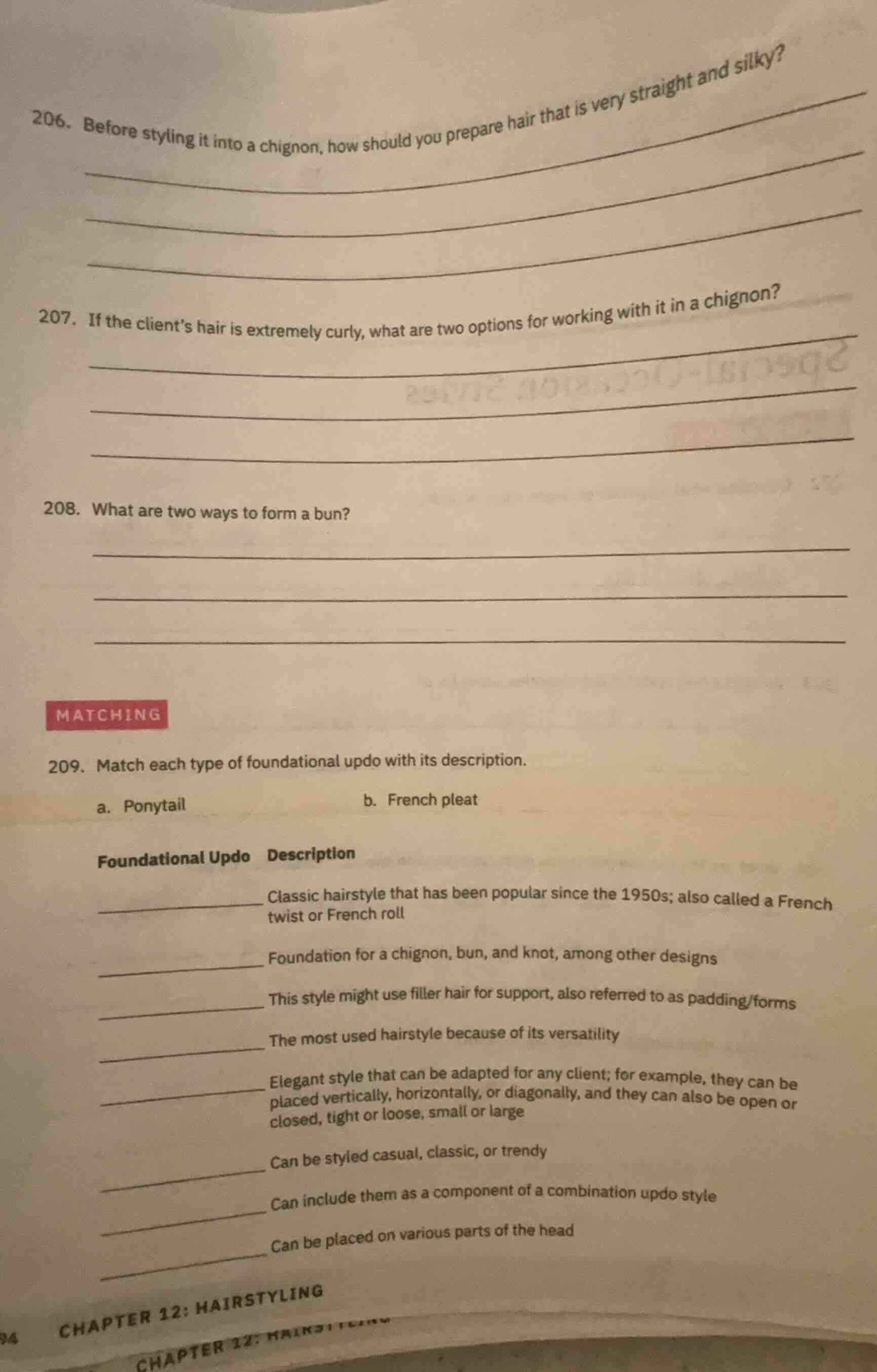
- before styling it into a chignon, how should you prepare hair that is very straight and silky?
- if the client’s hair is extremely curly, what are two options for working with it in a chignon?
- what are two ways to form a bun?
matching
- match each type of foundational updo with its description.
a. ponytail b. french pleat
foundational updo description
______ classic hairstyle that has been popular since the 1950s; also called a french twist or french roll
______ foundation for a chignon, bun, and knot, among other designs
______ this style might use filler hair for support, also referred to as padding/forms
______ the most used hairstyle because of its versatility
______ elegant style that can be adapted for any client; for example, they can be placed vertically, horizontally, or diagonally, and they can also be open or closed, tight or loose, small or large
______ can be styled casual, classic, or trendy
______ can include them as a component of a combination updo style
______ can be placed on various parts of the head
chapter 12: hairstyling
Question 206
To prepare very straight and silky hair for a chignon, adding texture is key. This can be done by teasing (backcombing) sections to create grip, or using texturizing products like mousse or dry shampoo to give the hair more volume and hold, as straight hair tends to be slippery and hard to pin.
For extremely curly hair in a chignon, options include either straightening the hair first (using a flat iron) to create a smoother base for the chignon, or embracing the curl by either leaving it curly and arranging the curls into the chignon (perhaps using pins to secure the curls) or partially straightening just the sections needed for the style while keeping some curl for texture. Another option could be using a curling iron to define the curls more uniformly before styling the chignon.
Two ways to form a bun: 1) The ponytail method: Gather hair into a ponytail, then wrap the hair around the base of the ponytail, securing with pins. 2) The twist method: Divide the hair into sections, twist each section, then wrap the twists around a central point (like the nape or crown) and secure with pins. Another common way is the braid - and - wrap method, but the two main simple ones are ponytail - based wrapping and twisting sections.

Snap & solve any problem in the app
Get step-by-step solutions on Sovi AI
Photo-based solutions with guided steps
Explore more problems and detailed explanations
Tease (backcomb) sections for grip or use texturizing products (mousse/dry shampoo) to add volume and hold.