QUESTION IMAGE
Question
21.
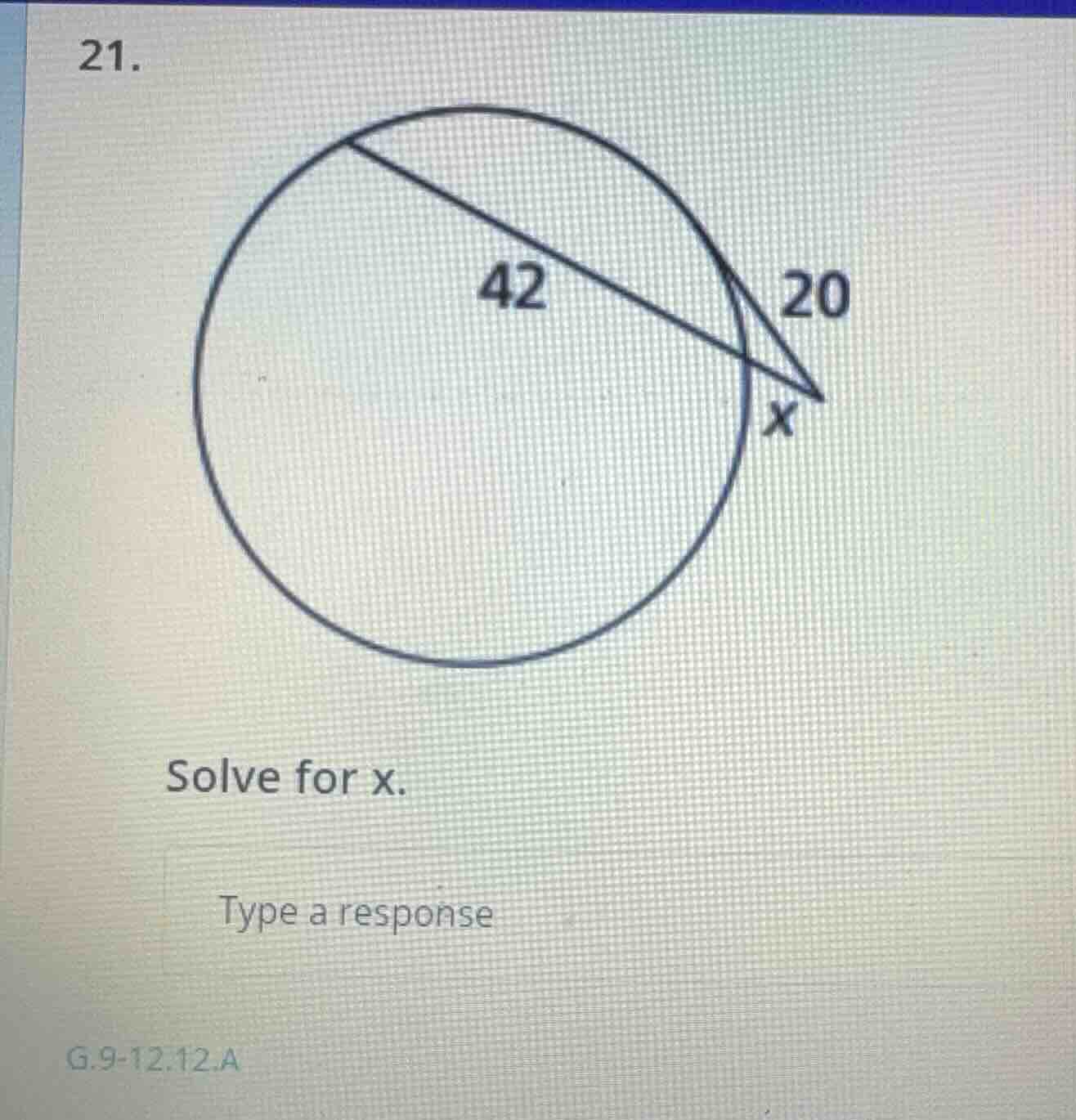
solve for x.
type a response
g.9-12.12.a
Step1: Recall the secant-secant theorem
The secant-secant theorem states that if a secant segment and a tangent segment are drawn from an external point to a circle, then the square of the length of the tangent segment is equal to the product of the lengths of the entire secant segment and its external part. In formula terms, if the tangent length is \( t \), the entire secant length is \( a + b \) (where \( a \) is the external part and \( b \) is the internal part), then \( t^{2}=a(a + b) \). Here, the tangent length is \( 20 \), the external part of the secant is \( x \), and the internal part is \( 42 \), so the entire secant length is \( x + 42 \). So we have the equation \( 20^{2}=x(x + 42) \).
Step2: Expand and simplify the equation
First, calculate \( 20^{2}=400 \). So the equation becomes \( 400=x^{2}+42x \). Rearranging it to standard quadratic form \( x^{2}+42x - 400 = 0 \).
Step3: Solve the quadratic equation
We can solve the quadratic equation \( x^{2}+42x - 400 = 0 \) using the quadratic formula \( x=\frac{-b\pm\sqrt{b^{2}-4ac}}{2a} \), where \( a = 1 \), \( b = 42 \), and \( c=- 400 \). First, calculate the discriminant \( \Delta=b^{2}-4ac=(42)^{2}-4\times1\times(-400)=1764 + 1600 = 3364 \). Then \( \sqrt{\Delta}=\sqrt{3364}=58 \). Now, \( x=\frac{-42\pm58}{2} \). We have two solutions: \( x_{1}=\frac{-42 + 58}{2}=\frac{16}{2}=8 \) and \( x_{2}=\frac{-42-58}{2}=\frac{-100}{2}=- 50 \). Since length cannot be negative, we discard \( x=-50 \).

Snap & solve any problem in the app
Get step-by-step solutions on Sovi AI
Photo-based solutions with guided steps
Explore more problems and detailed explanations
\( 8 \)