QUESTION IMAGE
Question
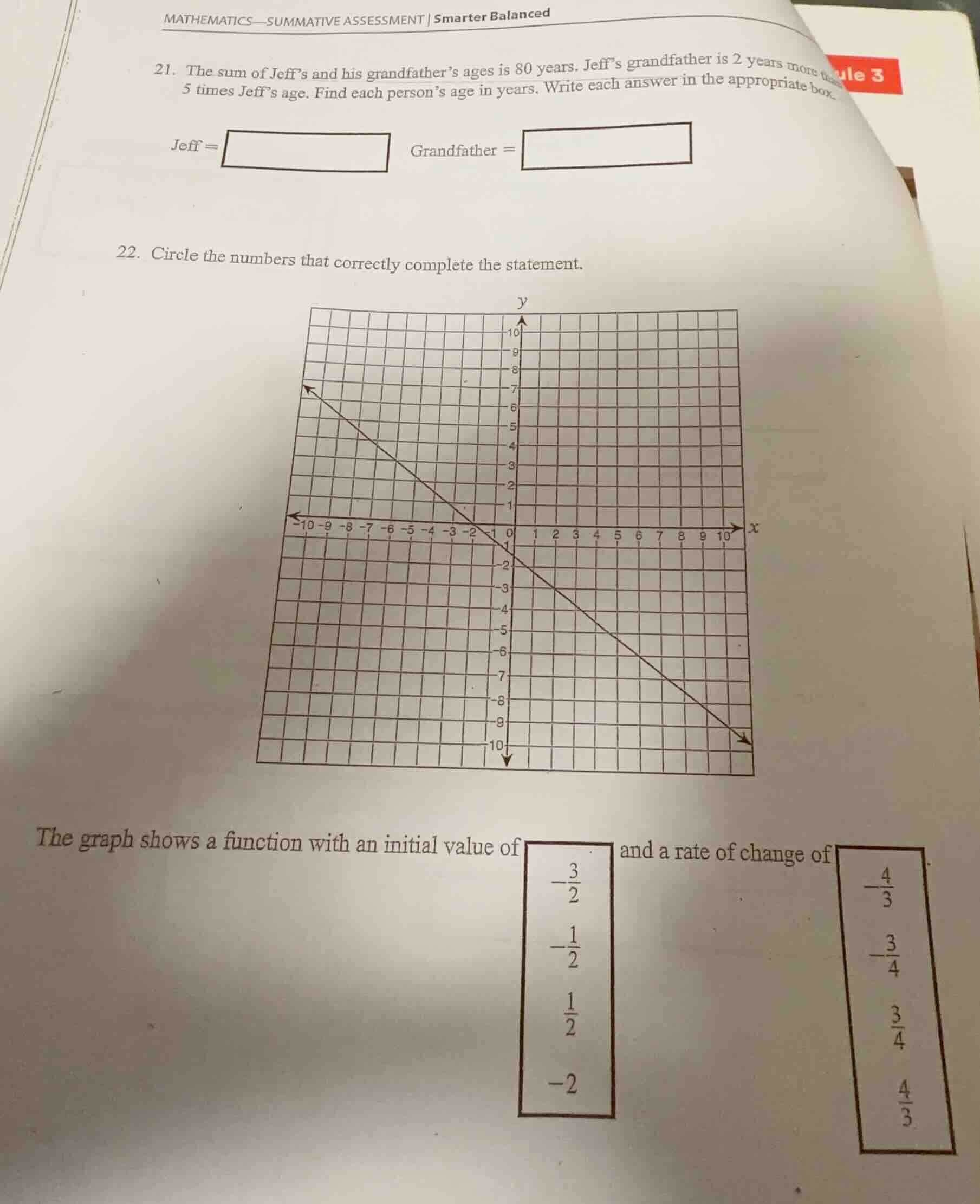
- the sum of jeff’s and his grandfather’s ages is 80 years. jeff’s grandfather is 2 years more than 5 times jeff’s age. find each person’s age in years. write each answer in the appropriate box. jeff = \boxed{} grandfather = \boxed{} 22. circle the numbers that correctly complete the statement. the graph shows a function with an initial value of \boxed{} and a rate of change of \boxed{}. the options for initial value are: $-\frac{3}{2}$, $-\frac{1}{2}$, $\frac{1}{2}$, $-2$; the options for rate of change are: $-\frac{4}{3}$, $-\frac{3}{4}$, $\frac{3}{4}$, $\frac{4}{3}$
Question 21
Step1: Define variables
Let Jeff's age be \( x \) years. Then his grandfather's age is \( 5x + 2 \) years (since grandfather is 2 years more than 5 times Jeff's age).
Step2: Set up the equation
The sum of their ages is 80, so \( x + (5x + 2) = 80 \).
Step3: Solve the equation
Simplify the left side: \( 6x + 2 = 80 \). Subtract 2 from both sides: \( 6x = 78 \). Divide both sides by 6: \( x = 13 \).
Step4: Find grandfather's age
Substitute \( x = 13 \) into \( 5x + 2 \): \( 5(13) + 2 = 65 + 2 = 67 \).
Step1: Find the initial value
The initial value of a function (y - intercept) is the value of \( y \) when \( x = 0 \). From the graph, when \( x = 0 \), \( y = - 2 \)? Wait, no, looking at the graph, when \( x = 0 \), the line crosses the y - axis at \( y=-1\)? Wait, no, let's re - examine. Wait, the points on the line: when \( x = 0 \), \( y=-1\)? Wait, no, the first table for initial value has - 2 as an option. Wait, maybe I made a mistake. Wait, the line passes through (0, - 1)? No, looking at the graph, when \( x = 0 \), the y - coordinate is - 1? Wait, no, the left box for initial value has options: \( -\frac{3}{2},-\frac{1}{2},\frac{1}{2}, - 2\). Wait, maybe the line passes through (0, - 2)? Wait, let's check two points. Let's take (0, - 1) and (3, - 3). The slope (rate of change) is \( \frac{-3 - (-1)}{3 - 0}=\frac{-2}{3}=-\frac{2}{3}\)? No, the right box has \( -\frac{4}{3},-\frac{3}{4},\frac{3}{4},\frac{4}{3}\). Wait, maybe another pair of points. Let's take (0, - 1) and (4, - 3). Then slope is \( \frac{-3+1}{4 - 0}=\frac{-2}{4}=-\frac{1}{2}\)? No. Wait, the initial value (y - intercept) is the value when \( x = 0 \). From the graph, when \( x = 0 \), the y - value is - 1? But the left box has - 2 as an option. Wait, maybe the line is \( y=-\frac{3}{4}x - 1\)? No, let's check the options again. The left box (initial value) options: \( -\frac{3}{2},-\frac{1}{2},\frac{1}{2}, - 2\). The right box (rate of change) options: \( -\frac{4}{3},-\frac{3}{4},\frac{3}{4},\frac{4}{3}\). Wait, maybe the line passes through (0, - 2) and (4, - 5). Then slope is \( \frac{-5 + 2}{4-0}=\frac{-3}{4}\). Wait, no. Wait, the correct initial value (y - intercept) is - 1? But it's not in the left box. Wait, maybe the line is \( y =-\frac{3}{4}x - 2\)? No, when \( x = 0 \), \( y=-2\). Then if \( x = 4 \), \( y=-2-\frac{3}{4}\times4=-2 - 3=-5\). Is (4, - 5) on the line? From the graph, when \( x = 4 \), \( y=-5\)? Yes, that seems right. So initial value (y - intercept) is - 2 (when \( x = 0 \), \( y=-2\)). Then the rate of change (slope) is \( \frac{-5 - (-2)}{4 - 0}=\frac{-3}{4}\). Wait, but the right box has \( -\frac{3}{4}\) as an option. Wait, the left box initial value: - 2 is an option. The right box rate of change: \( -\frac{3}{4}\) is an option. Wait, but let's confirm. If initial value is - 2 (y - intercept \( b=-2\)) and slope \( m =-\frac{3}{4}\), then the equation is \( y=-\frac{3}{4}x - 2\). Let's check \( x = 4 \): \( y=-\frac{3}{4}\times4-2=-3 - 2=-5\), which matches. \( x = 0 \): \( y=-2\), which matches. So initial value is - 2, rate of change is \( -\frac{3}{4}\). Wait, but the left box has - 2 as an option, and the right box has \( -\frac{3}{4}\) as an option.
Step1: Initial Value (y - intercept)
The initial value of a function is the value of \( y \) when \( x = 0 \). From the graph, when \( x = 0 \), \( y=-2 \), so the initial value is - 2.
Step2: Rate of Change (Slope)
The rate of change (slope) \( m=\frac{y_2 - y_1}{x_2 - x_1}\). Take two points on the line, e.g., \( (0, - 2) \) and \( (4, - 5) \). Then \( m=\frac{-5-(-2)}{4 - 0}=\frac{-3}{4}=-\frac{3}{4} \).

Snap & solve any problem in the app
Get step-by-step solutions on Sovi AI
Photo-based solutions with guided steps
Explore more problems and detailed explanations
Jeff = 13
Grandfather = 67