QUESTION IMAGE
Question
21.
use the given x on each triangle to express the pattern.
22.
practice 8.3 30-60-90 triangles
To solve for the unknown sides in these 45 - 45 - 90 triangles, we use the properties of 45 - 45 - 90 triangles: in a 45 - 45 - 90 triangle, the legs are equal, and the hypotenuse \(h\) is related to the leg length \(l\) by the formula \(h = l\sqrt{2}\), and if we know the hypotenuse \(h\), the leg length \(l=\frac{h}{\sqrt{2}}=\frac{h\sqrt{2}}{2}\)
Problem 21
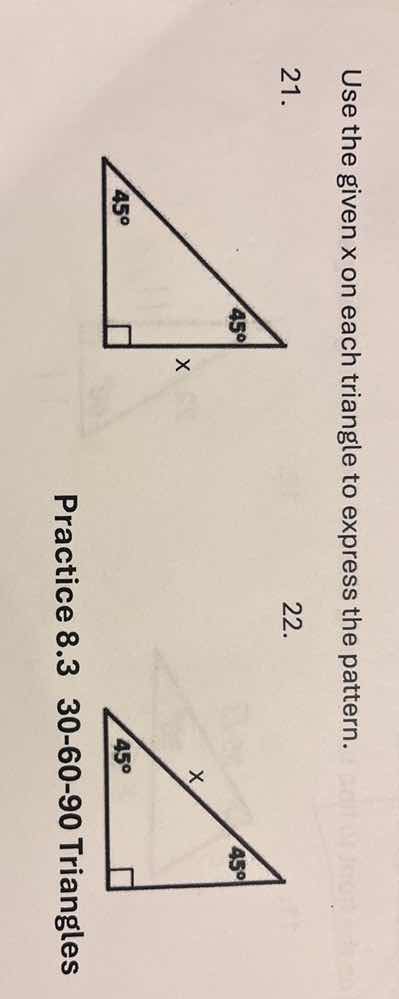
We have a 45 - 45 - 90 triangle with one leg of length \(x\) (the horizontal leg). Let the vertical leg be \(a\) and the hypotenuse be \(c\)
- Since it is a 45 - 45 - 90 triangle, the two legs are equal. So the vertical leg \(a=x\)
- To find the hypotenuse \(c\), we use the formula for the hypotenuse of a 45 - 45 - 90 triangle. If the leg length is \(l\), then the hypotenuse \(c = l\sqrt{2}\). Here \(l = x\), so the hypotenuse \(c=x\sqrt{2}\)
Problem 22
We have a 45 - 45 - 90 triangle with hypotenuse of length \(x\). Let the length of each leg be \(l\)
- For a 45 - 45 - 90 triangle, the relationship between the leg length \(l\) and the hypotenuse \(h\) is \(h=l\sqrt{2}\)
- We know \(h = x\), and we want to solve for \(l\). Rearranging the formula \(l=\frac{h}{\sqrt{2}}\)
- Rationalizing the denominator, we multiply the numerator and denominator by \(\sqrt{2}\): \(l=\frac{x\sqrt{2}}{2}\)
- Since it is a 45 - 45 - 90 triangle, the two legs are equal. So both legs have length \(\frac{x\sqrt{2}}{2}\)
Final Answers
Problem 21
- Vertical leg: \(\boldsymbol{x}\)
- Hypotenuse: \(\boldsymbol{x\sqrt{2}}\)
Problem 22
- Length of each leg: \(\boldsymbol{\frac{x\sqrt{2}}{2}}\)

Snap & solve any problem in the app
Get step-by-step solutions on Sovi AI
Photo-based solutions with guided steps
Explore more problems and detailed explanations
To solve for the unknown sides in these 45 - 45 - 90 triangles, we use the properties of 45 - 45 - 90 triangles: in a 45 - 45 - 90 triangle, the legs are equal, and the hypotenuse \(h\) is related to the leg length \(l\) by the formula \(h = l\sqrt{2}\), and if we know the hypotenuse \(h\), the leg length \(l=\frac{h}{\sqrt{2}}=\frac{h\sqrt{2}}{2}\)
Problem 21
We have a 45 - 45 - 90 triangle with one leg of length \(x\) (the horizontal leg). Let the vertical leg be \(a\) and the hypotenuse be \(c\)
- Since it is a 45 - 45 - 90 triangle, the two legs are equal. So the vertical leg \(a=x\)
- To find the hypotenuse \(c\), we use the formula for the hypotenuse of a 45 - 45 - 90 triangle. If the leg length is \(l\), then the hypotenuse \(c = l\sqrt{2}\). Here \(l = x\), so the hypotenuse \(c=x\sqrt{2}\)
Problem 22
We have a 45 - 45 - 90 triangle with hypotenuse of length \(x\). Let the length of each leg be \(l\)
- For a 45 - 45 - 90 triangle, the relationship between the leg length \(l\) and the hypotenuse \(h\) is \(h=l\sqrt{2}\)
- We know \(h = x\), and we want to solve for \(l\). Rearranging the formula \(l=\frac{h}{\sqrt{2}}\)
- Rationalizing the denominator, we multiply the numerator and denominator by \(\sqrt{2}\): \(l=\frac{x\sqrt{2}}{2}\)
- Since it is a 45 - 45 - 90 triangle, the two legs are equal. So both legs have length \(\frac{x\sqrt{2}}{2}\)
Final Answers
Problem 21
- Vertical leg: \(\boldsymbol{x}\)
- Hypotenuse: \(\boldsymbol{x\sqrt{2}}\)
Problem 22
- Length of each leg: \(\boldsymbol{\frac{x\sqrt{2}}{2}}\)