QUESTION IMAGE
Question
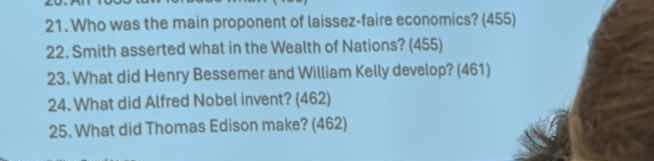
- who was the main proponent of laissez-faire economics? (455)
- smith asserted what in the wealth of nations? (455)
- what did henry bessemer and william kelly develop? (461)
- what did alfred nobel invent? (462)
- what did thomas edison make? (462)
Brief Explanations
- Laissez-faire economics centers on minimal government interference in markets, with Adam Smith as its foundational proponent.
- In The Wealth of Nations, Smith argued that a nation's wealth comes from the labor of its people (productive labor) rather than gold/silver, and that free markets guided by the "invisible hand" maximize prosperity.
- Henry Bessemer and William Kelly independently developed the Bessemer process, a method to mass-produce inexpensive steel by removing impurities from molten iron.
- Alfred Nobel invented dynamite, a stabilized explosive using nitroglycerin absorbed into inert materials, along with other related explosive devices.
- Thomas Edison developed and commercialized many innovations, most notably the practical, long-lasting incandescent light bulb, plus systems for electrical power distribution.

Snap & solve any problem in the app
Get step-by-step solutions on Sovi AI
Photo-based solutions with guided steps
Explore more problems and detailed explanations
- Adam Smith
- He asserted that the wealth of a nation is derived from the productive labor of its people, and that free, unregulated markets guided by the "invisible hand" lead to optimal economic prosperity.
- They developed the Bessemer process, a method for mass-producing low-cost steel.
- Alfred Nobel invented dynamite (and related explosive technologies).
- Thomas Edison created the practical, long-lasting incandescent light bulb, along with electrical power distribution systems.