QUESTION IMAGE
Question
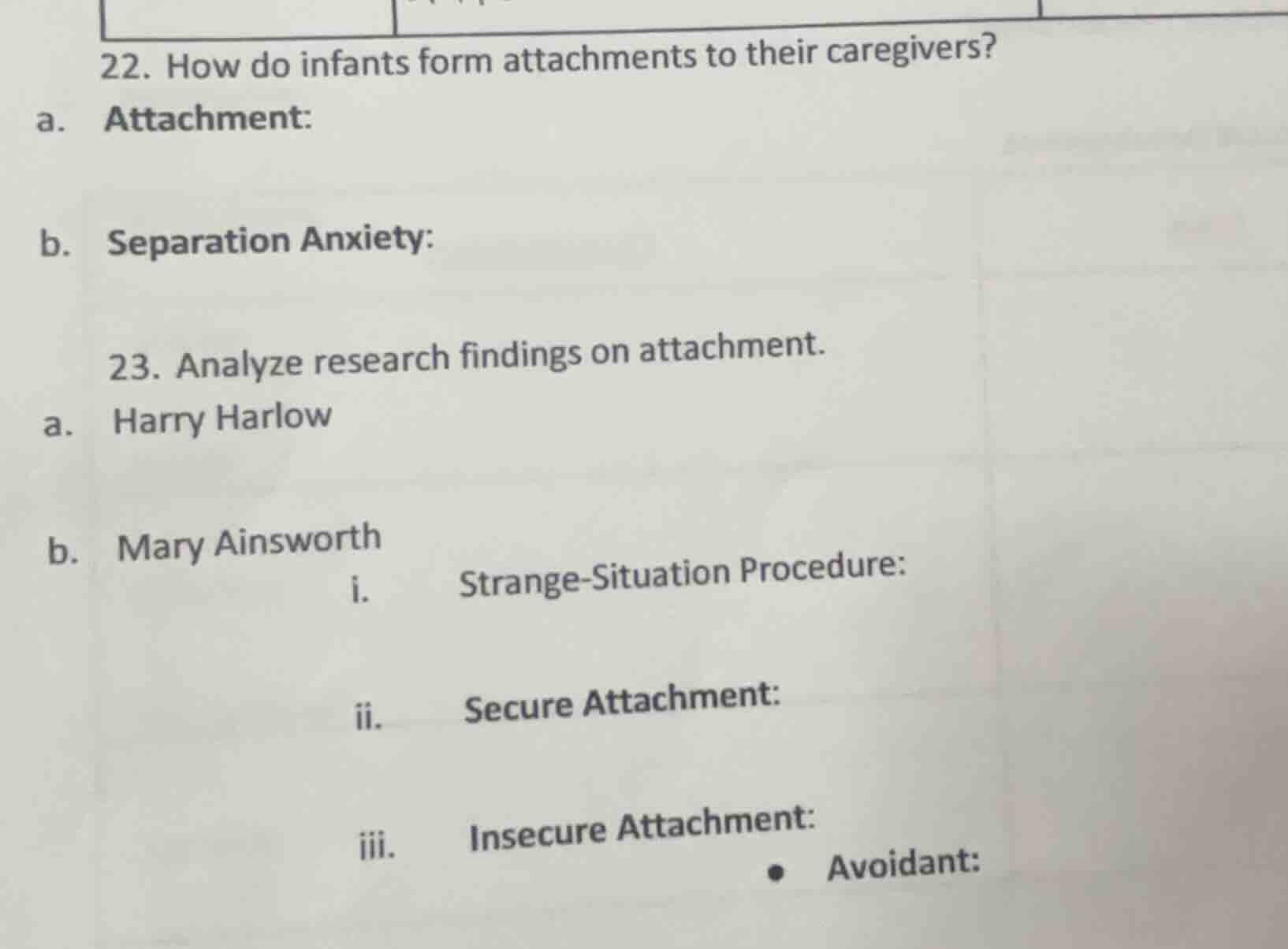
- how do infants form attachments to their caregivers?
a. attachment:
b. separation anxiety:
- analyze research findings on attachment.
a. harry harlow
b. mary ainsworth
i. strange - situation procedure:
ii. secure attachment:
iii. insecure attachment:
- avoidant:
For Question 22:
a. Attachment refers to the emotional bond infants form with caregivers, built through consistent, responsive care that meets their physical and emotional needs, serving as a secure base for exploration.
b. Separation Anxiety is a normal developmental stage (typically 6-8 months old) where infants distress when separated from their primary caregiver, signaling the formation of a meaningful attachment bond.
For Question 23:
a. Harry Harlow's rhesus monkey experiments showed that infants prioritize contact comfort (from a soft cloth "mother") over food (from a wire "mother"), proving attachment is rooted in emotional safety, not just nourishment.
b. i. The Strange-Situation Procedure is a standardized lab observation where infants experience caregiver separation/reunion with a stranger, to assess attachment styles.
ii. Secure Attachment: Infants distress when caregiver leaves, seek comfort on reunion, and use caregiver as a secure base; occurs when caregivers are consistently responsive.
iii. Insecure Attachment (Avoidant): Infants show little distress when separated, avoid or ignore caregiver on reunion; linked to unresponsive or rejecting caregiver behavior.

Snap & solve any problem in the app
Get step-by-step solutions on Sovi AI
Photo-based solutions with guided steps
Explore more problems and detailed explanations
Question 22
a. Attachment: An emotional bond formed via consistent, responsive caregiver care, acting as a secure base for infants to explore their environment.
b. Separation Anxiety: A normal developmental response (6-8 months) where infants feel distress when separated from their attached caregiver, indicating a formed attachment bond.
Question 23
a. Harry Harlow: His monkey studies demonstrated that attachment relies more on contact comfort (emotional warmth) than just food provision, challenging the idea that attachment is driven solely by nourishment.
b. i. Strange-Situation Procedure: A standardized observational test to classify infant attachment styles by observing reactions to caregiver separation, stranger presence, and reunion.
ii. Secure Attachment: Infants display distress on caregiver separation, seek and accept comfort on reunion, and use the caregiver as a safe base for exploration; tied to consistent, responsive care.
iii. Insecure Attachment (Avoidant): Infants show minimal distress during separation, avoid or are indifferent to the caregiver upon reunion; associated with unresponsive or emotionally unavailable caregiving.