QUESTION IMAGE
Question
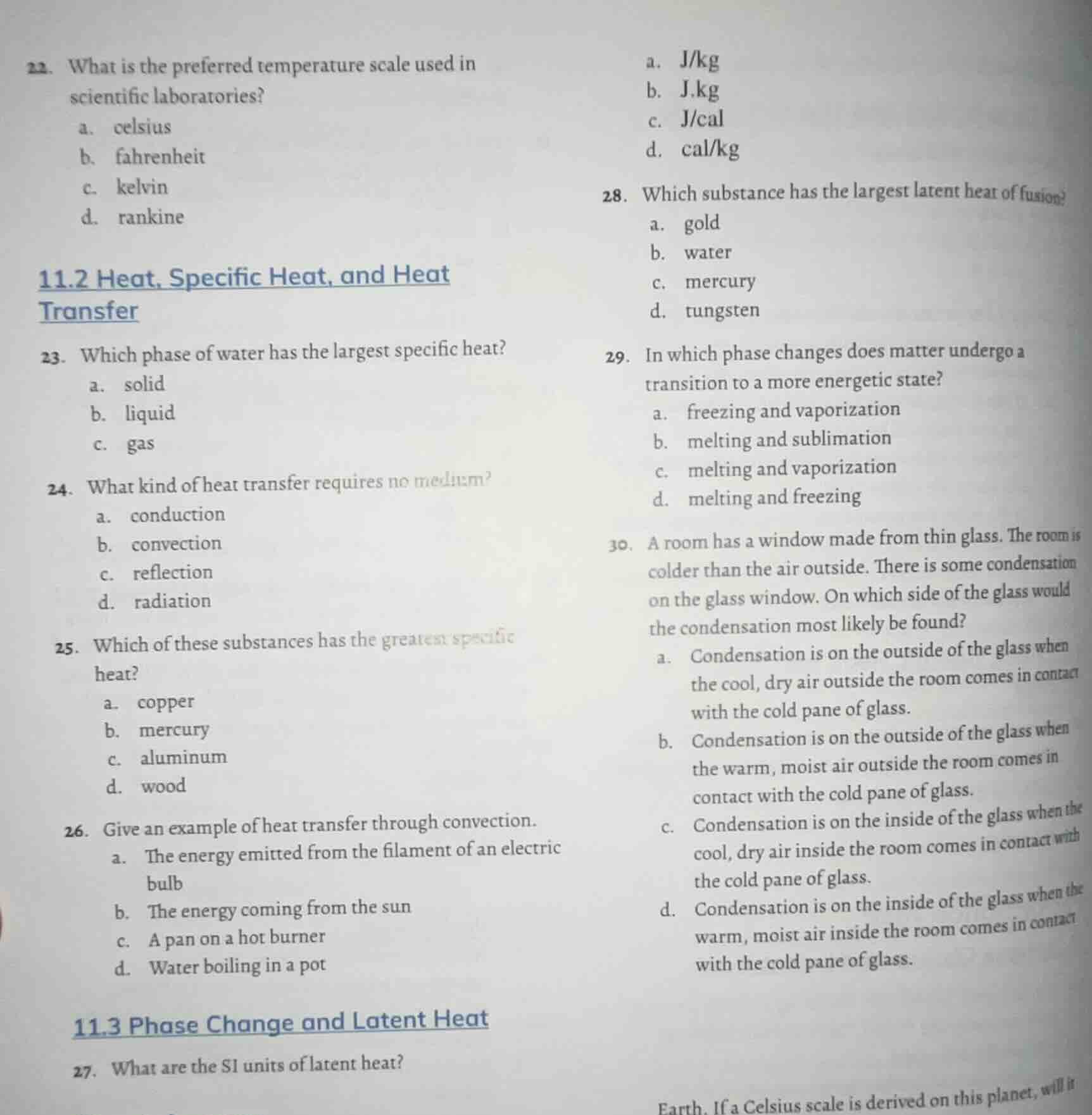
- what is the preferred temperature scale used in scientific laboratories?
a. celsius
b. fahrenheit
c. kelvin
d. rankine
11.2 heat, specific heat, and heat transfer
- which phase of water has the largest specific heat?
a. solid
b. liquid
c. gas
- what kind of heat transfer requires no medium?
a. conduction
b. convection
c. reflection
d. radiation
- which of these substances has the greatest specific heat?
a. copper
b. mercury
c. aluminum
d. wood
- give an example of heat transfer through convection.
a. the energy emitted from the filament of an electric bulb
b. the energy coming from the sun
c. a pan on a hot burner
d. water boiling in a pot
11.3 phase change and latent heat
- what are the si units of latent heat?
a. j/kg
b. j.kg
c. j/cal
d. cal/kg
- which substance has the largest latent heat of fusion?
a. gold
b. water
c. mercury
d. tungsten
- in which phase changes does matter undergo a transition to a more energetic state?
a. freezing and vaporization
b. melting and sublimation
c. melting and vaporization
d. melting and freezing
- a room has a window made from thin glass. the room is colder than the air outside. there is some condensation on the glass window. on which side of the glass would the condensation most likely be found?
a. condensation is on the outside of the glass when the cool, dry air outside the room comes in contact with the cold pane of glass.
b. condensation is on the outside of the glass when the warm, moist air outside the room comes in contact with the cold pane of glass.
c. condensation is on the inside of the glass when the cool, dry air inside the room comes in contact with the cold pane of glass.
d. condensation is on the inside of the glass when the warm, moist air inside the room comes in contact with the cold pane of glass.
earth. if a celsius scale is derived on this planet, will it
- Scientific labs use Kelvin as the standard temperature scale.
- Liquid water has the highest specific heat among water's phases.
- Radiation transfers heat without a medium.
- Wood has a far higher specific heat than the listed metals.
- Boiling water uses convection (fluid movement transfers heat).
- Latent heat is energy per unit mass, SI unit is J/kg.
- Water has an extremely high latent heat of fusion.
- Melting (solid to liquid) and vaporization (liquid to gas) increase particle energy.
- Warm, moist indoor air cools on cold glass, condensing inside the room.

Snap & solve any problem in the app
Get step-by-step solutions on Sovi AI
Photo-based solutions with guided steps
Explore more problems and detailed explanations
- c. kelvin
- b. liquid
- d. radiation
- d. wood
- d. Water boiling in a pot
- a. J/kg
- b. water
- c. melting and vaporization
- d. Condensation is on the inside of the glass when the warm, moist air inside the room comes in contact with the cold pane of glass.