QUESTION IMAGE
Question
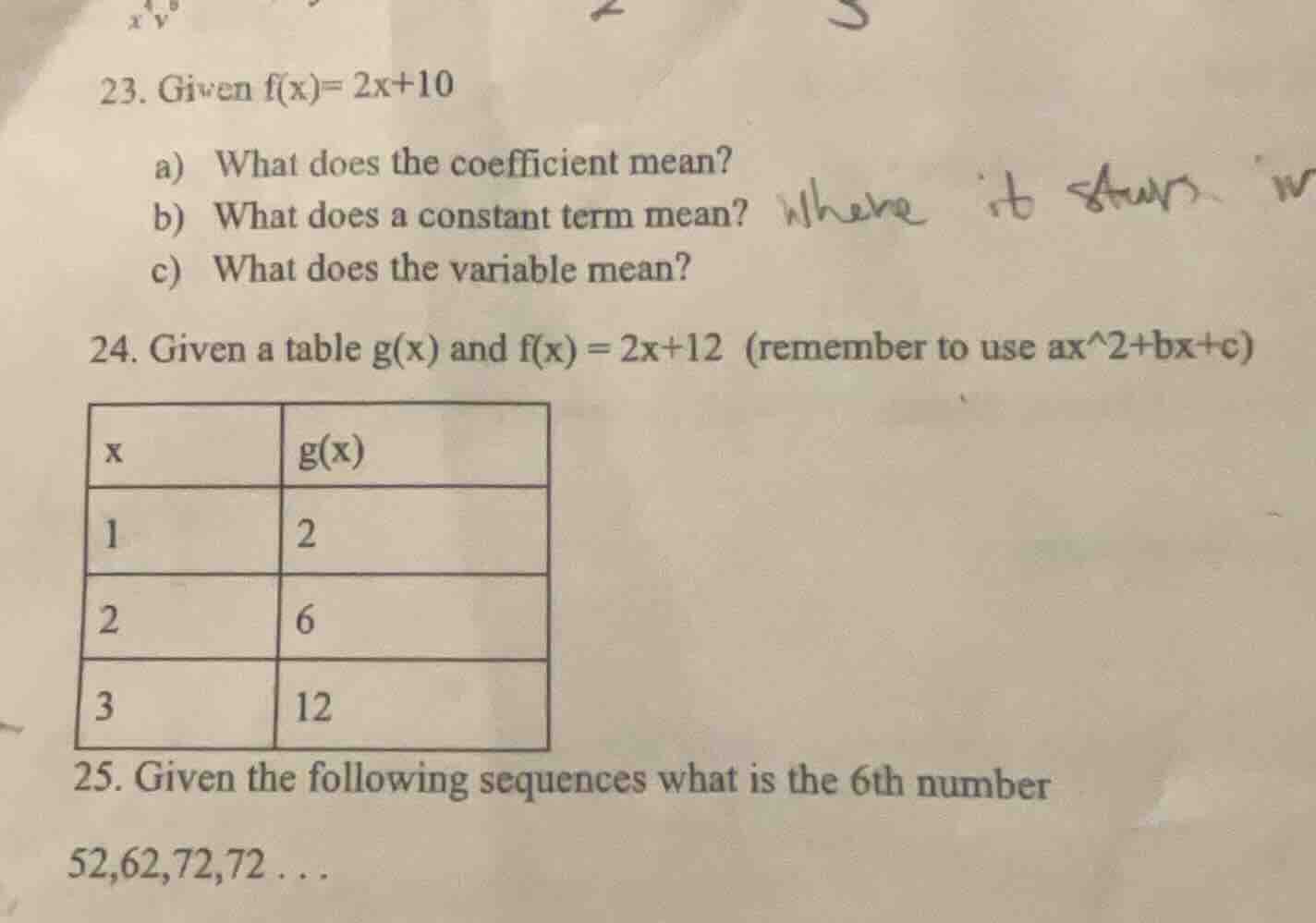
- given f(x)= 2x+10
a) what does the coefficient mean?
b) what does a constant term mean?
c) what does the variable mean?
- given a table g(x) and f(x) = 2x+12 (remember to use ax^2+bx+c)
| x | g(x) |
| 1 | 2 |
| 2 | 6 |
| 3 | 12 |
- given the following sequences what is the 6th number
52,62,72,72...
Question 23
a) In the linear function $f(x)=2x+10$, the coefficient 2 is the slope, representing the rate of change of $f(x)$ with respect to $x$: for every 1-unit increase in $x$, $f(x)$ increases by 2.
b) The constant term 10 is the y-intercept: it is the value of $f(x)$ when $x=0$.
c) The variable $x$ is the independent input value that can take on different numerical values, and $f(x)$ depends on $x$.
Step1: Set up quadratic equations
For $g(x)=ax^2+bx+c$, substitute $(1,2)$:
$a(1)^2 + b(1) + c = 2 \implies a + b + c = 2$
Substitute $(2,6)$:
$a(2)^2 + b(2) + c = 6 \implies 4a + 2b + c = 6$
Substitute $(3,12)$:
$a(3)^2 + b(3) + c = 12 \implies 9a + 3b + c = 12$
Step2: Eliminate c to find a,b
Subtract first equation from second:
$(4a+2b+c)-(a+b+c)=6-2 \implies 3a + b = 4$
Subtract second equation from third:
$(9a+3b+c)-(4a+2b+c)=12-6 \implies 5a + b = 6$
Step3: Solve for a
Subtract the new first equation from the new second:
$(5a+b)-(3a+b)=6-4 \implies 2a=2 \implies a=1$
Step4: Solve for b
Substitute $a=1$ into $3a + b = 4$:
$3(1)+b=4 \implies b=1$
Step5: Solve for c
Substitute $a=1,b=1$ into $a+b+c=2$:
$1+1+c=2 \implies c=0$
Step6: Define g(x)
Substitute $a=1,b=1,c=0$ into $ax^2+bx+c$
Step1: Identify sequence pattern
First three terms: 52, 62, 72 (each increases by 10). The fourth term is 72, so the pattern shifts to holding constant after the third term.
Step2: List terms up to 6th
Term1:52, Term2:62, Term3:72, Term4:72, Term5:72, Term6:72

Snap & solve any problem in the app
Get step-by-step solutions on Sovi AI
Photo-based solutions with guided steps
Explore more problems and detailed explanations
a) It is the slope (rate of change: $f(x)$ rises by 2 per $x$ increase of 1).
b) It is the y-intercept (value of $f(x)$ when $x=0$).
c) It is the independent input variable for the function.
---