QUESTION IMAGE
Question
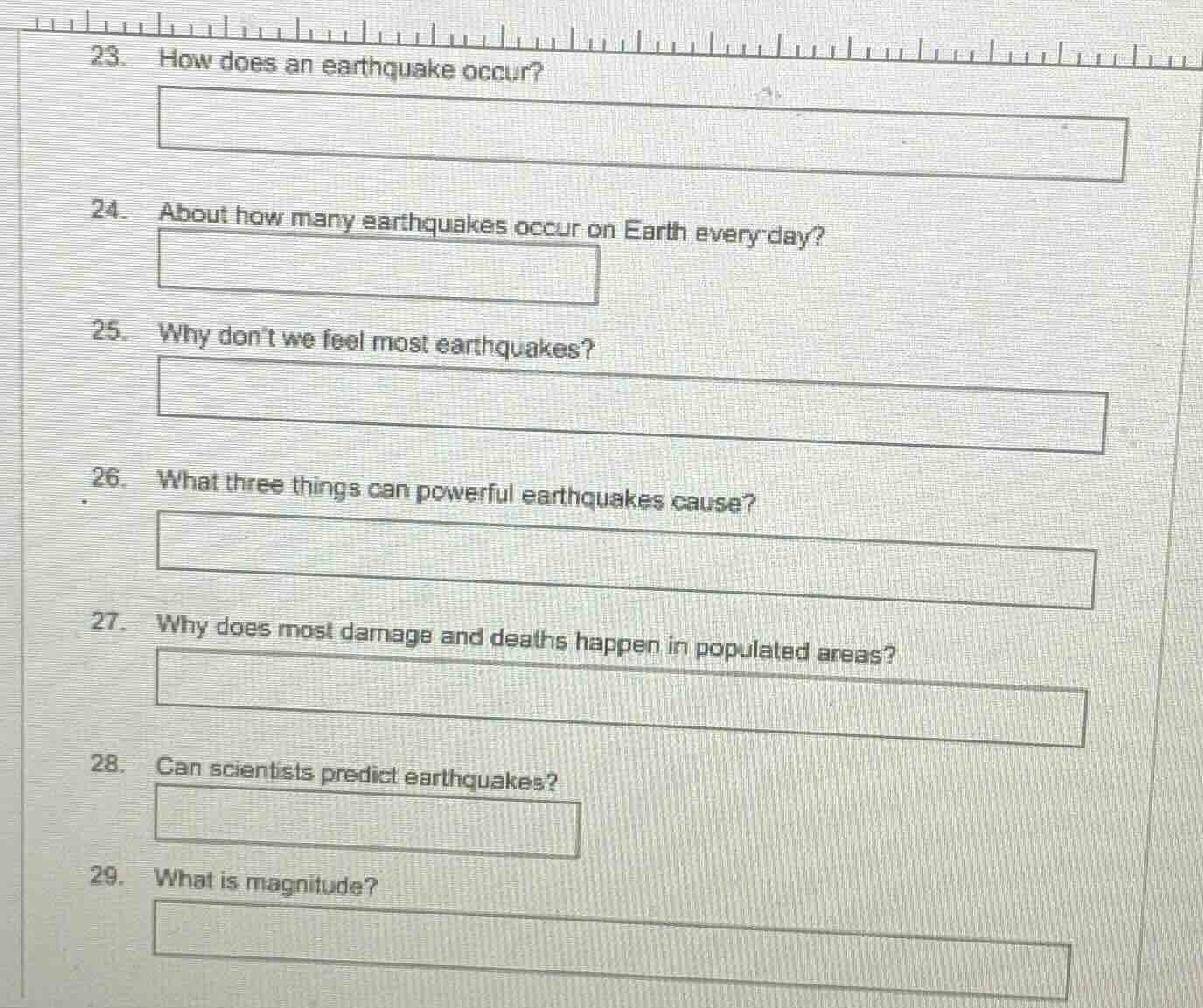
- how does an earthquake occur?
- about how many earthquakes occur on earth every day?
- why dont we feel most earthquakes?
- what three things can powerful earthquakes cause?
- why does most damage and deaths happen in populated areas?
- can scientists predict earthquakes?
- what is magnitude?
Brief Explanations
- Explains the geological mechanism of earthquakes.
- Cites the average daily global earthquake count from geological data.
- Covers factors like quake size, depth, and human location.
- Lists common destructive outcomes of strong earthquakes.
- Links population density to infrastructure and human presence.
- States the current scientific capability for earthquake prediction.
- Defines the measurement scale for earthquake strength.

Snap & solve any problem in the app
Get step-by-step solutions on Sovi AI
Photo-based solutions with guided steps
Explore more problems and detailed explanations
- Earthquakes occur when built-up stress in Earth's tectonic plates is suddenly released, causing the plates to shift and send seismic waves through the crust.
- About 500,000 earthquakes occur on Earth every day (most are too small to detect without instruments).
- Most earthquakes are either too low in magnitude, too deep underground, or occur in remote, unpopulated areas, so their seismic energy does not reach us in a noticeable way.
- Powerful earthquakes can cause building collapses, tsunamis, and landslides (or ground ruptures, fires from broken gas lines).
- Populated areas have dense clusters of buildings, infrastructure, and people; when an earthquake hits, there is more property to damage and more people at risk of injury or death from collapsing structures or hazards like tsunamis.
- No, scientists cannot reliably predict exactly when or where an earthquake will occur. They can identify areas at high risk and estimate long-term probabilities, but not precise short-term forecasts.
- Magnitude is a measure of the total amount of energy released by an earthquake, typically quantified using scales like the Richter scale or Moment Magnitude Scale (Mw).