QUESTION IMAGE
Question
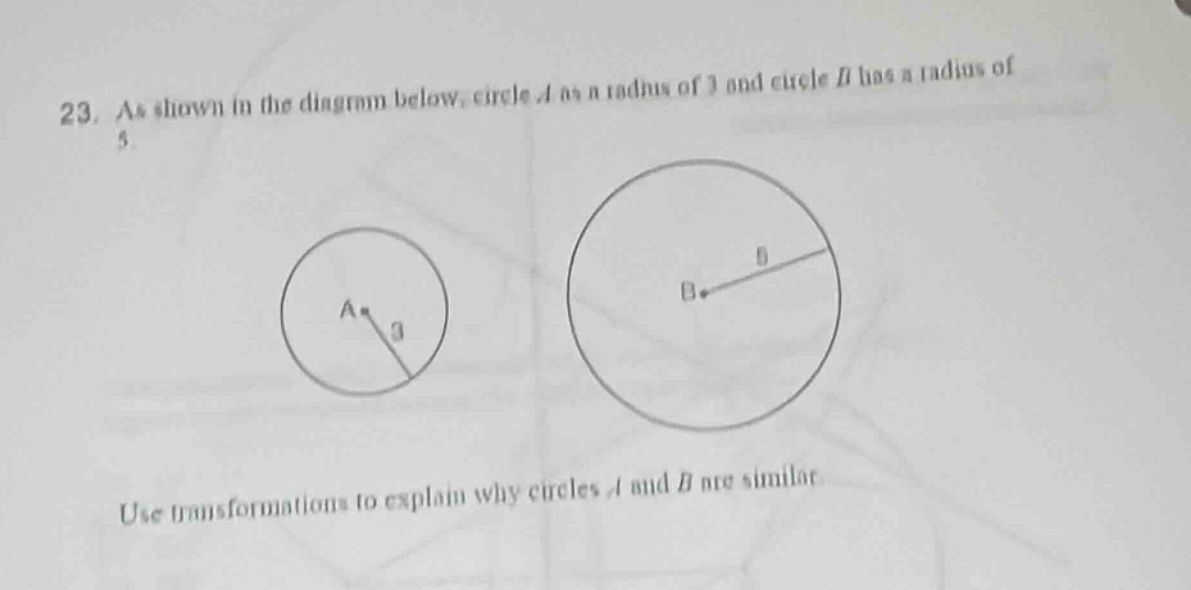
- as shown in the diagram below, circle a has a radius of 3 and circle b has a radius of 5.
use transformations to explain why circles a and b are similar.
Step1: Identify the transformation type
To show similarity, we can use a dilation (scaling) transformation. A dilation is a transformation that changes the size of a figure but not its shape.
Step2: Determine the scale factor
The radius of circle \( A \) is \( r_A = 3 \) and the radius of circle \( B \) is \( r_B = 5 \). The scale factor \( k \) for dilating circle \( A \) to circle \( B \) is \( k=\frac{r_B}{r_A}=\frac{5}{3}\).
Step3: Apply the dilation
If we apply a dilation with center at an appropriate point (it can be any point, but typically we can consider a translation first if needed, but since we are only concerned with similarity via dilation, the key is the scaling) and scale factor \( \frac{5}{3} \) to circle \( A \), the radius of circle \( A \) (which is 3) will be scaled to \( 3\times\frac{5}{3}=5 \), which is the radius of circle \( B \). Since a dilation preserves the shape (all circles are similar by definition, and dilation is a similarity transformation), circle \( A \) after dilation will coincide with circle \( B \) in shape (and size after dilation), showing they are similar. Also, we can consider translation: first, translate circle \( A \) so that its center coincides with the center of circle \( B \) (though this is not necessary for similarity, but for the visual alignment). Then apply the dilation. But the main transformation for similarity here is dilation.

Snap & solve any problem in the app
Get step-by-step solutions on Sovi AI
Photo-based solutions with guided steps
Explore more problems and detailed explanations
To show circles \( A \) and \( B \) are similar, we can use a dilation (a similarity transformation). The radius of circle \( A \) is \( 3 \), and the radius of circle \( B \) is \( 5 \). If we apply a dilation with scale factor \( \boldsymbol{\frac{5}{3}} \) to circle \( A \), its radius \( 3 \) scales to \( 3\times\frac{5}{3}=5 \) (matching circle \( B \)’s radius). Dilation preserves shape, so the dilated circle \( A \) is congruent in shape (and scaled in size) to circle \( B \), proving they are similar. (We can also translate circle \( A \) to align centers first, but dilation alone establishes similarity.)