QUESTION IMAGE
Question
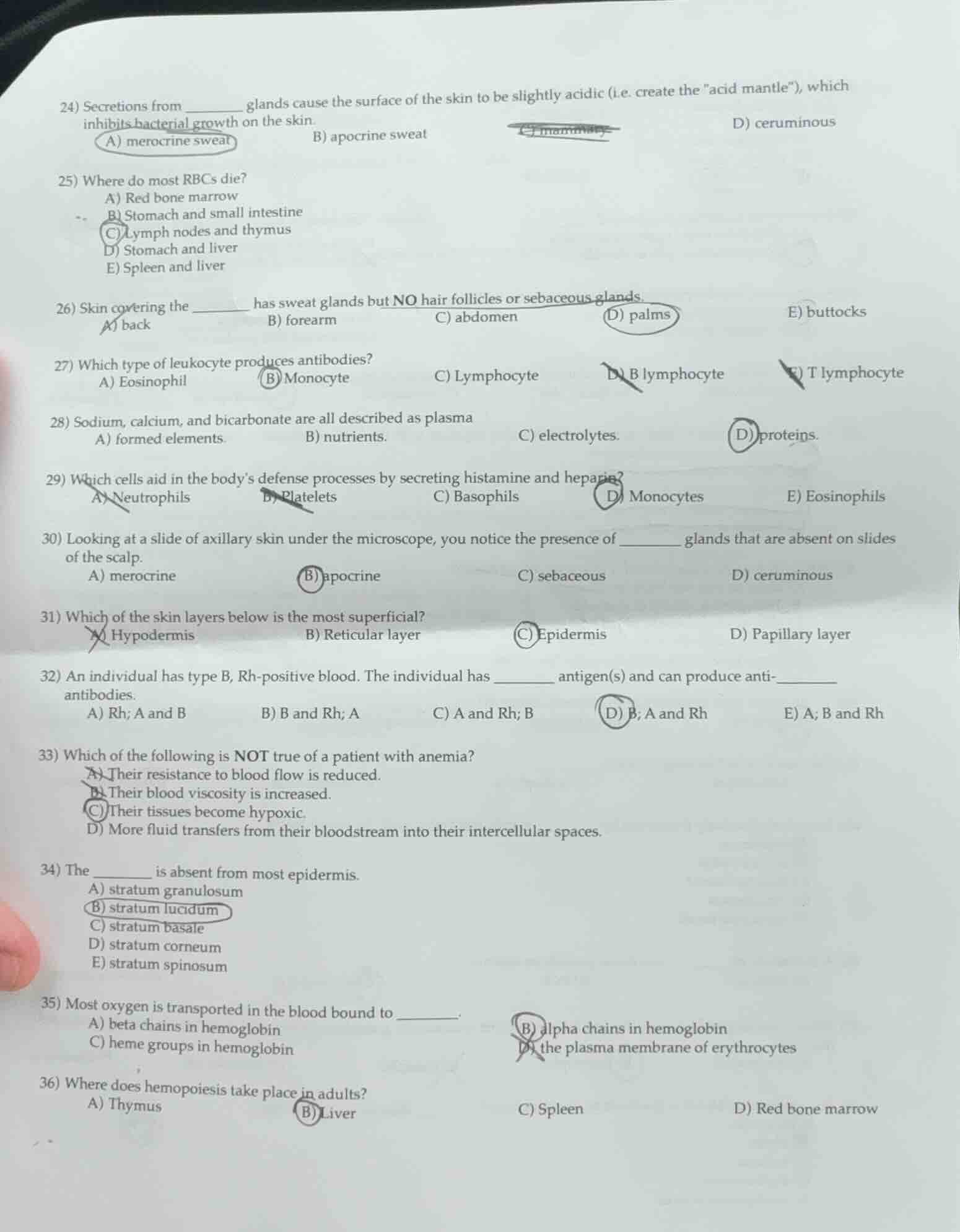
- secretions from ______ glands cause the surface of the skin to be slightly acidic (i.e. create the \acid mantle\), which inhibits bacterial growth on the skin.
a) merocrine sweat
b) apocrine sweat
d) ceruminous
- where do most rbcs die?
a) red bone marrow
b) stomach and small intestine
c) lymph nodes and thymus
d) stomach and liver
e) spleen and liver
- skin covering the ______ has sweat glands but no hair follicles or sebaceous glands.
a) back
b) forearm
c) abdomen
d) palms
e) buttocks
- which type of leukocyte produces antibodies?
a) eosinophil
b) monocyte
c) lymphocyte
d) b lymphocyte
e) t lymphocyte
- sodium, calcium, and bicarbonate are all described as plasma
a) formed elements.
b) nutrients.
c) electrolytes.
d) proteins.
- which cells aid in the bodys defense processes by secreting histamine and heparin?
a) neutrophils
b) platelets
c) basophils
d) monocytes
e) eosinophils
- looking at a slide of axillary skin under the microscope, you notice the presence of ______ glands that are absent on slides of the scalp.
a) merocrine
b) apocrine
c) sebaceous
d) ceruminous
- which of the skin layers below is the most superficial?
a) hypodermis
b) reticular layer
c) epidermis
d) papillary layer
- an individual has type b, rh-positive blood. the individual has ____ antigen(s) and can produce anti-____ antibodies.
a) rh; a and b
b) b and rh; a
c) a and rh; b
d) b; a and rh
e) a; b and rh
- which of the following is not true of a patient with anemia?
a) their resistance to blood flow is reduced.
b) their blood viscosity is increased.
c) their tissues become hypoxic.
d) more fluid transfers from their bloodstream into their intercellular spaces.
- the ______ is absent from most epidermis.
a) stratum granulosum
b) stratum lucidum
c) stratum basale
d) stratum corneum
e) stratum spinosum
- most oxygen is transported in the blood bound to ______.
a) beta chains in hemoglobin
b) alpha chains in hemoglobin
c) heme groups in hemoglobin
d) the plasma membrane of erythrocytes
- where does hemopoiesis take place in adults?
a) thymus
b) liver
c) spleen
d) red bone marrow
- Merocrine sweat glands secrete a dilute, acidic sweat that forms the skin's acid mantle to inhibit bacteria.
- Red blood cells (RBCs) are primarily broken down in the spleen (for old/damaged RBCs) and liver (for processing hemoglobin).
- Palm skin has eccrine (sweat) glands but lacks hair follicles and sebaceous glands.
- B lymphocytes (B cells) differentiate into plasma cells that produce antibodies for immune responses.
- Sodium, calcium, and bicarbonate are charged ions that function as plasma electrolytes.
- Basophils secrete histamine (for inflammation) and heparin (an anticoagulant) during immune responses.
- Apocrine sweat glands are found in axillary (armpit) skin but not on the scalp.
- The epidermis is the outermost, most superficial layer of the skin.
- Type B, Rh-positive blood has B and Rh antigens; the body produces anti-A antibodies (does not make antibodies to its own antigens).
- Anemia reduces RBC/hemoglobin levels, lowering blood viscosity (not increasing it), reducing flow resistance, causing tissue hypoxia, and shifting fluid to intercellular spaces.
- The stratum lucidum is a thin, translucent layer only present in thick skin (e.g., palms, soles), absent from most thin epidermis.
- Most oxygen in blood binds to the heme groups within hemoglobin molecules in RBCs.
- In adults, hemopoiesis (blood cell formation) primarily occurs in red bone marrow.

Snap & solve any problem in the app
Get step-by-step solutions on Sovi AI
Photo-based solutions with guided steps
Explore more problems and detailed explanations
- A) merocrine sweat
- E) Spleen and liver
- D) palms
- D) B lymphocyte
- C) electrolytes
- C) Basophils
- B) apocrine
- C) Epidermis
- B) B and Rh; A
- B) Their blood viscosity is increased.
- B) stratum lucidum
- C) heme groups in hemoglobin
- D) Red bone marrow