QUESTION IMAGE
Question
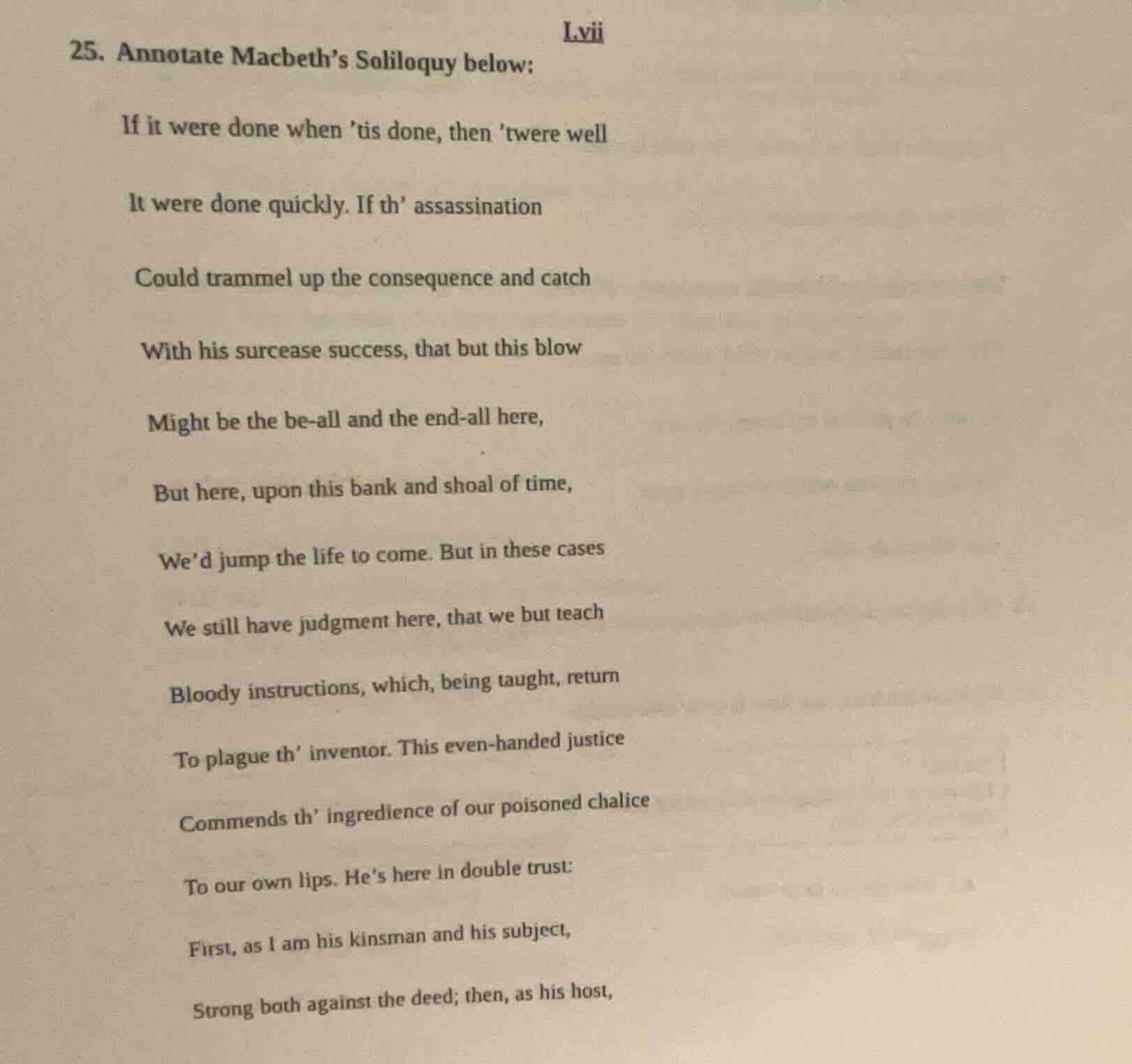
- annotate macbeth’s soliloquy below:
if it were done when ’tis done, then ’twere well
it were done quickly. if th’ assassination
could trammel up the consequence and catch
with his surcease success, that but this blow
might be the be - all and the end - all here,
but here, upon this bank and shoal of time,
we’d jump the life to come. but in these cases
we still have judgment here, that we but teach
bloody instructions, which, being taught, return
to plague th’ inventor. this even - handed justice
commends th’ ingredience of our poisoned chalice
to our own lips. he’s here in double trust:
first, as i am his kinsman and his subject,
strong both against the deed; then, as his host,
- Line 1 - 2: "If it were done when ’tis done, then ’twere well / It were done quickly." Macbeth contemplates the murder of Duncan. He wishes the deed (assassination) could be over immediately after doing it, so there are no lingering consequences. The repetition of "done" emphasizes his desire for finality and the urgency to get it over with.
- Line 3 - 5: "If th’ assassination / Could trammel up the consequence and catch / With his surcease success, that but this blow / Might be the be - all and the end - all here," "Trammel up" means to restrain or contain. Macbeth imagines that if the assassination could contain all its consequences (like a net catching things) and if the act of stopping (surcease) brought success, then this single blow (the murder) would be the beginning and end of the matter. He is thinking about the ideal scenario where the murder has no further repercussions.
- Line 6 - 8: "But here, upon this bank and shoal of time, / We’d jump the life to come. But in these cases / We still have judgment here, that we but teach" "Bank and shoal of time" is a metaphor for the present moment in the stream of time. Macbeth considers that if they commit the murder, they might be "jumping" (skipping) the afterlife (life to come) because of the sin. However, he also knows that in this world, there is judgment (from God or society) and that by committing murder, they are teaching others (and themselves) about violent actions.
- Line 9 - 11: "Bloody instructions, which, being taught, return / To plague th’ inventor. This even - handed justice / Commends th’ ingredience of our poisoned chalice" "Bloody instructions" refers to the violent act of murder. Macbeth realizes that when people are taught (by example) to use violence, that violence will come back to haunt (plague) the one who started it (the inventor). "Even - handed justice" is fair justice, and it will make the one who drinks from the "poisoned chalice" (the one who commits the murder) taste the poison (face the consequences) themselves.
- Line 12 - 13: "To our own lips. He’s here in double trust:" The "poisoned chalice" metaphor continues, meaning the consequences of the murder will come back to Macbeth and Lady Macbeth (they will "drink" the poison of their own actions). Duncan is in "double trust" with Macbeth.
- Line 14 - 16: "First, as I am his kinsman and his subject, / Strong both against the deed; then, as his host, / Who should against his murderer shut the door," Duncan is Macbeth's kinsman (relative) and Macbeth is his subject (loyal follower), both of which are reasons Macbeth should be against killing him. Also, as Duncan's host (the one who welcomes him into his home), Macbeth has a duty to protect him, not kill him. This shows Macbeth's internal conflict as he is aware of the moral and social obligations that go against his ambition.

Snap & solve any problem in the app
Get step-by-step solutions on Sovi AI
Photo-based solutions with guided steps
Explore more problems and detailed explanations
Annotations as explained above for each set of lines, analyzing Macbeth's thoughts on the murder of Duncan, the consequences, moral and social obligations, and the metaphorical language used.