QUESTION IMAGE
Question
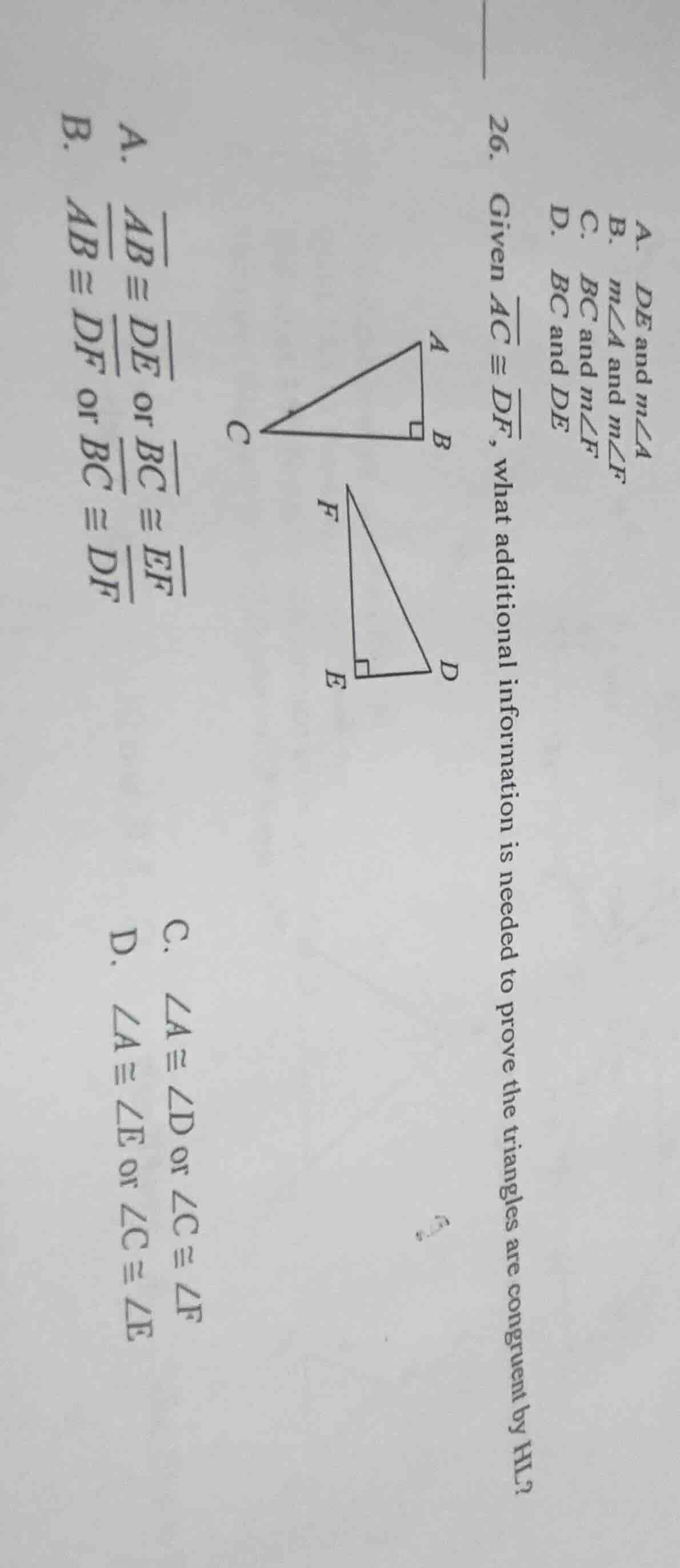
- given ( overline{ac} cong overline{df} ), what additional information is needed to prove the triangles are congruent by hl?
a. ( de ) and ( mangle a )
b. ( mangle a ) and ( mangle f )
c. ( bc ) and ( mangle f )
d. ( bc ) and ( de )
a.
( overline{ab} = overline{de} ) or ( overline{bc} cong overline{ef} )
b.
( overline{ab} = overline{df} ) or ( overline{bc} cong overline{df} )
c.
( angle a cong angle d ) or ( angle c cong angle f )
d.
( angle a cong angle e ) or ( angle c cong angle e )
To prove two right triangles congruent by HL (Hypotenuse - Leg) theorem, we need the hypotenuse and one leg of one right triangle to be congruent to the hypotenuse and one leg of the other right triangle. We know \( \overline{AC}\cong\overline{DF} \) (hypotenuses, assuming \( \angle B \) and \( \angle E \) are right angles). For HL, we need a leg from each triangle to be congruent. In triangle \( ABC \) (right - angled at \( B \)) and triangle \( DEF \) (right - angled at \( E \)), the legs are \( AB, BC \) and \( DE, EF \) respectively. Option A states \( \overline{AB}\cong\overline{DE} \) or \( \overline{BC}\cong\overline{EF} \), which provides the required leg congruence along with the given hypotenuse congruence to apply HL. Other options involve angle congruence (which is for AAS/ASA, not HL) or incorrect side congruence (like \( AB = DF \) where \( DF \) is a hypotenuse, not a leg in the context of HL for these triangles).

Snap & solve any problem in the app
Get step-by-step solutions on Sovi AI
Photo-based solutions with guided steps
Explore more problems and detailed explanations
A. \( \overline{AB}\cong\overline{DE} \) or \( \overline{BC}\cong\overline{EF} \)