QUESTION IMAGE
Question
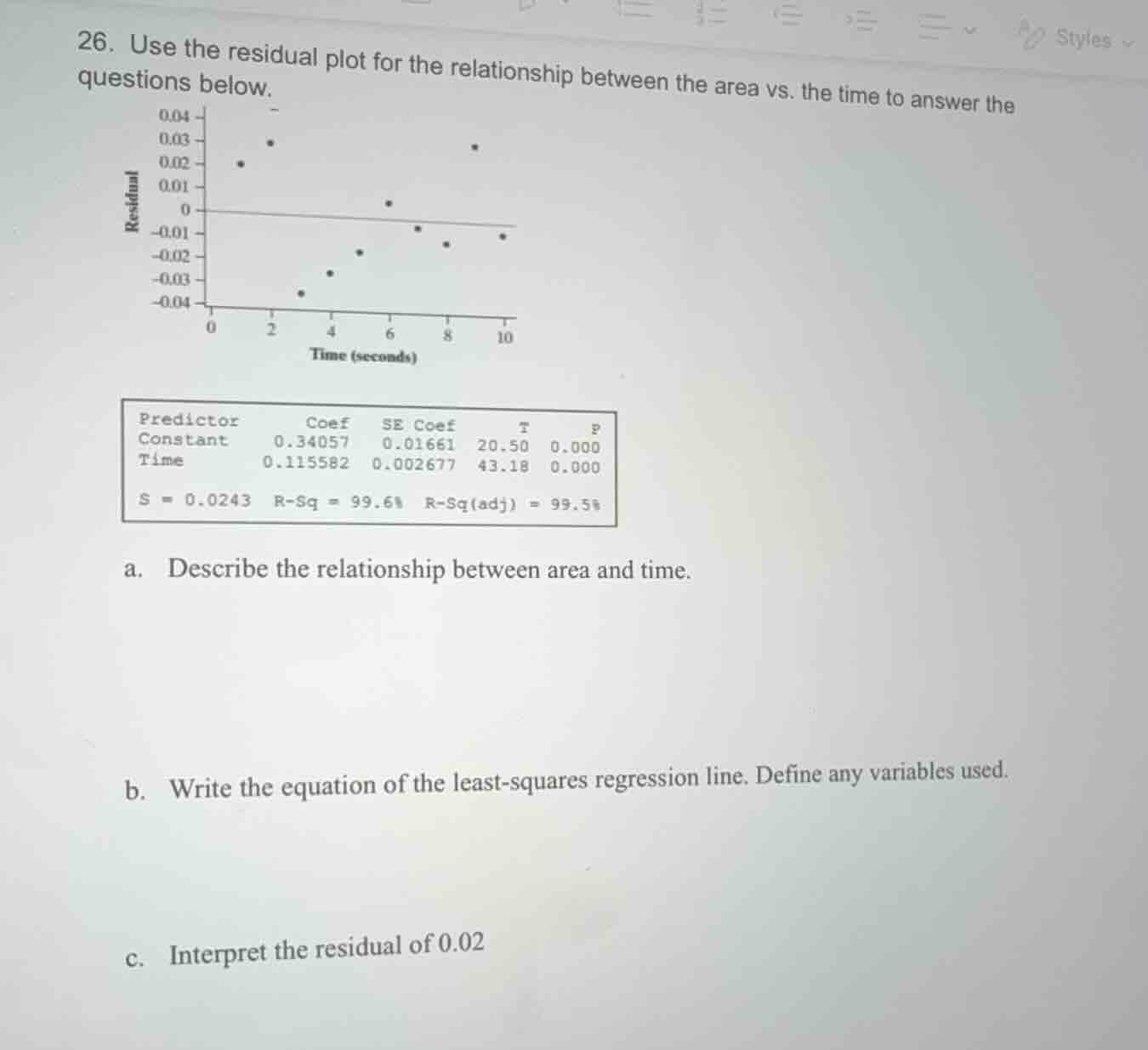
- use the residual plot for the relationship between the area vs. the time to answer the questions below.
predictor | coef | se coef | t | p
constant | 0.34057 | 0.01661 | 20.50 | 0.000
time | 0.115582 | 0.002677 | 43.18 | 0.000
s = 0.0243 r - sq = 99.6% r - sq(adj) = 99.5%
a. describe the relationship between area and time.
b. write the equation of the least - squares regression line. define any variables used.
c. interpret the residual of 0.02
a. First, check the regression coefficient for Time (positive, 0.115582) indicating a positive association. The R-Sq value of 99.6% shows an extremely strong linear relationship. The residual plot has no clear pattern (random scatter), confirming that a linear model is appropriate for the relationship.
b. The least-squares regression line follows the form $\hat{y} = a + bx$, where $a$ is the constant (intercept) and $b$ is the coefficient for the predictor (Time). Define the variables clearly: $\hat{\text{Area}}$ is the predicted area, and $\text{Time}$ is the time in seconds.
c. A residual is calculated as $\text{Residual} = \text{Observed Value} - \text{Predicted Value}$. A positive residual means the observed value is higher than the value predicted by the regression model.

Snap & solve any problem in the app
Get step-by-step solutions on Sovi AI
Photo-based solutions with guided steps
Explore more problems and detailed explanations
a. Area and time have a very strong, positive linear relationship, and a linear model is appropriate (supported by the random residual scatter and 99.6% of variation in area explained by time).
b. Let $\hat{\text{Area}}$ = predicted area, and $\text{Time}$ = time in seconds.
The regression line is:
$\hat{\text{Area}} = 0.34057 + 0.115582(\text{Time})$
c. A residual of 0.02 means the observed area is 0.02 units higher than the area predicted by the least-squares regression line for that specific time value.