QUESTION IMAGE
Question
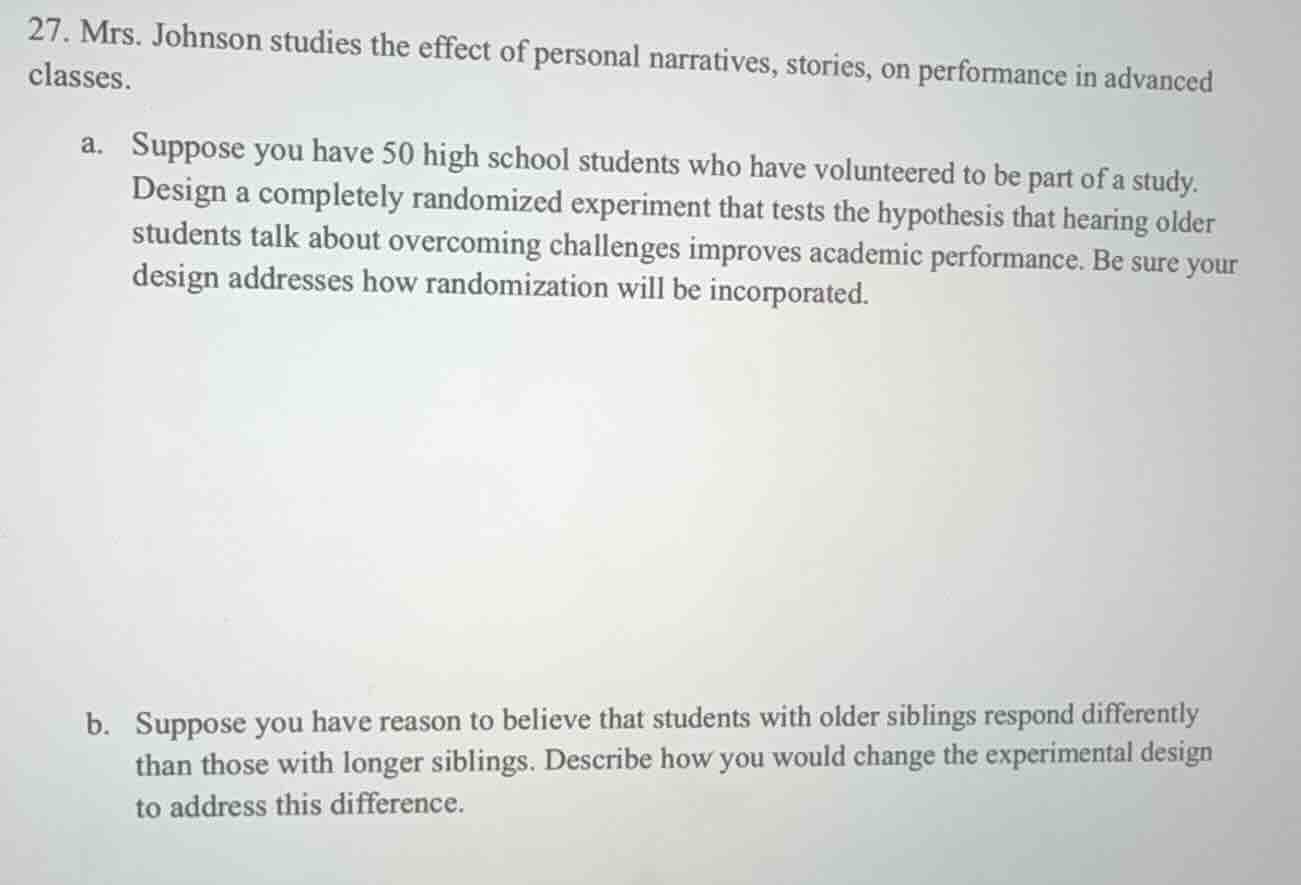
- mrs. johnson studies the effect of personal narratives, stories, on performance in advanced classes.
a. suppose you have 50 high school students who have volunteered to be part of a study. design a completely randomized experiment that tests the hypothesis that hearing older students talk about overcoming challenges improves academic performance. be sure your design addresses how randomization will be incorporated.
b. suppose you have reason to believe that students with older siblings respond differently than those with longer siblings. describe how you would change the experimental design to address this difference.
Part a:
- First, define the experimental groups: one group will receive the treatment (hearing older students' overcoming-challenge narratives), and the control group will not.
- Use randomization to assign the 50 students to these two groups to eliminate bias.
- Ensure both groups take the same advanced class and measure their academic performance (e.g., test scores) for comparison.
Part b:
- Identify the student characteristic (having older siblings vs. not) that may affect the outcome, which is a blocking variable.
- Split the sample into two blocks based on this characteristic first.
- Randomly assign students within each block to the treatment and control groups to isolate the effect of the treatment while accounting for the sibling variable.

Snap & solve any problem in the app
Get step-by-step solutions on Sovi AI
Photo-based solutions with guided steps
Explore more problems and detailed explanations
a. 1. Label each of the 50 students with a unique number from 1 to 50.
- Use a random number generator or random number table to select 25 distinct numbers. Assign the students with these numbers to the treatment group (they will listen to older students' personal narratives about overcoming academic challenges regularly during their advanced class).
- The remaining 25 students form the control group; they will attend the same advanced class but will not listen to the narratives.
- Over the course of the class, measure academic performance (e.g., exam scores, assignment grades) for all students, then compare the average performance of the treatment and control groups.
b. Use a randomized block design:
- First, split the 50 students into two blocks:
- Block 1: Students who have older siblings
- Block 2: Students who do not have older siblings
- For each block separately, use the same randomization method as in part (a): randomly assign half of the students in Block 1 to the treatment group and the other half to the control group; repeat this random assignment for Block 2.
- Administer the treatment (narratives) to the treatment subgroups and no treatment to the control subgroups, then measure and compare academic performance within and across blocks.