QUESTION IMAGE
Question
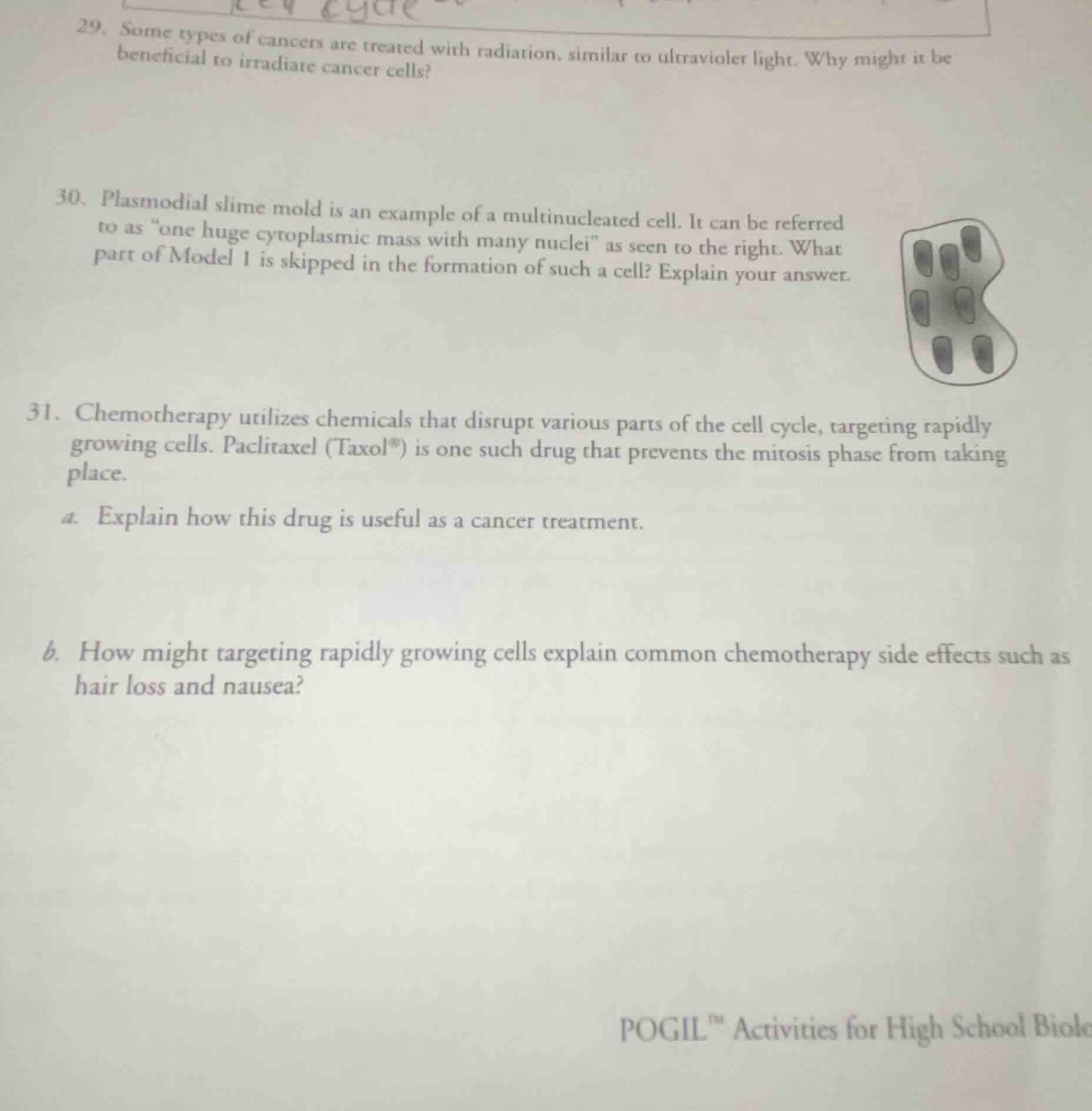
- some types of cancers are treated with radiation, similar to ultraviolet light. why might it be beneficial to irradiate cancer cells?
- plasmodial slime mold is an example of a multinucleated cell. it can be referred to as \one huge cytoplasmic mass with many nuclei\ as seen to the right. what part of model 1 is skipped in the formation of such a cell? explain your answer.
- chemotherapy utilizes chemicals that disrupt various parts of the cell cycle, targeting rapidly growing cells. paclitaxel (taxol®) is one such drug that prevents the mitosis phase from taking place.
a. explain how this drug is useful as a cancer treatment.
b. how might targeting rapidly growing cells explain common chemotherapy side effects such as hair loss and nausea?
Question 29:
Radiation damages the DNA of rapidly dividing cancer cells, which are less able to repair this damage compared to healthy cells. This damage prevents the cancer cells from continuing to divide and grow, eventually causing them to die.
Question 30:
The cytokinesis stage of the cell cycle is skipped. Cytokinesis is the process where the cytoplasm splits to form two separate daughter cells after nuclear division. In plasmodial slime molds, nuclear division (mitosis) occurs repeatedly without cytokinesis, resulting in a single large cytoplasmic mass with multiple nuclei.
Question 31a:
Cancer cells grow and divide rapidly, relying on mitosis to multiply. Paclitaxel blocks mitosis, which stops cancer cells from dividing and spreading. This slows or halts the growth of the tumor.
Question 31b:
Healthy cells like hair follicle cells and the cells lining the digestive tract also grow and divide rapidly. The chemotherapy drug targets all rapidly dividing cells, not just cancer cells. Damage to hair follicle cells causes hair loss, and damage to digestive tract cells leads to nausea.

Snap & solve any problem in the app
Get step-by-step solutions on Sovi AI
Photo-based solutions with guided steps
Explore more problems and detailed explanations
- Question 29: Radiation damages cancer cell DNA, preventing uncontrolled division and killing the abnormal cells, as they cannot repair DNA damage as effectively as healthy cells.
- Question 30: Cytokinesis is skipped. Mitosis (nuclear division) occurs repeatedly, but the cytoplasm does not split, creating a single mass with many nuclei.
- Question 31a: Paclitaxel stops mitosis, which blocks the rapid division of cancer cells, slowing or stopping tumor growth.
- Question 31b: Rapidly dividing healthy cells (hair follicle cells, digestive tract lining cells) are also targeted. Damage to hair follicles causes hair loss; damage to digestive cells causes nausea.