QUESTION IMAGE
Question
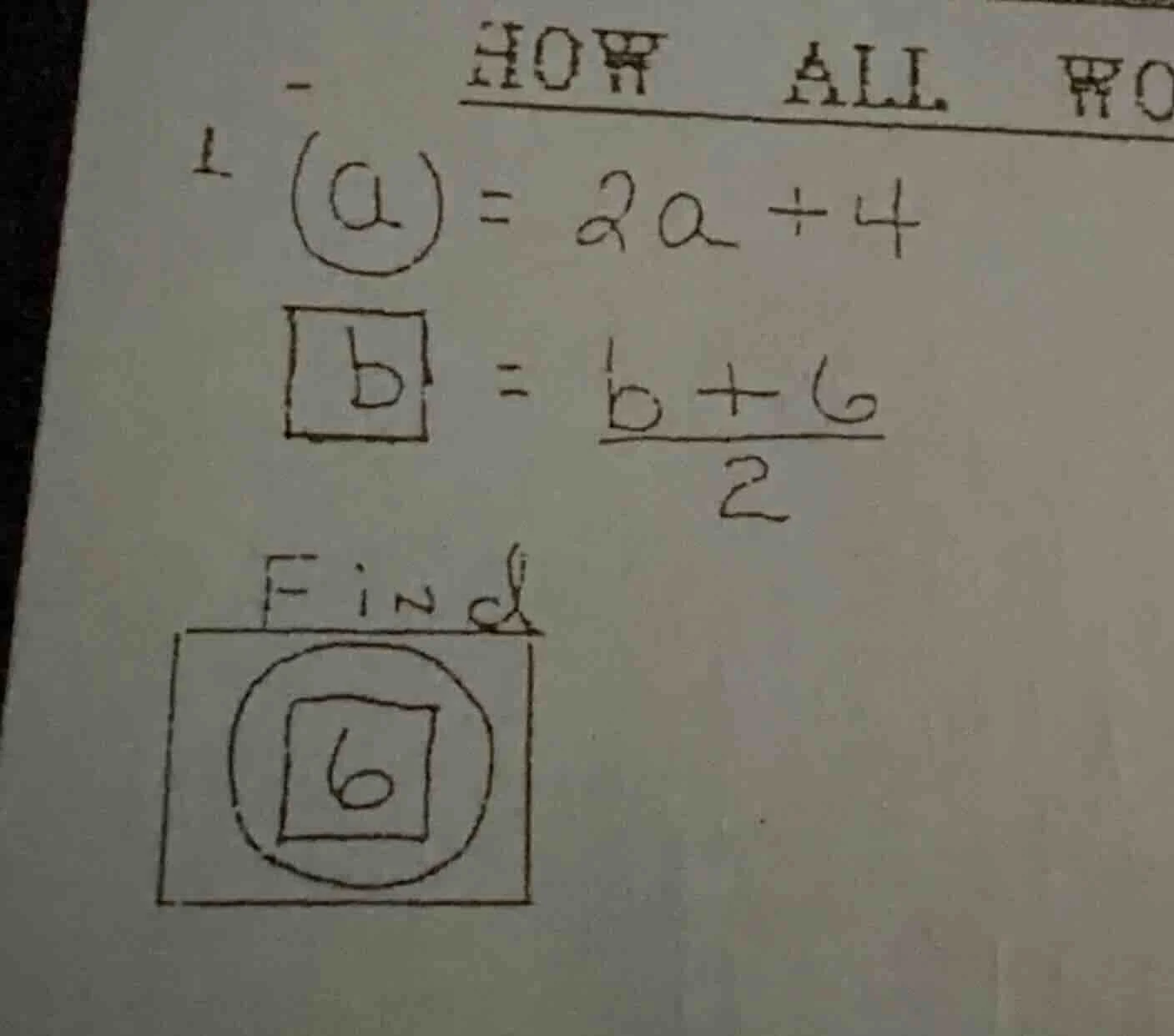
1 \\( (a) = 2a + 4 \\)
\\( \boxed{b} = \dfrac{b + 6}{2} \\)
find \\( \boxed{\bigcirc \boxed{6}} \\)
Step1: Evaluate the square function on 6
The square function is $\boxed{b} = \frac{b + 6}{2}$. Substitute $b = 6$ into this function:
$\frac{6 + 6}{2} = \frac{12}{2} = 6$
Step2: Evaluate the circle function on the result
The circle function is $\circled{a} = 2a + 4$. Substitute $a = 6$ (the result from Step 1) into this function:
$2(6) + 4 = 12 + 4 = 16$
Step3: Evaluate the rectangle function on the result
Wait, actually, looking at the diagram, the innermost is the square with 6, then the circle, then the rectangle? Wait, maybe the operations are: first apply the square function to 6, then apply the circle function to that result, then apply the rectangle? Wait, no, maybe the diagram is a composition: the innermost is square (6), then circle (the result of square), then rectangle (the result of circle). Wait, but the rectangle function—wait, maybe the rectangle is the outermost, but in the given functions, we have circle (a) = 2a + 4, square (b) = (b + 6)/2, and the outermost is rectangle? Wait, no, maybe the diagram is square inside circle inside rectangle? Wait, but the problem says "Find" the rectangle with circle with square 6. Wait, maybe the functions are: square (b) = (b + 6)/2, circle (a) = 2a + 4, and the outermost is rectangle? Wait, no, maybe the rectangle is the same as circle? Wait, no, maybe I misread. Wait, the given functions: circle (a) = 2a + 4, square (b) = (b + 6)/2. The diagram is a rectangle with a circle with a square with 6. Wait, maybe the rectangle is the same as the circle? No, maybe the operations are: first square(6), then circle(square(6)), then rectangle(circle(square(6)))? But there's no rectangle function. Wait, maybe the rectangle is a typo, or maybe the outermost is circle? Wait, no, let's re-express:
Wait, the problem has:
- Circle: $\circled{a} = 2a + 4$
- Square: $\boxed{b} = \frac{b + 6}{2}$
- The diagram is a rectangle (outer) with a circle (middle) with a square (inner) containing 6. Wait, maybe the rectangle is the same as the circle? No, maybe the rectangle is a mistake, and it's just circle and square. Wait, no, let's do step by step:
- Apply square function to 6: $\boxed{6} = \frac{6 + 6}{2} = 6$
- Apply circle function to the result (6): $\circled{6} = 2(6) + 4 = 16$
- Now, is there a rectangle function? Wait, maybe the rectangle is the same as the circle? No, maybe the diagram is square (6) → circle (result of square) → rectangle (result of circle). But we don't have a rectangle function. Wait, maybe the original problem's diagram is square inside circle, and the outermost is rectangle, but maybe the rectangle function is the same as the circle? No, that doesn't make sense. Wait, maybe I made a mistake. Wait, let's check again.
Wait, the user's diagram: innermost is square with 6, then circle, then rectangle. But the given functions are:
- Circle (a) = 2a + 4
- Square (b) = (b + 6)/2
- Is there a rectangle function? Wait, maybe the rectangle is a typo, and the outermost is circle? No, the diagram shows rectangle (outer), circle (middle), square (inner with 6). Wait, maybe the rectangle function is the same as the circle? No, that's not possible. Wait, maybe the problem is a composition of functions: first square(6), then circle(square(6)), then rectangle(circle(square(6))). But since we don't have a rectangle function, maybe the rectangle is the same as the circle? No, that can't be. Wait, maybe the diagram is square (6) → circle (result) → rectangle (result), but the rectangle function is not given. Wait, maybe the original problem has a typo, and the outermost…

Snap & solve any problem in the app
Get step-by-step solutions on Sovi AI
Photo-based solutions with guided steps
Explore more problems and detailed explanations
16