QUESTION IMAGE
Question
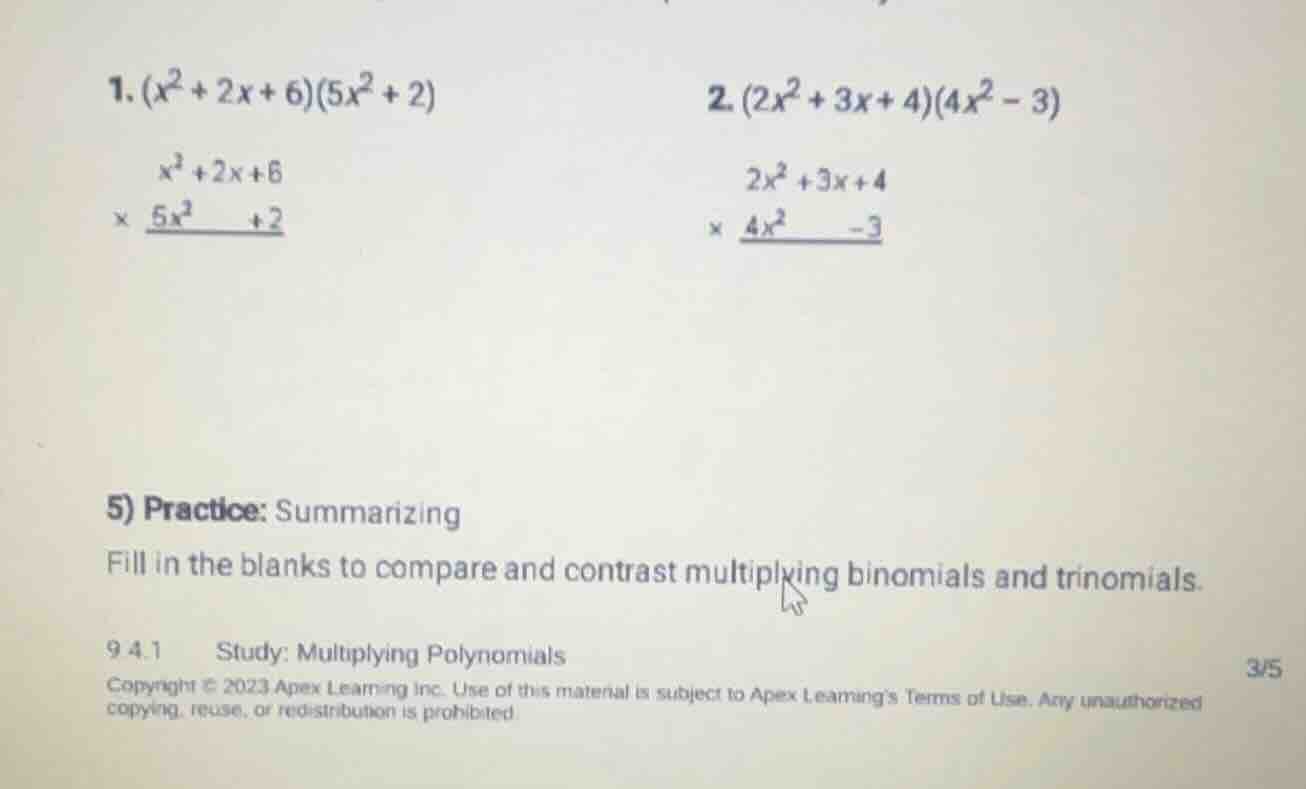
- $(x^2 + 2x + 6)(5x^2 + 2)$
$\
$
- $(2x^2 + 3x + 4)(4x^2 - 3)$
$\
$
- practice: summarizing
fill in the blanks to compare and contrast multiplying binomials and trinomials.
9.4.1 study: multiplying polynomials
copyright © 2023 apex learning inc. use of this material is subject to apex learning’s terms of use. any unauthorized copying, reuse, or redistribution is prohibited 3/5
To solve the multiplication of the given polynomials, we'll use the distributive property (also known as the FOIL method extended for polynomials with more terms). Let's solve each problem one by one.
Problem 1: \((x^2 + 2x + 6)(5x^2 + 2)\)
Step 1: Distribute each term in the first polynomial to each term in the second polynomial.
- Multiply \(x^2\) by \(5x^2\): \(x^2 \cdot 5x^2 = 5x^{2+2} = 5x^4\)
- Multiply \(x^2\) by \(2\): \(x^2 \cdot 2 = 2x^2\)
- Multiply \(2x\) by \(5x^2\): \(2x \cdot 5x^2 = 10x^{1+2} = 10x^3\)
- Multiply \(2x\) by \(2\): \(2x \cdot 2 = 4x\)
- Multiply \(6\) by \(5x^2\): \(6 \cdot 5x^2 = 30x^2\)
- Multiply \(6\) by \(2\): \(6 \cdot 2 = 12\)
Step 2: Combine like terms.
Now, we have the terms: \(5x^4\), \(2x^2\), \(10x^3\), \(4x\), \(30x^2\), \(12\)
Combine the \(x^2\) terms: \(2x^2 + 30x^2 = 32x^2\)
So, putting it all together: \(5x^4 + 10x^3 + 32x^2 + 4x + 12\)
Problem 2: \((2x^2 + 3x + 4)(4x^2 - 3)\)
Step 1: Distribute each term in the first polynomial to each term in the second polynomial.
- Multiply \(2x^2\) by \(4x^2\): \(2x^2 \cdot 4x^2 = 8x^{2+2} = 8x^4\)
- Multiply \(2x^2\) by \(-3\): \(2x^2 \cdot (-3) = -6x^2\)
- Multiply \(3x\) by \(4x^2\): \(3x \cdot 4x^2 = 12x^{1+2} = 12x^3\)
- Multiply \(3x\) by \(-3\): \(3x \cdot (-3) = -9x\)
- Multiply \(4\) by \(4x^2\): \(4 \cdot 4x^2 = 16x^2\)
- Multiply \(4\) by \(-3\): \(4 \cdot (-3) = -12\)
Step 2: Combine like terms.
Now, we have the terms: \(8x^4\), \(-6x^2\), \(12x^3\), \(-9x\), \(16x^2\), \(-12\)
Combine the \(x^2\) terms: \(-6x^2 + 16x^2 = 10x^2\)
So, putting it all together: \(8x^4 + 12x^3 + 10x^2 - 9x - 12\)
Final Answers:
- \(\boldsymbol{(x^2 + 2x + 6)(5x^2 + 2) = 5x^4 + 10x^3 + 32x^2 + 4x + 12}\)
- \(\boldsymbol{(2x^2 + 3x + 4)(4x^2 - 3) = 8x^4 + 12x^3 + 10x^2 - 9x - 12}\)

Snap & solve any problem in the app
Get step-by-step solutions on Sovi AI
Photo-based solutions with guided steps
Explore more problems and detailed explanations
To solve the multiplication of the given polynomials, we'll use the distributive property (also known as the FOIL method extended for polynomials with more terms). Let's solve each problem one by one.
Problem 1: \((x^2 + 2x + 6)(5x^2 + 2)\)
Step 1: Distribute each term in the first polynomial to each term in the second polynomial.
- Multiply \(x^2\) by \(5x^2\): \(x^2 \cdot 5x^2 = 5x^{2+2} = 5x^4\)
- Multiply \(x^2\) by \(2\): \(x^2 \cdot 2 = 2x^2\)
- Multiply \(2x\) by \(5x^2\): \(2x \cdot 5x^2 = 10x^{1+2} = 10x^3\)
- Multiply \(2x\) by \(2\): \(2x \cdot 2 = 4x\)
- Multiply \(6\) by \(5x^2\): \(6 \cdot 5x^2 = 30x^2\)
- Multiply \(6\) by \(2\): \(6 \cdot 2 = 12\)
Step 2: Combine like terms.
Now, we have the terms: \(5x^4\), \(2x^2\), \(10x^3\), \(4x\), \(30x^2\), \(12\)
Combine the \(x^2\) terms: \(2x^2 + 30x^2 = 32x^2\)
So, putting it all together: \(5x^4 + 10x^3 + 32x^2 + 4x + 12\)
Problem 2: \((2x^2 + 3x + 4)(4x^2 - 3)\)
Step 1: Distribute each term in the first polynomial to each term in the second polynomial.
- Multiply \(2x^2\) by \(4x^2\): \(2x^2 \cdot 4x^2 = 8x^{2+2} = 8x^4\)
- Multiply \(2x^2\) by \(-3\): \(2x^2 \cdot (-3) = -6x^2\)
- Multiply \(3x\) by \(4x^2\): \(3x \cdot 4x^2 = 12x^{1+2} = 12x^3\)
- Multiply \(3x\) by \(-3\): \(3x \cdot (-3) = -9x\)
- Multiply \(4\) by \(4x^2\): \(4 \cdot 4x^2 = 16x^2\)
- Multiply \(4\) by \(-3\): \(4 \cdot (-3) = -12\)
Step 2: Combine like terms.
Now, we have the terms: \(8x^4\), \(-6x^2\), \(12x^3\), \(-9x\), \(16x^2\), \(-12\)
Combine the \(x^2\) terms: \(-6x^2 + 16x^2 = 10x^2\)
So, putting it all together: \(8x^4 + 12x^3 + 10x^2 - 9x - 12\)
Final Answers:
- \(\boldsymbol{(x^2 + 2x + 6)(5x^2 + 2) = 5x^4 + 10x^3 + 32x^2 + 4x + 12}\)
- \(\boldsymbol{(2x^2 + 3x + 4)(4x^2 - 3) = 8x^4 + 12x^3 + 10x^2 - 9x - 12}\)