QUESTION IMAGE
Question
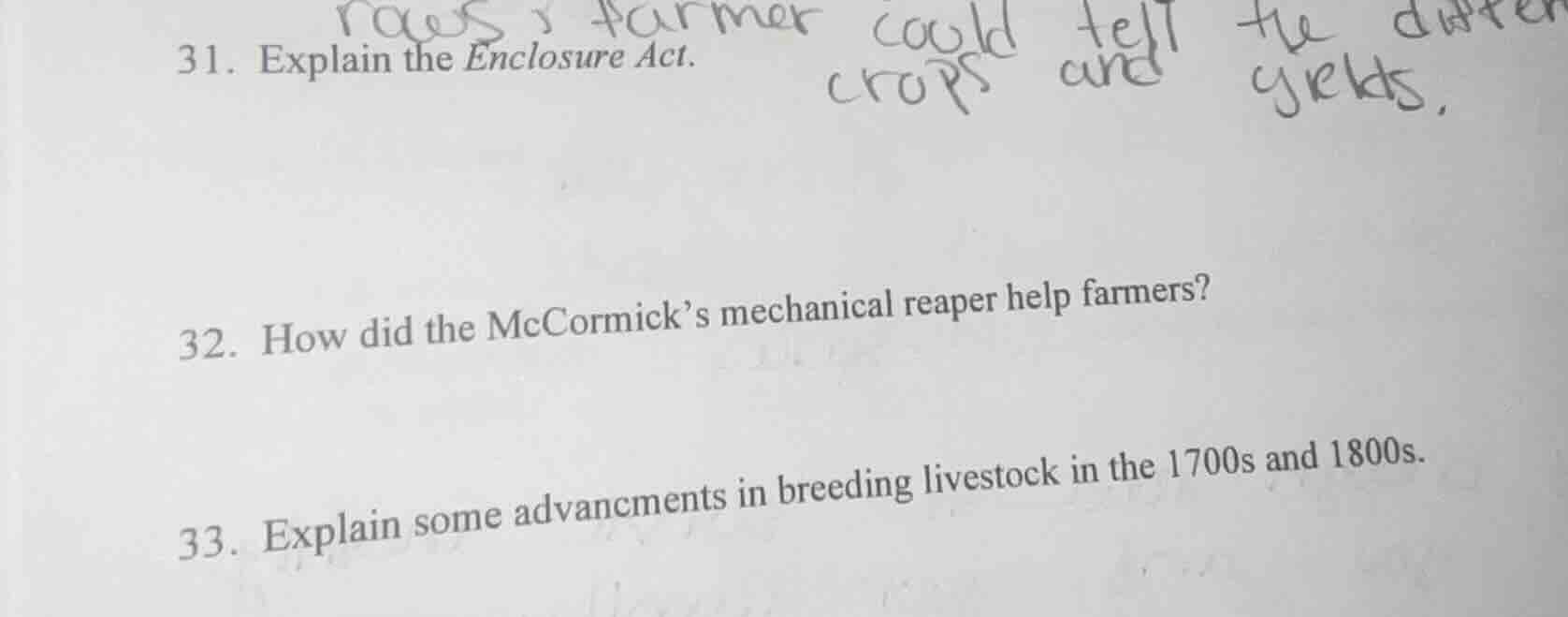
- explain the enclosure act.
- how did the mccormick’s mechanical reaper help farmers?
- explain some advancments in breeding livestock in the 1700s and 1800s.
For Question 31:
The Enclosure Acts were a series of British laws from the 16th to 19th centuries that privatized common agricultural land, which was previously shared by local villagers for grazing and growing crops. Landowners enclosed land with fences, hedges, or walls, taking control of it. This shifted farming from small-scale, subsistence-based practices to large, commercial operations, enabling more efficient crop rotation and higher yields, but also displaced many rural poor who lost access to common land.
For Question 32:
McCormick's mechanical reaper, invented in the 1830s, automated the process of cutting grain crops. Before this, farmers had to harvest grain by hand with scythes, which was slow and labor-intensive. The reaper allowed a single farmer to harvest far more acreage in a single day, reduced labor costs, enabled farmers to expand their crop operations, and helped them harvest crops quickly before weather could damage the yield.
For Question 33:
In the 1700s and 1800s, livestock breeding saw key advancements. Farmers began using selective breeding (systematically mating animals with desirable traits like higher milk production, larger size, or faster growth) instead of random mating. For example, Robert Bakewell developed improved breeds of sheep and cattle by selecting only the best animals for breeding, which increased the quality and quantity of meat, wool, and dairy products. Additionally, farmers started keeping detailed breeding records to track and reinforce desirable traits over generations, leading to more consistent and productive livestock lines.

Snap & solve any problem in the app
Get step-by-step solutions on Sovi AI
Photo-based solutions with guided steps
Explore more problems and detailed explanations
- The Enclosure Acts were British laws (16th–19th c.) that privatized shared common agricultural land. Landowners enclosed land, shifting farming to large commercial operations with more efficient practices, but displaced many rural poor who lost access to communal land for subsistence.
- McCormick's mechanical reaper automated grain harvesting, allowing farmers to harvest far more acreage per day, cut labor costs, expand crop operations, and avoid crop loss from delayed harvesting due to weather.
- Key advancements included selective breeding (mating animals with desirable traits like higher yield or size, e.g., Robert Bakewell's improved sheep/cattle breeds) and the use of detailed breeding records to consistently reinforce productive traits, boosting livestock quality and output for meat, wool, and dairy.