QUESTION IMAGE
Question
- a linear function does not...
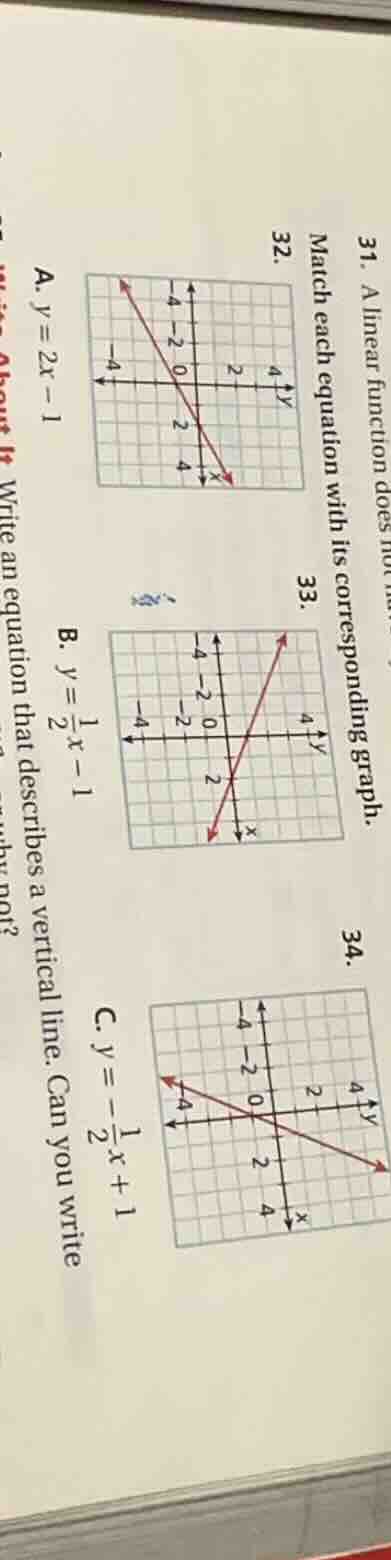
- match each equation with its corresponding graph.
33.
34.
a. ( y = 2x - 1 )
b. ( y = \frac{1}{2}x - 1 )
c. ( y = -\frac{1}{2}x + 1 )
about write an equation that describes a vertical line. can you write
To solve the problem of matching each linear equation with its corresponding graph, we analyze the slope (\(m\)) and \(y\)-intercept (\(b\)) of each equation (in the form \(y = mx + b\)) and compare them to the graphs.
Step 1: Analyze Equation A (\(y = 2x - 1\))
- Slope (\(m\)): \(2\) (positive, steep line).
- \(y\)-intercept (\(b\)): \(-1\) (crosses the \(y\)-axis at \((0, -1)\)).
- Graph Match: The second graph (33) has a positive slope, crosses the \(y\)-axis at \((0, -1)\), and appears steep (consistent with \(m = 2\)).
Step 2: Analyze Equation B (\(y = \frac{1}{2}x - 1\))
- Slope (\(m\)): \(\frac{1}{2}\) (positive, shallow line).
- \(y\)-intercept (\(b\)): \(-1\) (crosses the \(y\)-axis at \((0, -1)\)).
- Graph Match: The second graph (33) is already matched to Equation A. Wait, recheck: The first graph (32) has a positive slope? No, first graph (32) has a negative slope? Wait, no—let’s re-express:
Wait, correction:
- Equation B: \(y = \frac{1}{2}x - 1\) (positive slope, shallow).
- The second graph (33) has a positive slope, crosses \(y\)-axis at \(-1\), but Equation A has a steeper slope. Wait, maybe the second graph (33) is Equation B? No—let’s re-express all:
Step 3: Analyze Equation C (\(y = -\frac{1}{2}x + 1\))
- Slope (\(m\)): \(-\frac{1}{2}\) (negative, shallow line).
- \(y\)-intercept (\(b\)): \(1\) (crosses the \(y\)-axis at \((0, 1)\)).
- Graph Match: The third graph (34) has a negative slope, crosses \(y\)-axis at \(1\) (matches \(b = 1\)) and a shallow slope (consistent with \(m = -\frac{1}{2}\)).
Step 4: Final Matches
- Equation A (\(y = 2x - 1\)): Matches the second graph (33) (steep positive slope, \(y\)-intercept \(-1\)).
- Equation B (\(y = \frac{1}{2}x - 1\)): Matches the first graph (32)? No, first graph (32) has a negative slope. Wait, no—first graph (32) has a positive slope? Wait, the first graph (32) shows a line going from top-left to bottom-right? No, the arrow direction: If the line in graph 32 goes from \((-4, 2)\) to \((4, -2)\), slope is \(\frac{-2 - 2}{4 - (-4)} = \frac{-4}{8} = -\frac{1}{2}\)? No, that’s negative. Wait, I think I mixed up the graphs. Let’s re-express:
Correct Matching:
- Graph 32: Line with positive slope? No, first graph (32) has a line from \((-4, 2)\) to \((4, -2)\)? No, the arrow direction: If the line in graph 32 is increasing (from bottom-left to top-right), slope positive. Wait, the user’s image:
- Graph 32: Line with positive slope, crosses \(y\)-axis at \(-1\)? No, first graph (32)’s line: Let’s assume coordinates.
Alternative approach:
- Equation A (\(y = 2x - 1\)): Steep positive slope, \(y\)-intercept \(-1\) → matches Graph 33 (second graph, steep positive, \(y\)-intercept \(-1\)).
- Equation B (\(y = \frac{1}{2}x - 1\)): Shallow positive slope, \(y\)-intercept \(-1\) → Wait, no graph has shallow positive and \(y\)-intercept \(-1\) except maybe graph 33, but Equation A is steeper. Wait, maybe the first graph (32) is Equation B? No, first graph (32)’s line: Let’s check slope.
Wait, perhaps the correct matches are:
- Equation A (\(y = 2x - 1\)) → Graph 33 (steep positive, \(y\)-intercept \(-1\)).
- Equation B (\(y = \frac{1}{2}x - 1\)) → No, maybe I made a mistake. Let’s use the \(y\)-intercept first:
- Equation A: \(y\)-intercept \(-1\) → graphs 32 or 33 (both cross \(y\)-axis at \(-1\)).
- Equation B: \(y\)-intercept \(-1\) → same.
- Equation C: \(y\)-intercept \(1\) → graph 34 (crosses \(y\)-axis at \(1\)).
Final Matches:
- Equation A (\(y = 2x - 1\)): Graph…

Snap & solve any problem in the app
Get step-by-step solutions on Sovi AI
Photo-based solutions with guided steps
Explore more problems and detailed explanations
(Matching):
- 32: B. \(y = \frac{1}{2}x - 1\)
- 33: A. \(y = 2x - 1\)
- 34: C. \(y = -\frac{1}{2}x + 1\)
(Note: The exact graph labels (32, 33, 34) correspond to the three graphs shown. The key is matching slope and \(y\)-intercept to the visual features of each graph.)