QUESTION IMAGE
Question
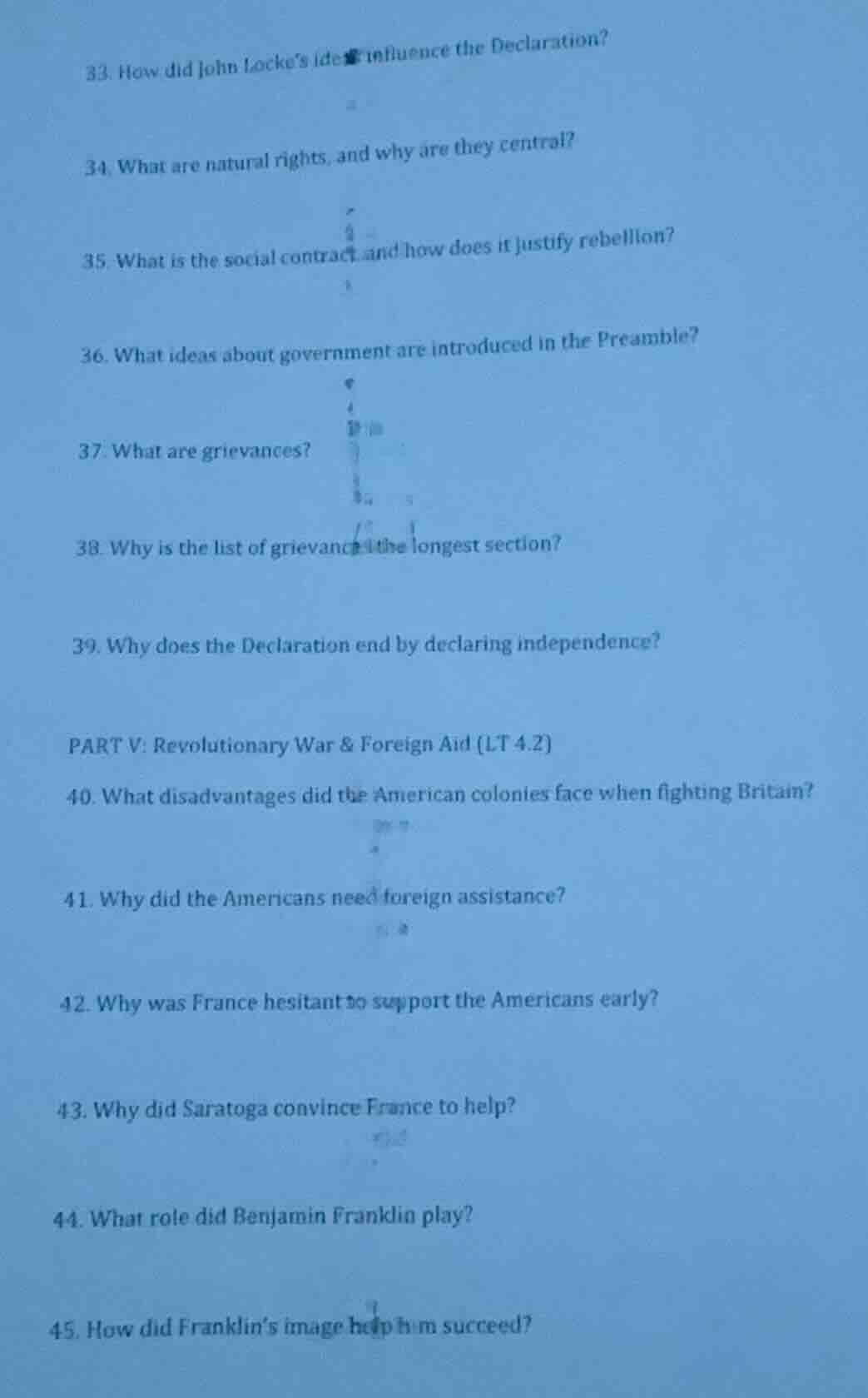
- how did john locke’s ideas influence the declaration?
- what are natural rights, and why are they central?
- what is the social contract, and how does it justify rebellion?
- what ideas about government are introduced in the preamble?
- what are grievances?
- why is the list of grievances the longest section?
- why does the declaration end by declaring independence?
part v: revolutionary war & foreign aid (lt 4.2)
- what disadvantages did the american colonies face when fighting britain?
- why did the americans need foreign assistance?
- why was france hesitant to support the americans early?
- why did saratoga convince france to help?
- what role did benjamin franklin play?
- how did franklin’s image help him succeed?
33.
John Locke's ideas of natural rights (life, liberty, property) and the social contract directly shaped the Declaration. The document adapted "life, liberty, and the pursuit of happiness" from his natural rights theory, and used his social contract idea that governments derive authority from the governed; if a government fails to protect rights, the people can overthrow it.
34.
Natural rights are inherent, inalienable rights people possess by birth, not granted by a government. They are central because they form the moral foundation for just governance—governments exist primarily to protect these rights, and violating them justifies challenging the government.
35.
The social contract is an implicit agreement between people and their government: people surrender some freedoms to the state in exchange for protection of their natural rights. If the government breaks this contract by violating rights (e.g., tyranny), the people have the right to rebel and replace the government.
36.
The Preamble introduces core ideas: that all men are created equal, they have unalienable natural rights, governments are instituted to protect these rights, and governments derive their just powers from the consent of the governed.
37.
Grievances are formal complaints against a governing authority. In the Declaration, they are specific accusations against King George III of violating the colonists' rights and acting tyrannically.
38.
The list of grievances is the longest section to provide concrete, evidence-based justification for declaring independence. It details specific, repeated abuses by the British crown, proving that the government had broken the social contract and left the colonists with no other option but separation.
39.
The Declaration ends by declaring independence to formalize the colonists' break from British rule, establish the United States as a sovereign nation, and solidify their claim to self-governance after demonstrating the failure of British authority to protect their rights.
40.
The American colonies faced disadvantages including: a smaller, less trained military compared to Britain's professional army; a lack of a centralized government to coordinate resources; limited access to weapons and supplies; and a portion of the colonial population remaining loyal to Britain (Loyalists).
41.
The Americans needed foreign assistance to compensate for their military and resource disadvantages against Britain. Foreign aid provided critical supplies, troops, naval support, and financial backing that helped them sustain the war effort and compete with the powerful British military.
42.
France was hesitant to support the Americans early because they doubted the colonists could win against Britain, the world's dominant military power. France also did not want to waste resources on a losing cause, and feared retaliation from Britain if they openly supported the rebellion.
43.
The American victory at Saratoga convinced France to help because it proved the colonists could defeat the British military. France saw an opportunity to weaken its long-time rival Britain, so it formed an alliance with the Americans, providing military and financial support.
44.
Benjamin Franklin served as a key diplomatic representative in France, working to secure French support for the American Revolution. He negotiated the Treaty of Alliance (1778) that formalized French military and financial aid, and helped maintain the alliance throughout the war.
45.
Franklin's image as a humble, wise, and hardworking "American f…

Snap & solve any problem in the app
Get step-by-step solutions on Sovi AI
Photo-based solutions with guided steps
Explore more problems and detailed explanations
- Locke's natural rights and social contract ideas provided the moral and philosophical framework for the Declaration, including the right to overthrow unjust government and the focus on inalienable rights.
- Natural rights are inherent, unalienable birth rights; they are central as they are the foundation of just governance and justify challenging oppressive rule.
- The social contract is an agreement where people trade some freedom for government protection of rights; it justifies rebellion if the government breaks the contract by violating rights.
- The Preamble introduces equality, unalienable natural rights, government by consent, and government's purpose to protect rights.
- Grievances are formal, specific complaints against a governing authority; in the Declaration, they are abuses by King George III.
- The long grievance list provides concrete evidence of British tyranny, justifying the colonists' decision to declare independence.
- Declaring independence formalizes the colonists' break from Britain, establishes U.S. sovereignty, and finalizes their claim to self-rule after proving British rule was unjust.
- Disadvantages included a smaller, untrained military, limited resources/supplies, no centralized command structure, and internal Loyalist opposition.
- Americans needed foreign aid to offset their military and resource deficits against Britain's powerful, well-supplied forces.
- France doubted the colonists could defeat Britain, feared wasting resources on a losing cause, and feared British retaliation.
- Saratoga was a major American victory that proved they could defeat Britain, showing France supporting them would weaken its rival Britain.
- Franklin was the lead American diplomat in France, negotiating the critical 1778 Treaty of Alliance to secure French military and financial aid.
- Franklin's beloved image as a humble, wise American inventor/thinker won French public and court favor, enabling his successful diplomatic efforts.