QUESTION IMAGE
Question
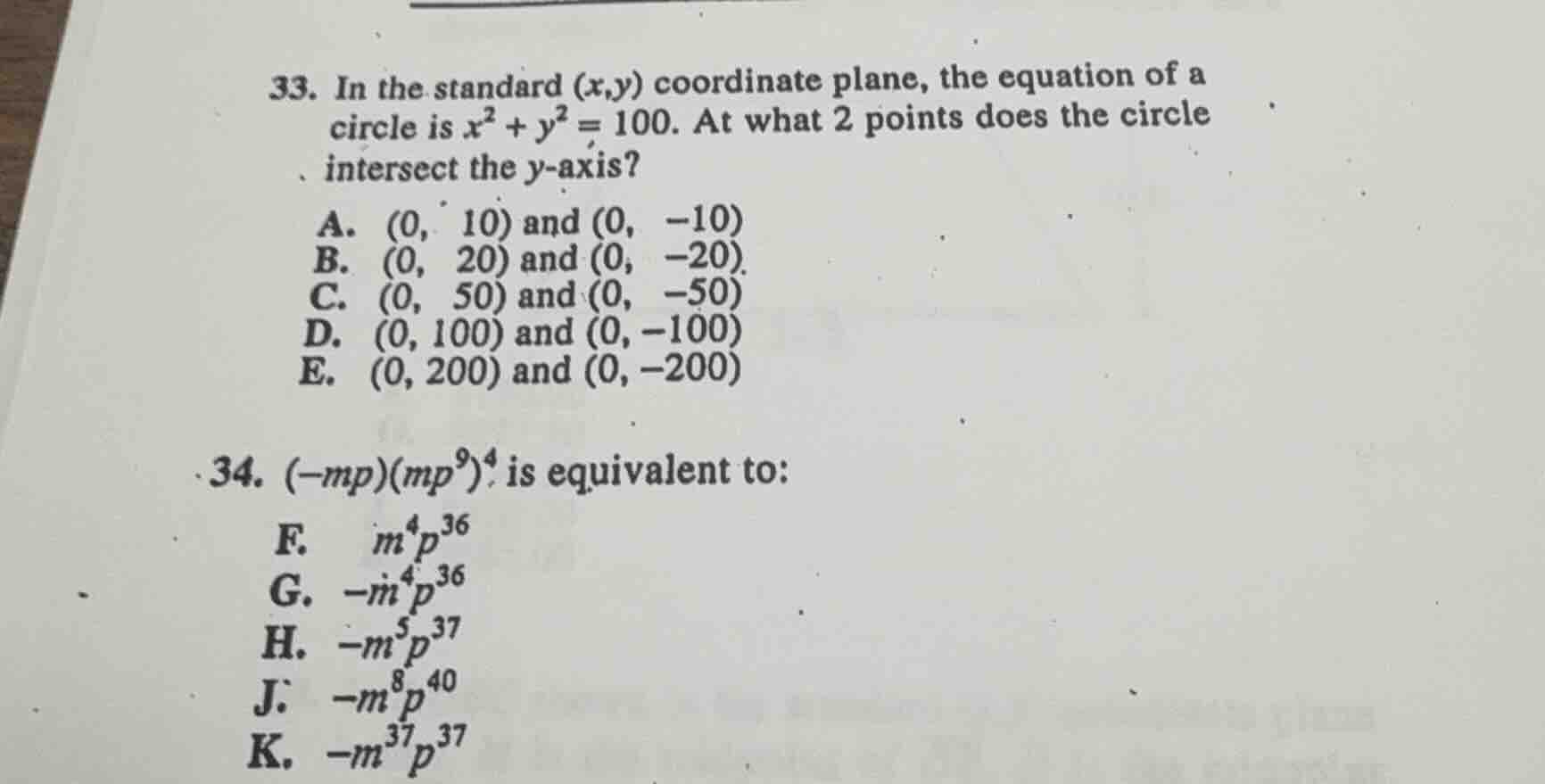
- in the standard (x,y) coordinate plane, the equation of a circle is $x^2 + y^2 = 100$. at what 2 points does the circle intersect the y - axis?
a. (0, 10) and (0, -10)
b. (0, 20) and (0, -20)
c. (0, 50) and (0, -50)
d. (0, 100) and (0, -100)
e. (0, 200) and (0, -200)
- $(-mp)(mp^9)^4$ is equivalent to:
f. $m^4p^{36}$
g. $-m^4p^{36}$
h. $-m^5p^{37}$
j. $-m^8p^{40}$
k. $-m^{37}p^{37}$
Question 33
Step1: Recall y - axis intersection
To find where a circle intersects the \(y\) - axis, we know that on the \(y\) - axis, the \(x\) - coordinate is \(0\) (because any point on the \(y\) - axis has the form \((0,y)\)). So we substitute \(x = 0\) into the equation of the circle.
The equation of the circle is \(x^{2}+y^{2}=100\). Substituting \(x = 0\) into the equation, we get \(0^{2}+y^{2}=100\), which simplifies to \(y^{2}=100\).
Step2: Solve for y
To solve \(y^{2}=100\), we take the square root of both sides. The square root of \(100\) is \(\pm10\), so \(y=\sqrt{100}=10\) or \(y =-\sqrt{100}=- 10\).
Since the \(x\) - coordinate is \(0\) (from the \(y\) - axis intersection property), the points of intersection are \((0,10)\) and \((0, - 10)\).
Step1: Apply the power of a product rule
First, we use the power of a product rule \((ab)^{n}=a^{n}b^{n}\) on \((mp^{9})^{4}\). So \((mp^{9})^{4}=m^{4}(p^{9})^{4}\).
Step2: Apply the power of a power rule
Next, we use the power of a power rule \((a^{m})^{n}=a^{mn}\) on \((p^{9})^{4}\). So \((p^{9})^{4}=p^{9\times4}=p^{36}\). Thus, \((mp^{9})^{4}=m^{4}p^{36}\).
Step3: Multiply the two terms
Now we multiply \((-mp)\) by \(m^{4}p^{36}\). When multiplying variables with exponents, we use the rule \(a^{m}\times a^{n}=a^{m + n}\). For the \(m\) - terms: \(m\times m^{4}=m^{1 + 4}=m^{5}\)? Wait, no, wait. Wait, the first term is \(-mp=-m^{1}p^{1}\) and the second term is \(m^{4}p^{36}\). So for the \(m\) - terms: \(m^{1}\times m^{4}=m^{1 + 4}=m^{5}\)? No, wait, no. Wait, the first factor is \(-mp=-m^{1}p^{1}\) and the second factor is \((mp^{9})^{4}=m^{4}p^{36}\). So when we multiply \(-m^{1}p^{1}\times m^{4}p^{36}\), for the \(m\) - exponents: \(1 + 4=5\)? Wait, no, wait, no. Wait, \((-mp)(mp^{9})^{4}=(-m\times p)\times(m^{4}\times p^{36})\). Using the commutative and associative properties of multiplication, we group the \(m\) - terms and \(p\) - terms: \(-(m\times m^{4})\times(p\times p^{36})\). Then, using \(a^{m}\times a^{n}=a^{m + n}\), for \(m\) - terms: \(m^{1+4}=m^{5}\)? Wait, no, wait, I made a mistake. Wait, \((mp^{9})^{4}\): the base is \(m\) (exponent 1) and \(p^{9}\) (exponent 9). So \((mp^{9})^{4}=m^{4}(p^{9})^{4}=m^{4}p^{36}\) (since \((p^{9})^{4}=p^{9\times4}=p^{36}\)). Now, multiply by \(-mp\) (which is \(-m^{1}p^{1}\)). So for the \(m\) - terms: \(m^{1}\times m^{4}=m^{1 + 4}=m^{5}\)? No, wait, no. Wait, \(-m\times m^{4}=-m^{1+4}=-m^{5}\)? Wait, no, wait, the first term is \(-mp=-m^{1}p^{1}\), the second term is \(m^{4}p^{36}\). So multiplying the \(m\) - parts: \(m^{1}\times m^{4}=m^{5}\), multiplying the \(p\) - parts: \(p^{1}\times p^{36}=p^{37}\), and the coefficient is \(-1\). Wait, no, wait, \((-mp)(mp^{9})^{4}=(-m\times p)\times(m^{4}\times p^{36})=- (m\times m^{4})\times(p\times p^{36})=-m^{1 + 4}p^{1+36}=-m^{5}p^{37}\)? Wait, no, wait, no. Wait, \((mp^{9})^{4}\): the exponent on \(m\) is 1, so when we raise to the 4th power, it's \(m^{4}\), and the exponent on \(p^{9}\) is 9, raised to 4th power is \(p^{36}\). Then, multiplying by \(-mp\) (which is \(-m^{1}p^{1}\)): for \(m\): \(m^{1}\times m^{4}=m^{5}\), for \(p\): \(p^{1}\times p^{36}=p^{37}\), and the sign is negative. So the result is \(-m^{5}p^{37}\). Wait, but let's check again. Wait, \((-mp)(mp^{9})^{4}=(-1\times m\times p)\times(m^{4}\times p^{36})=-1\times m^{1 + 4}\times p^{1+36}=-m^{5}p^{37}\).

Snap & solve any problem in the app
Get step-by-step solutions on Sovi AI
Photo-based solutions with guided steps
Explore more problems and detailed explanations
A. \((0,10)\) and \((0,-10)\)