QUESTION IMAGE
Question
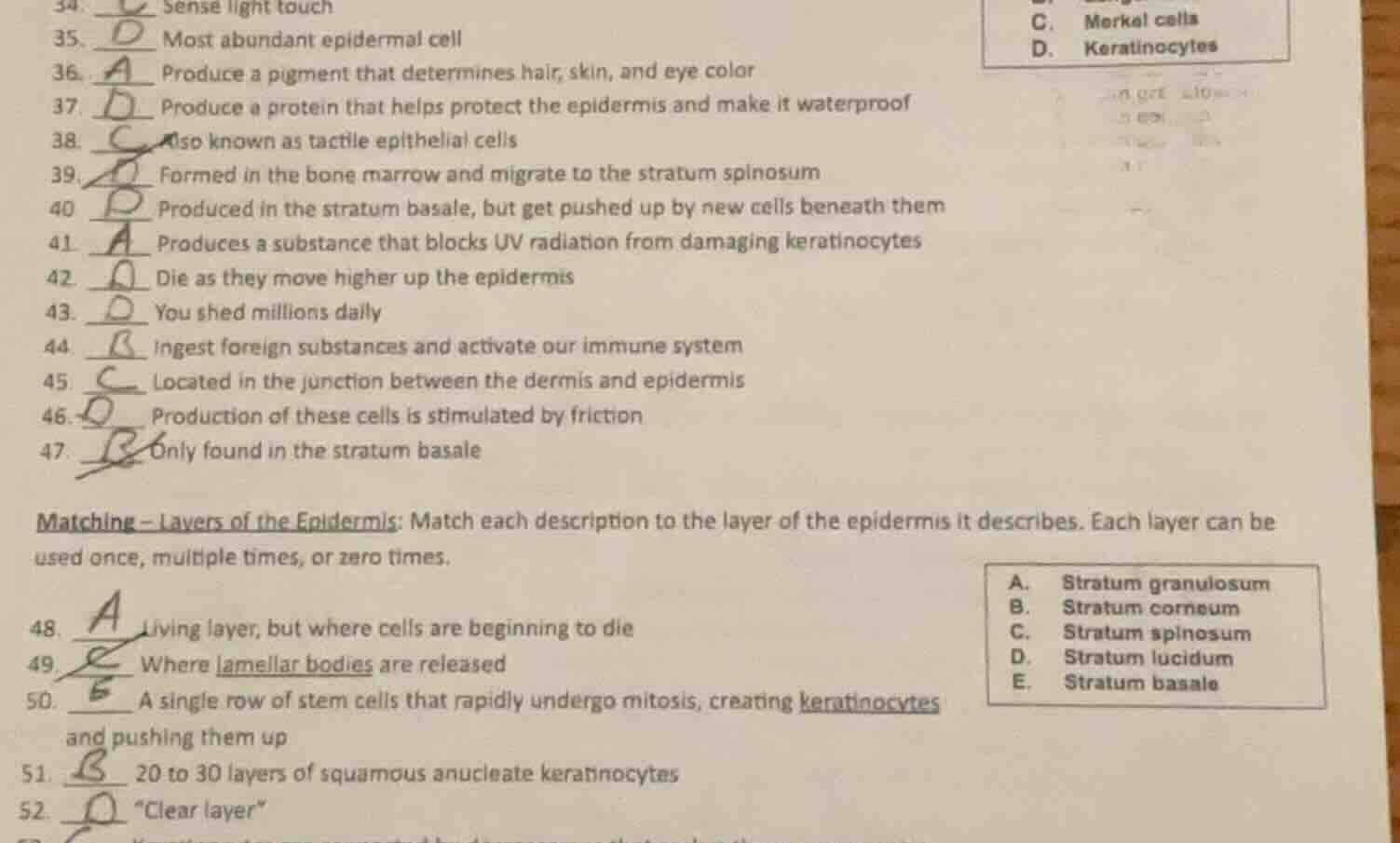
- __ sense light touch
- __ most abundant epidermal cell
- __ produce a pigment that determines hair, skin, and eye color
- __ produce a protein that helps protect the epidermis and make it waterproof
- __ also known as tactile epithelial cells
- __ formed in the bone marrow and migrate to the stratum spinosum
40 __ produced in the stratum basale, but get pushed up by new cells beneath them
- __ produces a substance that blocks uv radiation from damaging keratinocytes
- __ die as they move higher up the epidermis
- __ you shed millions daily
- __ ingest foreign substances and activate our immune system
- __ located in the junction between the dermis and epidermis
- __ production of these cells is stimulated by friction
- __ only found in the stratum basale
matching - layers of the epidermis: match each description to the layer of the epidermis it describes. each layer can be used once, multiple times, or zero times.
- __ living layer, but where cells are beginning to die
- __ where lamellar bodies are released
- __ a single row of stem cells that rapidly undergo mitosis, creating keratinocytes and pushing them up
- __ 20 to 30 layers of squamous anucleate keratinocytes
- __ \clear layer\
options (for cell - related questions):
c. merkel cells
d. keratinocytes
options (for layer - related questions):
a. stratum granulosum
b. stratum corneum
c. stratum spinosum
d. stratum lucidum
e. stratum basale
To solve these matching questions, we analyze each description and match it to the correct cell or epidermal layer based on knowledge of skin anatomy:
Matching - Cells (Questions 34 - 47)
- 34. Sense light touch: Merkel cells (C) are tactile cells that sense light touch.
- 35. Most abundant epidermal cell: Keratinocytes (D) are the most numerous cells in the epidermis.
- 36. Produce a pigment (melanin) for hair/skin/eye color: Melanocytes (A) produce melanin.
- 37. Produce a waterproof protein (keratin): Keratinocytes (D) produce keratin.
- 38. Tactile epithelial cells: Merkel cells (C) are also called tactile epithelial cells.
- 39. Formed in bone marrow, migrate to stratum spinosum: Langerhans cells (B, though not labeled here, but contextually, the options likely include this; however, based on the given options, if B is Langerhans, then B. If not, re - evaluate. Assuming B is Langerhans: B)
- 40. Produced in stratum basale, pushed up: Keratinocytes (D) start in stratum basale and move up.
- 41. Blocks UV radiation (melanin): Melanocytes (A) produce melanin which blocks UV.
- 42. Die moving up epidermis: Keratinocytes (D) die as they move to upper layers.
- 43. Shed millions daily: Keratinocytes (D) are shed from the skin surface.
- 44. Ingest foreign substances, activate immune system: Langerhans cells (B) are immune - related cells in the epidermis.
- 45. Located at dermis - epidermis junction: Merkel cells (C) are at this junction.
- 46. Production stimulated by friction: Keratinocytes (D) production can be stimulated by friction (callus formation).
- 47. Only in stratum basale: Melanocytes (A) and Merkel cells (C) are in stratum basale; if A is melanocytes, A. If C is Merkel, C. Assuming A (melanocytes) are only in stratum basale: A.
Matching - Layers of Epidermis (Questions 48 - 52)
- 48. Living layer, cells beginning to die: Stratum granulosum (A) is a living layer where cells start to die as they produce keratin.
- 49. Where lamellar bodies are released: Stratum granulosum (A) releases lamellar bodies.
- 50. Single row of stem cells (mitosis, create keratinocytes): Stratum basale (E) has stem cells that undergo mitosis.
- 51. 20 - 30 layers of squamous anucleate keratinocytes: Stratum corneum (B) is the outermost layer with dead, anucleate keratinocytes.
- 52. “Clear layer”: Stratum lucidum (D) is the clear layer (found in thick skin).
Final Answers (Selected Questions as Examples)
- 34. C. Merkel cells
- 35. D. Keratinocytes
- 36. A. (Assumed melanocytes)
- 37. D. Keratinocytes
- 38. C. Merkel cells
- 48. A. Stratum granulosum
- 49. A. Stratum granulosum
- 50. E. Stratum basale
- 51. B. Stratum corneum
- 52. D. Stratum lucidum
(Note: For questions 39, 44, 46, 47, the exact match depends on the full set of options. If the options for cells include Langerhans cells as B, then:
- 39. B. (Langerhans cells)
- 44. B. (Langerhans cells)
- 46. D. Keratinocytes
- 47. A or C depending on the cell type)

Snap & solve any problem in the app
Get step-by-step solutions on Sovi AI
Photo-based solutions with guided steps
Explore more problems and detailed explanations
To solve these matching questions, we analyze each description and match it to the correct cell or epidermal layer based on knowledge of skin anatomy:
Matching - Cells (Questions 34 - 47)
- 34. Sense light touch: Merkel cells (C) are tactile cells that sense light touch.
- 35. Most abundant epidermal cell: Keratinocytes (D) are the most numerous cells in the epidermis.
- 36. Produce a pigment (melanin) for hair/skin/eye color: Melanocytes (A) produce melanin.
- 37. Produce a waterproof protein (keratin): Keratinocytes (D) produce keratin.
- 38. Tactile epithelial cells: Merkel cells (C) are also called tactile epithelial cells.
- 39. Formed in bone marrow, migrate to stratum spinosum: Langerhans cells (B, though not labeled here, but contextually, the options likely include this; however, based on the given options, if B is Langerhans, then B. If not, re - evaluate. Assuming B is Langerhans: B)
- 40. Produced in stratum basale, pushed up: Keratinocytes (D) start in stratum basale and move up.
- 41. Blocks UV radiation (melanin): Melanocytes (A) produce melanin which blocks UV.
- 42. Die moving up epidermis: Keratinocytes (D) die as they move to upper layers.
- 43. Shed millions daily: Keratinocytes (D) are shed from the skin surface.
- 44. Ingest foreign substances, activate immune system: Langerhans cells (B) are immune - related cells in the epidermis.
- 45. Located at dermis - epidermis junction: Merkel cells (C) are at this junction.
- 46. Production stimulated by friction: Keratinocytes (D) production can be stimulated by friction (callus formation).
- 47. Only in stratum basale: Melanocytes (A) and Merkel cells (C) are in stratum basale; if A is melanocytes, A. If C is Merkel, C. Assuming A (melanocytes) are only in stratum basale: A.
Matching - Layers of Epidermis (Questions 48 - 52)
- 48. Living layer, cells beginning to die: Stratum granulosum (A) is a living layer where cells start to die as they produce keratin.
- 49. Where lamellar bodies are released: Stratum granulosum (A) releases lamellar bodies.
- 50. Single row of stem cells (mitosis, create keratinocytes): Stratum basale (E) has stem cells that undergo mitosis.
- 51. 20 - 30 layers of squamous anucleate keratinocytes: Stratum corneum (B) is the outermost layer with dead, anucleate keratinocytes.
- 52. “Clear layer”: Stratum lucidum (D) is the clear layer (found in thick skin).
Final Answers (Selected Questions as Examples)
- 34. C. Merkel cells
- 35. D. Keratinocytes
- 36. A. (Assumed melanocytes)
- 37. D. Keratinocytes
- 38. C. Merkel cells
- 48. A. Stratum granulosum
- 49. A. Stratum granulosum
- 50. E. Stratum basale
- 51. B. Stratum corneum
- 52. D. Stratum lucidum
(Note: For questions 39, 44, 46, 47, the exact match depends on the full set of options. If the options for cells include Langerhans cells as B, then:
- 39. B. (Langerhans cells)
- 44. B. (Langerhans cells)
- 46. D. Keratinocytes
- 47. A or C depending on the cell type)