QUESTION IMAGE
Question
- which type of active transport is \cell drinking\?
(1) phagocytosis
(2) exocytosis
(3) diffusion
(4) pinocytosis
- which active transport process below uses food vacuoles to ingest large particles?
(1) phagocytosis
(2) exocytosis
(3) diffusion
(4) pinocytosis
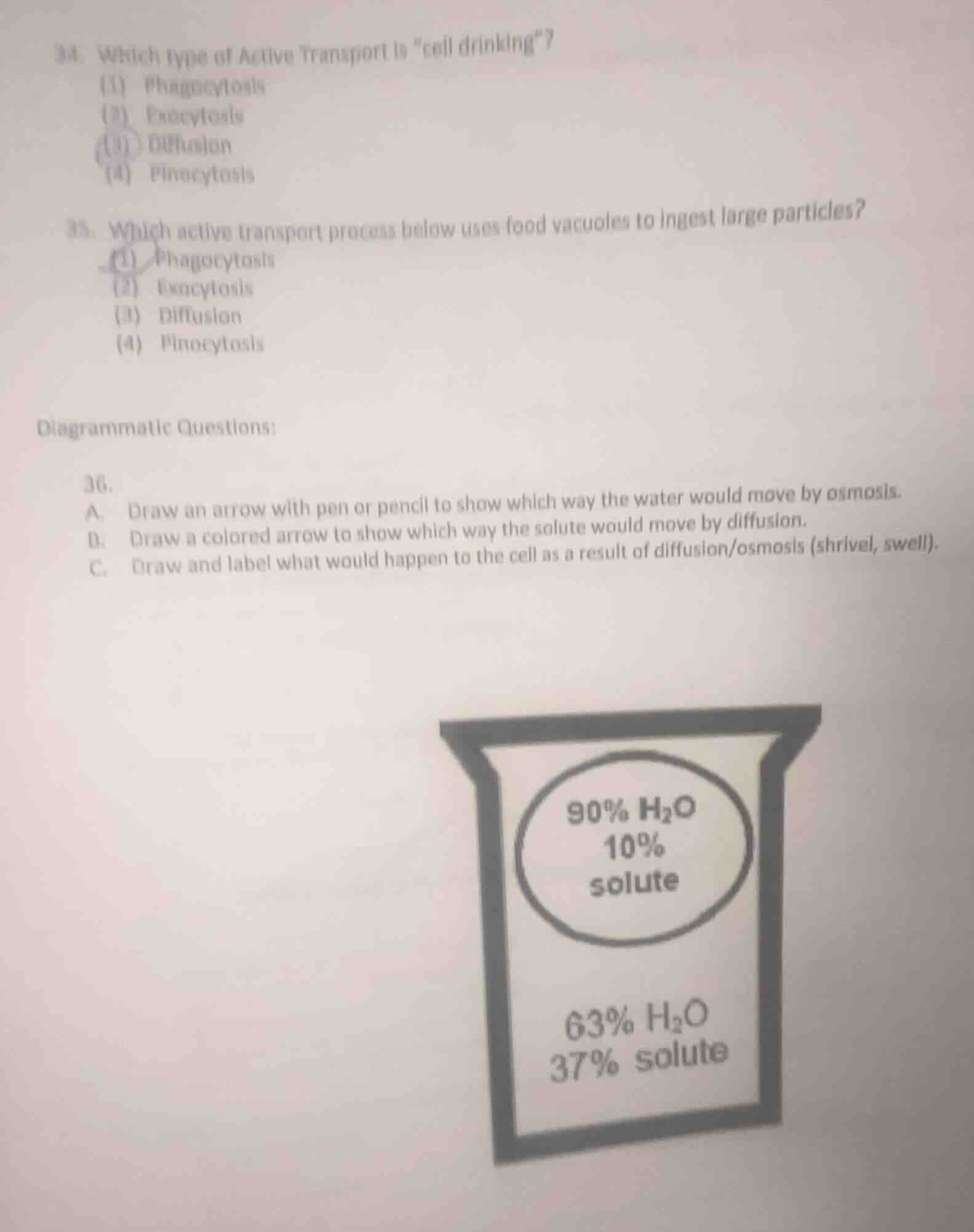
diagrammatic questions:
36.
a. draw an arrow with pen or pencil to show which way the water would move by osmosis.
b. draw a colored arrow to show which way the solute would move by diffusion.
c. draw and label what would happen to the cell as a result of diffusion/osmosis (shrivel, swell).
image of a cell with 90% h₂o, 10% solute inside and 63% h₂o, 37% solute outside
- "Cell drinking" refers to the active transport process where cells take in small fluid droplets, which is pinocytosis. Diffusion is passive transport, phagocytosis is "cell eating" for large particles, and exocytosis is expelling materials.
- Phagocytosis is the active transport process where cells use food vacuoles to ingest large particles. Exocytosis expels materials, diffusion is passive, and pinocytosis takes in fluid droplets.
- A. Osmosis is water movement to lower water concentration: water moves out of the cell (90% water) into the external environment (63% water).
B. Diffusion is solute movement to lower solute concentration: solute moves out of the external environment (37% solute) into the cell (10% solute).
C. Since water leaves the cell, the cell will shrivel as it loses water.

Snap & solve any problem in the app
Get step-by-step solutions on Sovi AI
Photo-based solutions with guided steps
Explore more problems and detailed explanations
- (4) Pinocytosis
- (1) Phagocytosis
- A. Arrow pointing from the cell (90% H₂O) to the external environment (63% H₂O)
B. Arrow pointing from the external environment (37% solute) to the cell (10% solute)
C. Draw a shrunken cell labeled "shrivel"