QUESTION IMAGE
Question
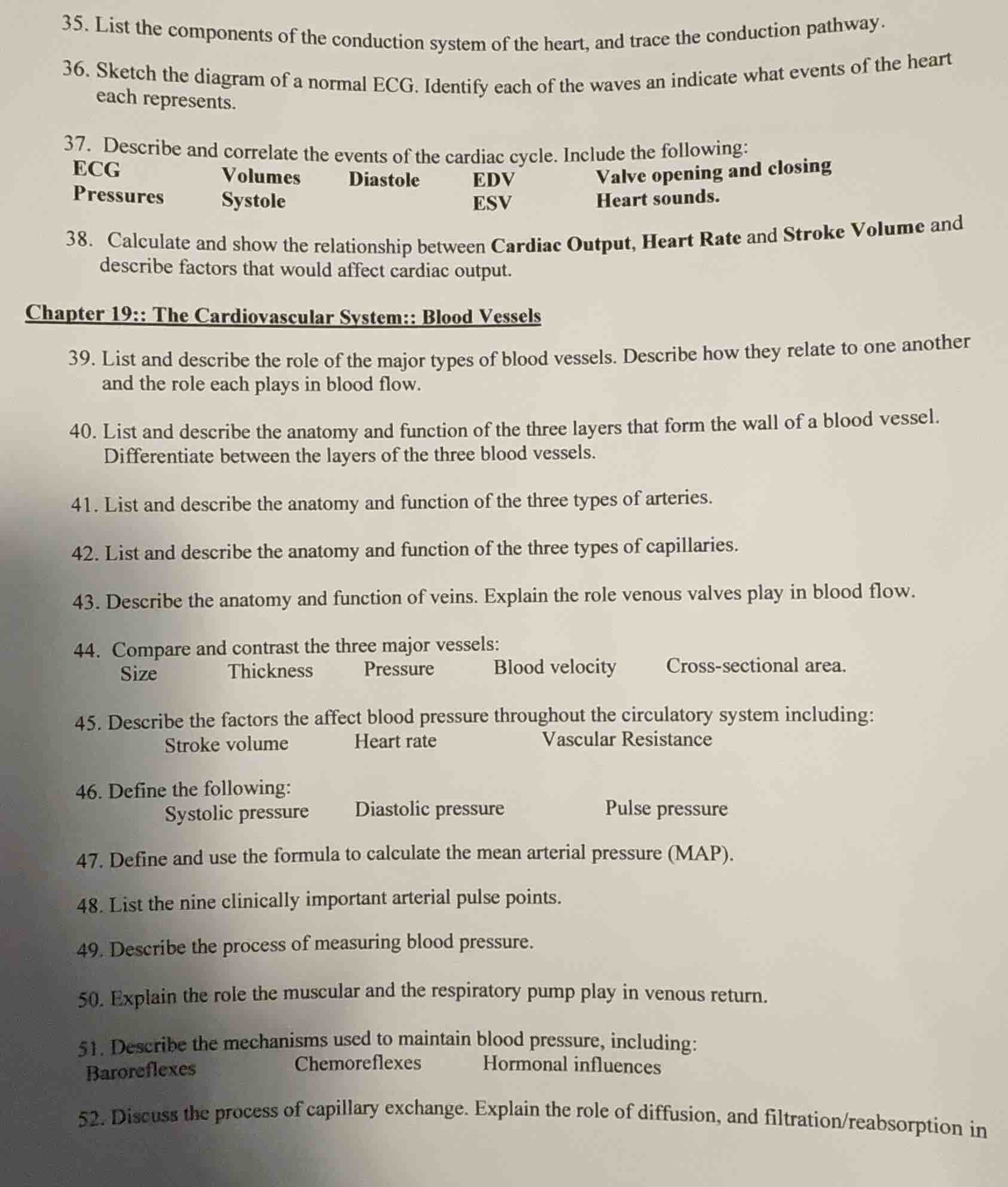
- list the components of the conduction system of the heart, and trace the conduction pathway.
- sketch the diagram of a normal ecg. identify each of the waves an indicate what events of the heart each represents.
- describe and correlate the events of the cardiac cycle. include the following:
ecg volumes diastole edv valve opening and closing
pressures systole esv heart sounds.
- calculate and show the relationship between cardiac output, heart rate and stroke volume and describe factors that would affect cardiac output.
chapter 19:: the cardiovascular system:: blood vessels
- list and describe the role of the major types of blood vessels. describe how they relate to one another and the role each plays in blood flow.
- list and describe the anatomy and function of the three layers that form the wall of a blood vessel. differentiate between the layers of the three blood vessels.
- list and describe the anatomy and function of the three types of arteries.
- list and describe the anatomy and function of the three types of capillaries.
- describe the anatomy and function of veins. explain the role venous valves play in blood flow.
- compare and contrast the three major vessels:
size thickness pressure blood velocity cross-sectional area.
- describe the factors the affect blood pressure throughout the circulatory system including:
stroke volume heart rate vascular resistance
- define the following:
systolic pressure diastolic pressure pulse pressure
- define and use the formula to calculate the mean arterial pressure (map).
- list the nine clinically important arterial pulse points.
- describe the process of measuring blood pressure.
- explain the role the muscular and the respiratory pump play in venous return.
- describe the mechanisms used to maintain blood pressure, including:
baroreflexes chemoreflexes hormonal influences
- discuss the process of capillary exchange. explain the role of diffusion, and filtration/reabsorption in
Question 35
The heart's conduction system coordinates electrical signals for contraction. The pathway starts at the sinoatrial node, the natural pacemaker, which sends signals to the atrioventricular node. Signals then travel through the bundle of His, bundle branches, and Purkinje fibers to trigger ventricular contraction.
Question 36
A normal ECG has 3 key waves:
- P wave: Represents atrial depolarization (atria contract)
- QRS complex: Represents ventricular depolarization (ventricles contract, atria repolarize)
- T wave: Represents ventricular repolarization (ventricles relax)
Question 37
The cardiac cycle has diastole (ventricular relaxation/filling) and systole (ventricular contraction/ejection):
- Early Diastole: AV valves open, semilunar valves closed. Passive ventricular filling (ECG: end of T wave; EDV increases, pressures low; no heart sound)
- Atrial Systole: Atria contract, final ventricular filling (ECG: P wave; EDV peaks; small pressure rise; no distinct sound)
- Ventricular Systole (Isovolumetric Contraction): Ventricles contract, AV valves close (S1 heart sound). No volume change (ESV unchanged; ECG: QRS complex; ventricular pressure rises sharply)
- Ventricular Ejection: Semilunar valves open, blood exits ventricles (ECG: ST segment; EDV → ESV; pressure peaks; no sound)
- Early Diastole (Isovolumetric Relaxation): Ventricles relax, semilunar valves close (S2 heart sound). No volume change; ECG: T wave; ventricular pressure drops sharply
Question 38
Cardiac Output (CO) is total blood pumped by the heart per minute. It depends on heart rate (HR, beats per minute) and stroke volume (SV, blood per beat). Factors affecting CO include fitness, age, hormones, and blood volume.
Question 39
Major blood vessels work in sequence for blood flow:
- Arteries: Carry oxygen-rich blood away from the heart; stretch to handle high pressure, maintain blood flow between heartbeats
- Arterioles: Small arteries that regulate blood flow to specific tissues by constricting/dilating
- Capillaries: Tiny vessels where nutrient/gas exchange occurs between blood and cells
- Venules: Collect blood from capillaries
- Veins: Carry oxygen-poor blood back to the heart; use valves and muscle movement to counter gravity
Question 40
All blood vessels have 3 layers, modified by vessel type:
- Tunica Intima: Innermost layer (endothelium + connective tissue). Smooth surface to prevent clotting; in arteries, has an elastic internal lamina.
- Tunica Media: Middle layer (smooth muscle + elastic fibers). Thickest in arteries; controls vessel diameter (vasoconstriction/vasodilation) to regulate pressure and flow.
- Tunica Externa: Outermost layer (connective tissue). Anchors vessels to surrounding tissues; thickest in veins.
- Arteries: Thick tunica media with many elastic fibers
- Capillaries: Only tunica intima (for exchange)
- Veins: Thin tunica media, thick tunica externa
Question 41
Three types of arteries:
- Elastic (Conducting) Arteries: Largest (aorta, pulmonary trunk). Thick elastic layers to stretch with systole and recoil during diastole, maintaining steady blood flow.
- Muscular (Distributing) Arteries: Medium-sized (brachial, femoral). Thick smooth muscle layer to regulate blood flow to specific organs via vasoconstriction/dilation.
- Arterioles: Smallest arteries. Main site of vascular resistance; smooth muscle controls diameter to adjust blood pressure and tissue perfusion.
Question 42
Three types of capillaries:
- **Continuous…

Snap & solve any problem in the app
Get step-by-step solutions on Sovi AI
Photo-based solutions with guided steps
Explore more problems and detailed explanations
Question 35
Components and pathway: Sinoatrial (SA) Node → Atrioventricular (AV) Node → Bundle of His → Right/Left Bundle Branches → Purkinje Fibers
Question 36
- P wave: Atrial depolarization
- QRS complex: Ventricular depolarization
- T wave: Ventricular repolarization
Question 37
Cycle stages: Atrial Systole → Isovolumetric Ventricular Contraction → Ventricular Ejection → Isovolumetric Ventricular Relaxation → Passive Ventricular Filling; correlated with ECG waves, pressure/volume changes, and heart sounds (S1, S2)
Question 38
Formula: $\text{CO} = \text{HR} \times \text{SV}$; factors include age, fitness, hormones, blood volume, and heart function
Question 39
Vessels (in flow order): Arteries (carry blood away, maintain pressure) → Arterioles (regulate flow) → Capillaries (exchange) → Venules (collect blood) → Veins (return blood to heart)
Question 40
Layers: Tunica Intima (inner, smooth surface), Tunica Media (middle, muscle/elastic for dilation/constriction), Tunica Externa (outer, anchor); modified by vessel type (thick media in arteries, only intima in capillaries)
Question 41
- Elastic Arteries: Large, elastic, maintain blood flow between beats
- Muscular Arteries: Medium, smooth muscle, distribute blood to organs
- Arterioles: Small, main site of vascular resistance, regulate tissue perfusion
Question 42
- Continuous: Tight junctions, skin/muscle, small solute exchange
- Fenestrated: Pores, kidneys/intestines, rapid fluid exchange
- Sinusoidal: Large gaps, liver/spleen, large molecule/cell exchange
Question 43
Veins: Thin-walled, large lumen vessels that carry blood back to the heart; venous valves prevent backflow to maintain upward blood flow in limbs
Question 44
| Feature | Arteries | Capillaries | Veins |
|---|---|---|---|
| Wall Thickness | Thick | Extremely thin | Thin |
| Blood Pressure | High | Very low | Low |
| Blood Velocity | Fast | Slowest | Medium |
| Cross-Sectional Area | Smallest total | Largest total | Medium total |
Question 45
Factors: Stroke volume (higher = higher pressure), heart rate (higher = higher pressure), vascular resistance (higher = higher pressure)
Question 46
- Systolic pressure: Peak arterial pressure during ventricular contraction
- Diastolic pressure: Minimum arterial pressure during ventricular relaxation
- Pulse pressure: Systolic pressure - diastolic pressure
Question 47
Definition: Average arterial blood pressure over a cardiac cycle; Formula: $\text{MAP} = \text{DP} + \frac{1}{3}\text{PP}$ or $\text{MAP} = \frac{2\text{DP} + \text{SP}}{3}$
Question 48
Temporal, Carotid, Brachial, Radial, Femoral, Popliteal, Dorsalis pedis, Posterior tibial, Apical
Question 49
- Inflate cuff above systolic pressure
- Release pressure slowly
- First sound = systolic pressure
- Disappearing sound = diastolic pressure
Question 50
- Muscular Pump: Muscle contraction squeezes veins, valves prevent backflow
- Respiratory Pump: Inhalation creates pressure gradient to pull blood toward the heart
Question 51
- Baroreflexes: Adjust HR and vessel diameter via pressure receptors
- Chemoreflexes: Respond to gas/pH changes to adjust pressure
- Hormones: Epinephrine, angiotensin II, aldosterone, and ADH modify pressure/volume
Question 52
- Diffusion: Substances move down concentration gradients (O2, glucose out; CO2 in)
- Filtration: Fluid pushed out of capillaries at the arterial end via hydrostatic pressure
- Reabsorption: Fluid pulled back into capillaries at the venous end via osmotic pressure; excess fluid enters lymphatic vessels