QUESTION IMAGE
Question
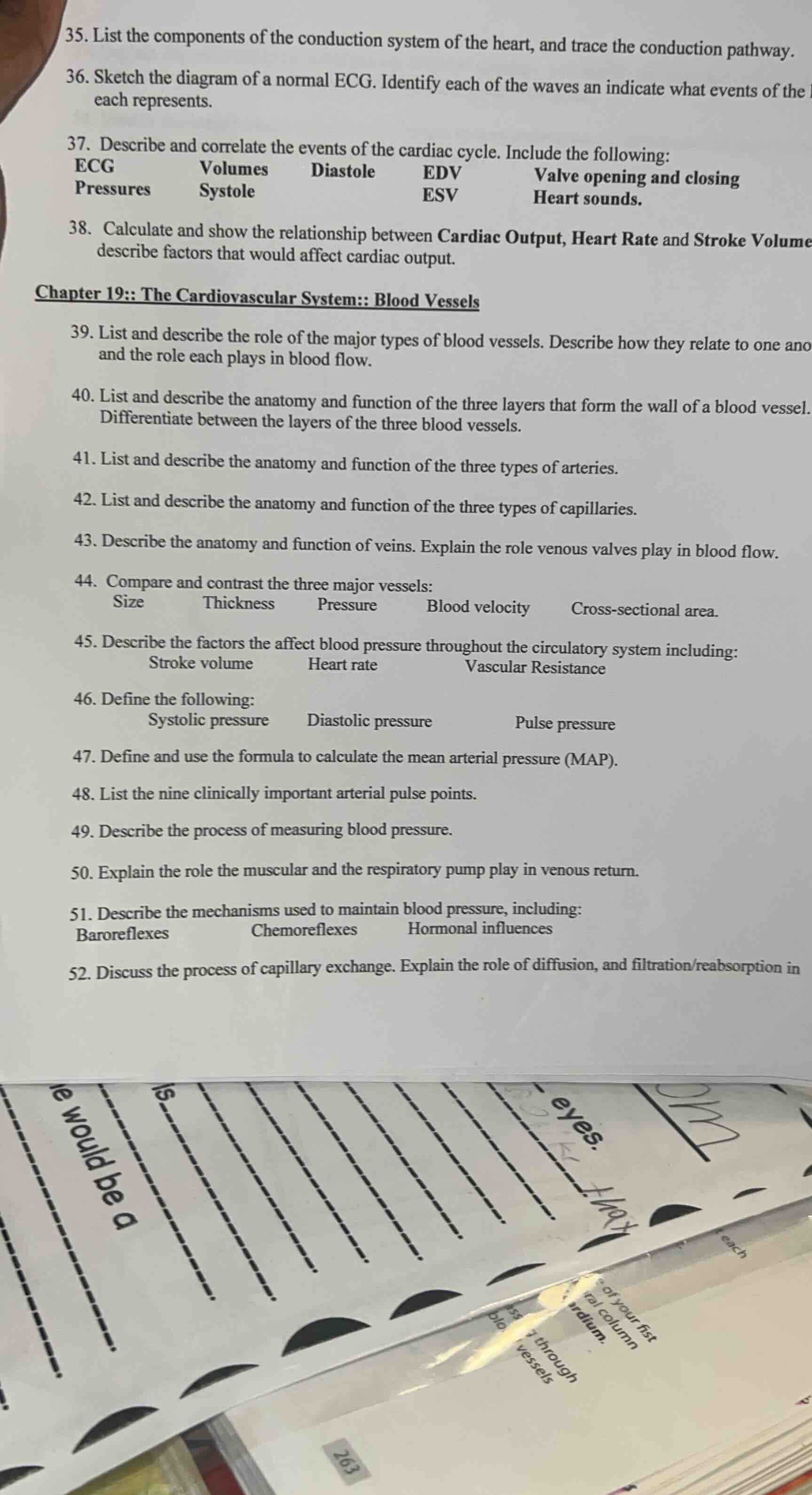
- list the components of the conduction system of the heart, and trace the conduction pathway.
- sketch the diagram of a normal ecg. identify each of the waves an indicate what events of the
each represents.
- describe and correlate the events of the cardiac cycle. include the following:
ecg volumes diastole edv valve opening and closing
pressures systole esv heart sounds.
- calculate and show the relationship between cardiac output, heart rate and stroke volume
describe factors that would affect cardiac output.
chapter 19:: the cardiovascular system:: blood vessels
- list and describe the role of the major types of blood vessels. describe how they relate to one ano
and the role each plays in blood flow.
- list and describe the anatomy and function of the three layers that form the wall of a blood vessel.
differentiate between the layers of the three blood vessels.
- list and describe the anatomy and function of the three types of arteries.
- list and describe the anatomy and function of the three types of capillaries.
- describe the anatomy and function of veins. explain the role venous valves play in blood flow.
- compare and contrast the three major vessels:
size thickness pressure blood velocity cross - sectional area.
- describe the factors the affect blood pressure throughout the circulatory system including:
stroke volume heart rate vascular resistance
- define the following:
systolic pressure diastolic pressure pulse pressure
- define and use the formula to calculate the mean arterial pressure (map).
- list the nine clinically important arterial pulse points.
- describe the process of measuring blood pressure.
- explain the role the muscular and the respiratory pump play in venous return.
- describe the mechanisms used to maintain blood pressure, including:
baroreflexes chemoreflexes hormonal influences
- discuss the process of capillary exchange. explain the role of diffusion, and filtration/reabsorption in
Since there are multiple sub - questions, we will answer them one by one. We choose the Natural Science discipline (sub - field: Medicine and Health) and use the Answer - Explanation Format.
Question 35
The heart's conduction system components are the sinoatrial (SA) node, atrioventricular (AV) node, bundle of His, bundle branches, and Purkinje fibers. The conduction pathway starts at the SA node (in the right atrium), which generates an electrical impulse. This impulse spreads through the atria, causing them to contract. Then the impulse reaches the AV node, which delays it briefly. After that, the impulse travels through the bundle of His, down the bundle branches, and through the Purkinje fibers to the ventricles, causing ventricular contraction.
A normal ECG has three main waves: P wave, QRS complex, and T wave. The P wave represents atrial depolarization (atrial contraction). The QRS complex represents ventricular depolarization (ventricular contraction). The T wave represents ventricular repolarization (ventricular relaxation). To sketch the ECG, draw a horizontal baseline (isoelectric line). The P wave is a small upward wave. The QRS complex is a larger, more complex wave (Q is a small downward deflection, R is a large upward deflection, S is a small downward deflection after R). The T wave is an upward wave after the QRS complex.
The cardiac cycle has diastole (relaxation) and systole (contraction) phases for atria and ventricles.
- ECG: P wave (atrial systole), QRS (ventricular systole), T wave (ventricular diastole).
- Volumes: EDV (End - Diastolic Volume, volume in ventricles at end of diastole), ESV (End - Systolic Volume, volume in ventricles at end of systole), Stroke Volume (SV = EDV - ESV).
- Diastole: Atrial diastole (atria relax, fill with blood) and ventricular diastole (ventricles relax, fill with blood from atria).
- Systole: Atrial systole (atria contract, push blood into ventricles) and ventricular systole (ventricles contract, eject blood).
- Valve opening and closing: Atrioventricular (AV) valves (mitral, tricuspid) open during diastole (allow blood from atria to ventricles) and close during ventricular systole (prevent backflow to atria). Semilunar valves (aortic, pulmonary) open during ventricular systole (allow blood to leave ventricles) and close during diastole (prevent backflow to ventricles).
- Pressures: Atrial pressure < Ventricular pressure during diastole (AV valves open); Ventricular pressure > Atrial pressure and > Arterial pressure during systole (semilunar valves open, AV valves closed); Ventricular pressure < Arterial pressure during diastole (semilunar valves closed).
- Heart sounds: S1 (lub) is due to AV valve closure; S2 (dub) is due to semilunar valve closure.

Snap & solve any problem in the app
Get step-by-step solutions on Sovi AI
Photo-based solutions with guided steps
Explore more problems and detailed explanations
Components: Sinoatrial (SA) node, Atrioventricular (AV) node, Bundle of His, Bundle branches, Purkinje fibers.
Conduction Pathway: SA node (right atrium) → Atria (contraction) → AV node (delay) → Bundle of His → Bundle branches → Purkinje fibers → Ventricles (contraction).