QUESTION IMAGE
Question
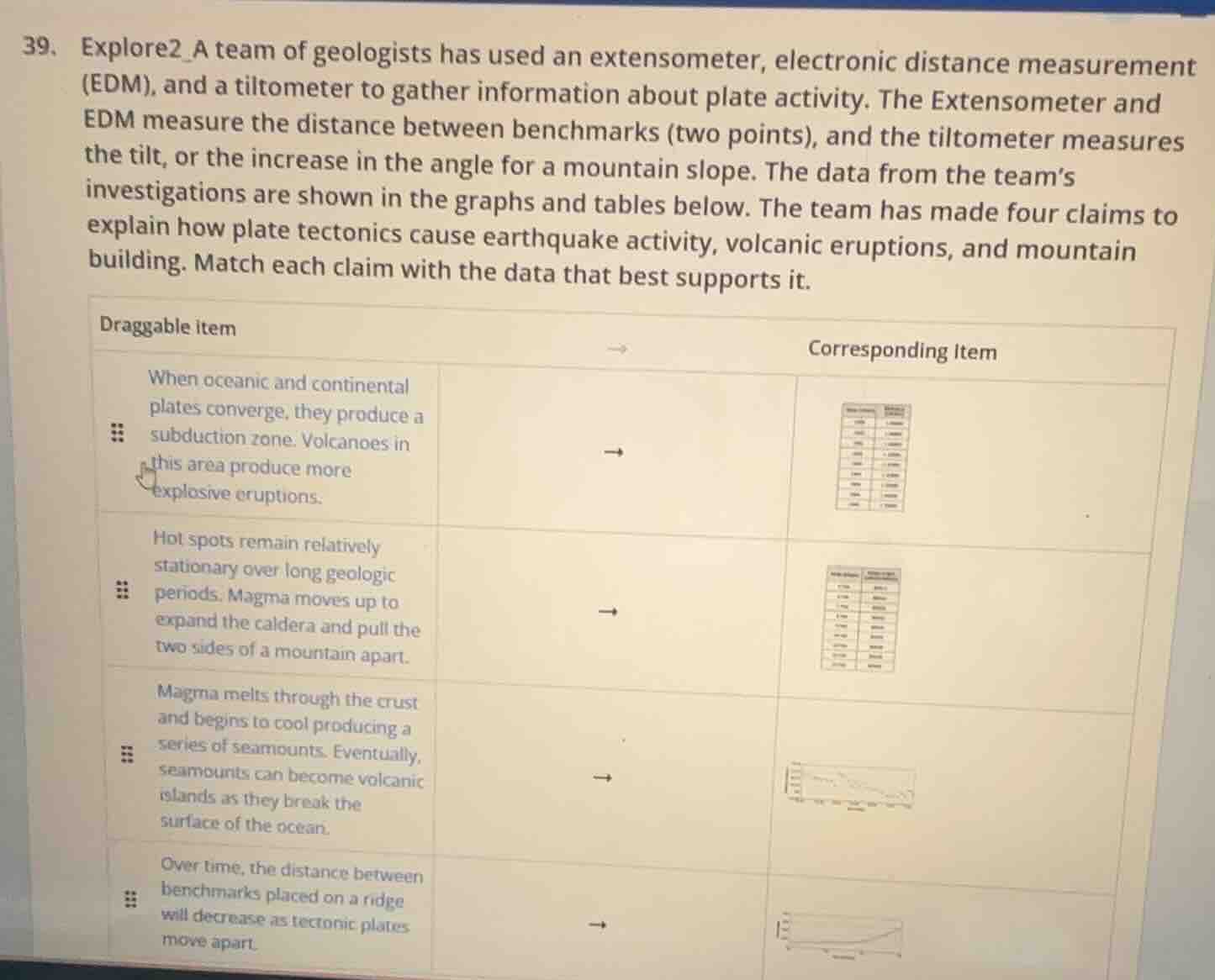
- explore2_a team of geologists has used an extensometer, electronic distance measurement (edm), and a tiltometer to gather information about plate activity. the extensometer and edm measure the distance between benchmarks (two points), and the tiltometer measures the tilt, or the increase in the angle for a mountain slope. the data from the team’s investigations are shown in the graphs and tables below. the team has made four claims to explain how plate tectonics cause earthquake activity, volcanic eruptions, and mountain building. match each claim with the data that best supports it.
draggable item → corresponding item
when oceanic and continental plates converge, they produce a subduction zone. volcanoes in this area produce more explosive eruptions. →
hot spots remain relatively stationary over long geologic periods. magma moves up to expand the caldera and pull the two sides of a mountain apart. →
magma melts through the crust and begins to cool producing a series of seamounts. eventually, seamounts can become volcanic islands as they break the surface of the ocean. →
over time, the distance between benchmarks placed on a ridge will decrease as tectonic plates move apart. →
- For the claim "When oceanic and continental plates converge, they produce a subduction zone. Volcanoes in this area produce more explosive eruptions.": We need data related to volcanic eruption types (explosive vs non - explosive) in subduction zones. A table or graph showing the frequency or characteristics of explosive eruptions in subduction - zone volcanoes would support this.
- For "Hot spots remain relatively stationary over long geologic periods. Magma moves up to expand the caldera and pull the two sides of a mountain apart.": Data showing the movement (or lack thereof) of hot spots and the resulting changes in caldera and mountain - side distance (e.g., a graph of distance between mountain sides over time related to hot - spot activity) would support this.
- For "Magma melts through the crust and begins to cool producing a series of seamounts. Eventually, seamounts can become volcanic islands as they break the surface of the ocean.": Data showing the formation of seamounts over time and their transition to islands (e.g., a table with age and elevation of seamounts/islands) would support this.
- For "Over time, the distance between benchmarks placed on a ridge will decrease as tectonic plates move apart.": A graph showing the change in distance between benchmarks on a ridge over time (with distance decreasing as plates move apart) would support this.
Assuming the right - hand side has:
- A table about volcanic eruption types in subduction zones for the first claim.
- A graph about mountain - side distance and hot - spot activity for the second claim.
- A table about seamounts and island formation for the third claim.
- A graph about benchmark distance on a ridge over time for the fourth claim.
So the matches would be:
- "When oceanic and continental plates converge, they produce a subduction zone. Volcanoes in this area produce more explosive eruptions." → (corresponding data about volcanic eruption types in subduction zones)
- "Hot spots remain relatively stationary over long geologic periods. Magma moves up to expand the caldera and pull the two sides of a mountain apart." → (corresponding data about mountain - side distance and hot - spot activity)
- "Magma melts through the crust and begins to cool producing a series of seamounts. Eventually, seamounts can become volcanic islands as they break the surface of the ocean." → (corresponding data about seamounts and island formation)
- "Over time, the distance between benchmarks placed on a ridge will decrease as tectonic plates move apart." → (corresponding data about benchmark distance on a ridge over time)

Snap & solve any problem in the app
Get step-by-step solutions on Sovi AI
Photo-based solutions with guided steps
Explore more problems and detailed explanations
- "When oceanic and continental plates converge, they produce a subduction zone. Volcanoes in this area produce more explosive eruptions." → (the data item related to volcanic eruption types in subduction zones)
- "Hot spots remain relatively stationary over long geologic periods. Magma moves up to expand the caldera and pull the two sides of a mountain apart." → (the data item related to mountain - side distance and hot - spot activity)
- "Magma melts through the crust and begins to cool producing a series of seamounts. Eventually, seamounts can become volcanic islands as they break the surface of the ocean." → (the data item related to seamounts and island formation)
- "Over time, the distance between benchmarks placed on a ridge will decrease as tectonic plates move apart." → (the data item related to benchmark distance on a ridge over time)
(Note: Since the actual visual data is not fully described, the above is a general matching based on the nature of each claim. In a real - world scenario, one would match based on the specific data in the graphs/tables.)