QUESTION IMAGE
Question
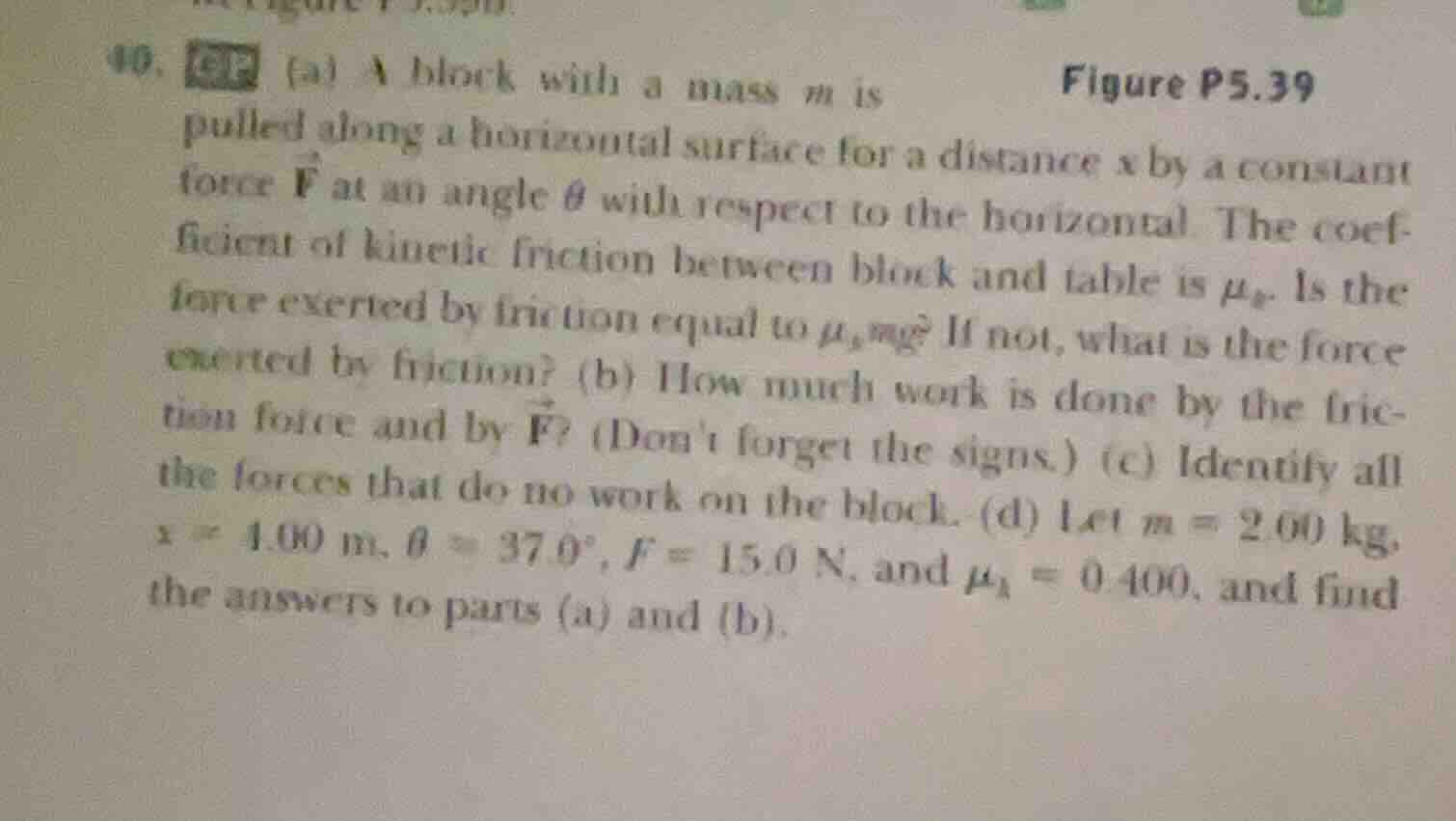
- (a) a block with a mass ( m ) is pulled along a horizontal surface for a distance ( x ) by a constant force ( vec{f} ) at an angle ( \theta ) with respect to the horizontal. the coefficient of kinetic friction between block and table is ( mu_k ). is the force exerted by friction equal to ( mu_k mg )? if not, what is the force exerted by friction? (b) how much work is done by the friction force and by ( vec{f} )? (dont forget the signs.) (c) identify all the forces that do no work on the block. (d) let ( m = 2.00 , \text{kg} ), ( x = 4.00 , \text{m} ), ( \theta = 37.0^circ ), ( f = 15.0 , \text{n} ), and ( mu_k = 0.400 ), and find the answers to parts (a) and (b).
Part (a)
Step 1: Analyze Vertical Forces
The normal force \( N \) on the block is not just \( mg \) because the applied force \( F \) has a vertical component \( F\sin\theta \) that reduces the normal force. The vertical forces are in equilibrium (no acceleration vertically), so \( N + F\sin\theta = mg \), which gives \( N = mg - F\sin\theta \).
Step 2: Determine Frictional Force
The kinetic frictional force is given by \( f_k=\mu_k N \). Substituting \( N = mg - F\sin\theta \), we get \( f_k=\mu_k(mg - F\sin\theta) \). So the frictional force is not \( \mu_k mg \) unless \( F\sin\theta = 0 \) (i.e., \( \theta = 0 \)).
Part (b)
Step 1: Work Done by Friction
The work done by a force is \( W = F_{\text{parallel}} \cdot d \cdot \cos\phi \), where \( \phi \) is the angle between the force and displacement. The frictional force is opposite to displacement, so \( \phi = 180^\circ \), \( \cos(180^\circ)= - 1 \). The frictional force magnitude is \( f_k=\mu_k(mg - F\sin\theta) \), displacement is \( x \). So \( W_f=-f_k x=-\mu_k(mg - F\sin\theta)x \).
Step 2: Work Done by Applied Force \( \vec{F} \)
The horizontal component of \( \vec{F} \) is \( F\cos\theta \), which is parallel to displacement ( \( \phi = 0^\circ \), \( \cos(0^\circ)=1 \) ). So \( W_F = F\cos\theta \cdot x \).
Part (d)
Step 1: Calculate Frictional Force (Part a)
Given \( m = 2.00\space kg \), \( g = 9.8\space m/s^2 \), \( F = 15.0\space N \), \( \theta = 37.0^\circ \), \( \mu_k = 0.400 \). First, find \( N = mg - F\sin\theta \). \( \sin(37^\circ)\approx0.6 \), so \( N=(2\times9.8)-(15\times0.6)=19.6 - 9 = 10.6\space N \). Then \( f_k=\mu_k N=0.4\times10.6 = 4.24\space N \).
Step 2: Work Done by Friction (Part b)
\( W_f=-f_k x=-4.24\times4=-16.96\space J \) (approx - 17.0 J).
Step 3: Work Done by \( \vec{F} \) (Part b)
\( F\cos\theta = 15\times\cos(37^\circ)\approx15\times0.8 = 12\space N \). \( W_F = 12\times4 = 48\space J \).
Final Answers (Part d)
(a) Frictional Force:

Snap & solve any problem in the app
Get step-by-step solutions on Sovi AI
Photo-based solutions with guided steps
Explore more problems and detailed explanations
\( \boldsymbol{4.24\space N} \) (magnitude, direction opposite to displacement)